Trucking companies begin their defense investigation the same day the crash happens. Call 911, get medical help, document the scene, and contact a truck accident lawyer before their insurance team reaches you.
A collision with a semi-truck, 18-wheeler, or tractor-trailer produces injuries and evidence loss on a faster timeline than a standard car crash. Black box data, ELD records, and dashcam footage are overwritten within days. The trucking company’s claims team begins its investigation the same day the crash happens.
Ace Law Group’s Las Vegas truck accident attorney handles truck accident cases throughout Las Vegas, Henderson, North Las Vegas, and the greater Clark County area. We work on contingency. There is no fee unless you recover. Call 702-333-4223 for a free case review.
Key Takeaways: What to Do After a Truck Accident in Las Vegas
- Call 911 and get medical help right away, even if your injuries seem minor.
- Take photos of the truck, license plates, company markings, damage, skid marks, and the scene before anything is moved.
- Get the driver’s name, insurance information, USDOT number, and witness contact details if you can do so safely.
- Contact a truck accident attorney before speaking with the trucking company’s insurance adjuster.
- Preserve evidence quickly, including black box data, dashcam footage, ELD records, and driver logs.
- Nevada gives most injury victims two years to file a lawsuit, but evidence can disappear much sooner.
- You may still recover compensation if you were partly at fault, depending on how much responsibility is assigned to you.
The scene of a truck accident is the foundation of your legal case. Every photo, piece of identifying information, and witness contact collected there determines what an attorney can build.
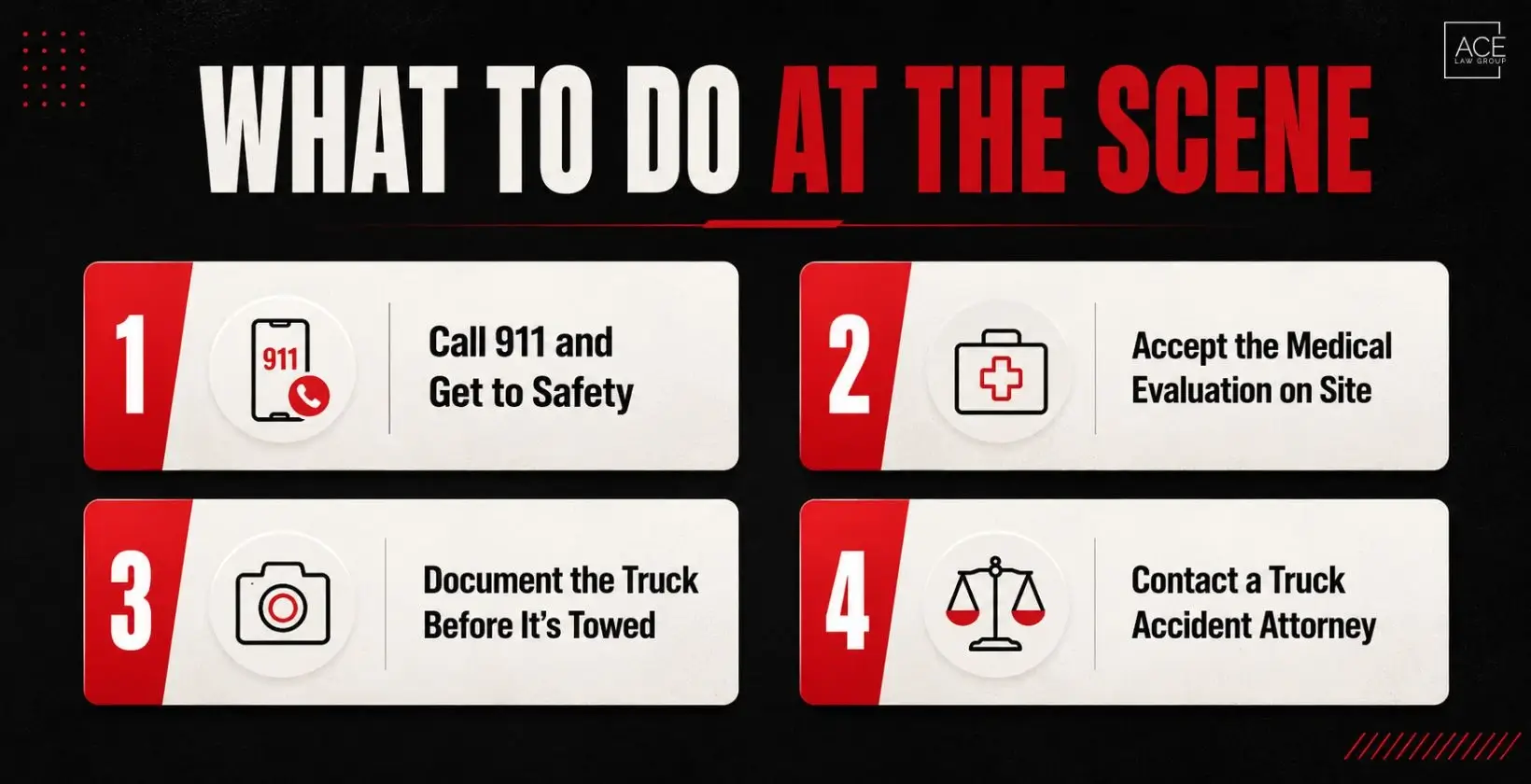
Step 1: Call 911 and Get to Safety
If you are physically able, move your vehicle out of active traffic and turn on your hazard lights. Nevada law requires you to report any accident involving injury, death of a driver or passenger, or property damage exceeding $750. Call 911 immediately, even if injuries appear minor. Police will respond, document the scene, and generate an official crash report.
When officers arrive, provide an accurate account of the collision. Do not speculate about fault, admit responsibility, or say you are fine if you are not. The crash report becomes a foundational document in your case.
Step 2: Accept the Medical Evaluation on Site
Allow paramedics to evaluate you before leaving the scene. Even if you feel uninjured, do not decline. Internal organ damage, traumatic brain injury, and spinal cord injuries frequently produce no immediate symptoms. Adrenaline and shock suppress pain signals during and immediately after a collision.
Getting evaluated at the scene creates a timestamp that connects your injuries to the accident. Insurers routinely challenge claims where the victim did not seek immediate care, arguing the injuries were pre-existing or occurred elsewhere.
Step 3: Document the Truck Before It’s Towed
Commercial trucks carry identifying information that is essential to building your case. Capture the following before the vehicles are moved:
- USDOT number (displayed on the cab door): allows your attorney to pull the carrier’s federal safety and compliance history from the FMCSA database
- Motor Carrier (MC) number: the trucking company’s federal operating authority
- Trucking company name: usually printed on the trailer
- License plate numbers on both the cab and trailer
- Truck driver’s name, CDL number, and contact information
- Insurance carrier name and policy number
- Photos of all vehicle damage locations, tire skid marks, road surface, cargo spill, traffic signals, and any visible injuries
- Names and phone numbers of any witnesses
The USDOT and MC numbers are the starting point for identifying which companies and policies are in play. Photograph any visible cargo spill or load shift. Those images become direct evidence in overloading and securement claims. For a deeper look at what each piece of evidence supports, see our guide on truck accident case evidence.
Step 4: Contact a Truck Accident Attorney
Before you leave the scene or shortly after, contact an attorney. This is not premature; it is the step that protects every other step that follows.
An attorney can send a preservation letter to the trucking company within hours of being retained, creating a legal obligation to preserve the black box data, ELD records, dashcam footage, and driver logs before those windows close. That preservation letter is one piece of what a truck accident lawyer does in Las Vegas, NV, from the first day of the case. They can also advise you on what to say and what not to say before the trucking company’s insurance adjuster makes contact, which often happens within 24 hours of the crash.
Ace Law Group handles truck accident cases in Las Vegas on a contingency basis. There is no fee unless you recover. Call 702-333-4223 to start the process now.
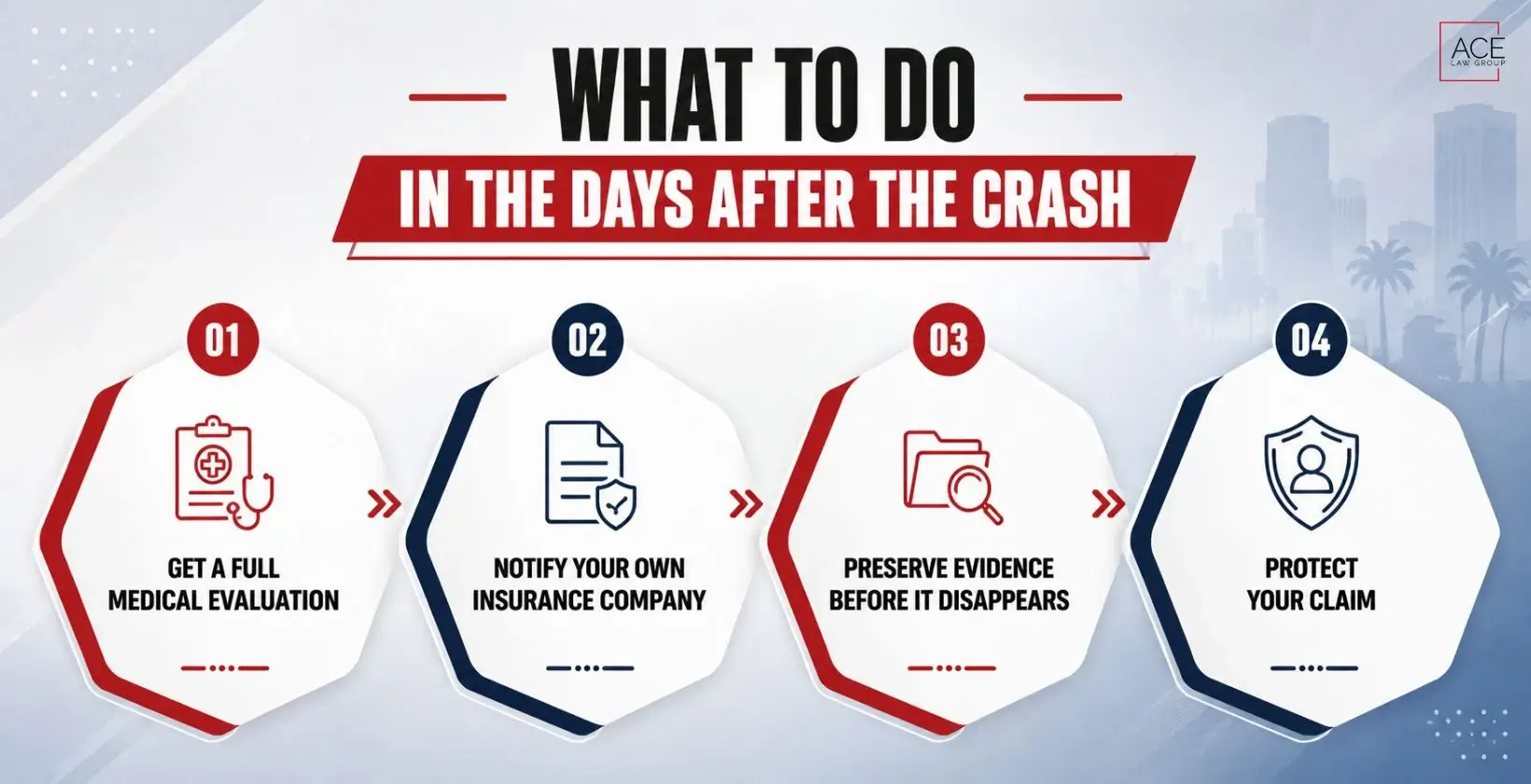
Leaving the scene does not pause the timeline. The trucking company’s insurer begins building its defense immediately. The 4 steps below protect your position in the first 24 to 72 hours.
Step 5: Get a Full Medical Evaluation
Go to a doctor or urgent care facility within 24 hours of the accident, even if the scene paramedics cleared you. The evaluation at the scene is brief. Paramedics rule out immediate emergencies, not injuries that develop in the hours and days after impact. Imaging, specialist referral, and a documented treatment record come from follow-up care.
Medical records establish the nature and severity of your injuries, the treatment required, and the future care costs your attorney will include when calculating damages such as medical expenses, lost wages, and non-economic damages like pain and suffering. Defense teams exploit gaps in treatment records, even brief ones, to argue injuries were minor or unrelated. Continue all prescribed treatment until your physician formally concludes it.
Step 6: Notify Your Own Insurance Company
Most auto insurance policies require prompt reporting of accidents, regardless of fault. Contact your insurer and provide the basic facts: date, location, vehicles involved, and whether injuries occurred. Prompt notification also preserves your rights under any MedPay or underinsured motorist coverage you carry, since late reporting can give your insurer grounds to deny those benefits.
Be accurate but brief. Do not provide a recorded statement to the trucking company’s insurer at this stage. That is a separate contact with a different legal relationship to your claim.
Step 7: Preserve Evidence Before It Disappears
The evidence that matters most in truck accident cases is time-limited in a way that ordinary car accident evidence is not.
Electronic Logging Device (ELD) data records the driver’s hours of service, speed, and route. Federal law requires carriers to retain ELD records for a minimum of six months, but that floor only applies when no legal demand exists. The truck’s black box captures engine inputs, braking behavior, and speed in the seconds before impact.
An attorney can send a preservation letter to the trucking company within hours of being retained. This letter creates a legal obligation to preserve all records related to the crash. If the company destroys or alters evidence after receiving that letter, it faces a spoliation finding at trial, which courts treat as an adverse inference against them.
Step 8: Protect Your Claim
Four actions taken in the days after the crash can significantly damage an otherwise valid claim:
- Giving a recorded statement to the trucking company’s insurance adjuster. These statements lock victims into early accounts that can be contradicted by later medical findings. Before talking to the insurance company after an accident, speak with an attorney.
- Posting about the accident on social media. Insurance adjusters monitor public accounts for content that appears inconsistent with injury claims. Photos, check-ins, and comments, even ones that seem unrelated, can become evidence.
- Accepting an early settlement. Initial settlement offers arrive before your treating physicians have documented the full scope of your injuries. Accepting one closes your claim permanently, including any future costs for surgery, rehabilitation, or long-term care that were not yet known when you signed. What seems adequate at six weeks can fall far short at six months.
- Discussing the case with anyone other than your attorney. Conversations with friends, family, or coworkers are not protected by the attorney-client privilege and can be subpoenaed. An offhand comment about how you feel, what you remember, or what you think happened can be used to contradict your formal account of the accident.
Nevada Laws That Govern Your Truck Accident Claim
Every step in the sections above connects to a specific legal rule. Nevada law and federal trucking regulations together determine who is liable, what types of compensation you can recover, and how long you have to act. Three rules govern every truck accident claim in the state.
Modified Comparative Negligence (NRS 41.141)
Nevada is not a no-fault state; it follows a modified comparative negligence system under NRS 41.141. You can recover compensation as long as your share of fault is 50% or less. Once your assigned fault reaches 51%, recovery is barred entirely. If your damages total $200,000 and you are found 20% at fault, you recover $160,000.
Commercial trucks pose considerable danger to other vehicles, and trucking companies and their insurers will attempt to assign you a portion of fault during the investigation. The more fault attributed to you, the less they pay. This is why the steps above, documenting the scene, declining recorded statements, and preserving evidence, all feed directly into how Nevada’s modified comparative negligence law applies to your case, how liability is proven, and what compensation you can recover.
Statute of Limitations (NRS 11.190)
You have two years from the date of the accident to file a personal injury lawsuit in Nevada. Missing that statute of limitations typically extinguishes your right to recover. One exception: when an injury was not reasonably discoverable at the time of the accident, Nevada courts have held that the two-year clock begins when the injury was discovered or should have been discovered through reasonable diligence, not when the crash occurred. When a truck accident causes a death, the family’s wrongful death claim also generally has a two-year deadline; see our Las Vegas wrongful death attorney page for details. An attorney can tell you whether that exception applies to your situation
Federal Trucking Regulations as Evidence of Negligence
Commercial truck drivers and carriers operating in Nevada are subject to federal FMCSA regulations. Two sets of rules are most commonly violated in Las Vegas truck accident cases: 49 CFR Part 395, which governs hours of service, and 49 CFR Part 396, which governs vehicle inspection and maintenance. Nevada has adopted these federal standards through state regulation.
Hours of service violations occur when a driver exceeds the 11-hour daily driving limit. Fatigued semi-truck and 18-wheeler drivers are a leading cause of commercial crashes on Nevada highways.
Maintenance violations occur when a carrier operates a truck with known brake defects, worn tires, or defective steering. Those defects directly cause jackknife accidents, rollovers, and tire blowout crashes.
Liability extends beyond the driver in four directions: to the trucking company through negligent hiring and supervision, to cargo loaders through improper load securement, to maintenance contractors through known mechanical defects, and to parts manufacturers through defective components. A Nevada truck accident lawyer investigates all four liability channels as part of the initial case evaluation.
Frequently Asked Questions
Should I Give a Recorded Statement to the Trucking Company’s Insurance Adjuster?
No. A recorded statement locks you into an account of the accident before the full picture of the evidence exists. It can be used against you if your medical findings or the investigation later contradict it. Speak with an attorney before providing any recorded statement to the other party’s insurer.
How Long Do I Have to File a Truck Accident Lawsuit in Las Vegas?
The deadline to file a truck accident personal injury lawsuit in Las Vegas is 2 years from the date of the accident under NRS 11.190(4)(e). The 2-year clock starts on the date of the crash. One exception applies: when an injury is not discovered until later, the clock starts from the date the injury was discovered or should have been discovered through reasonable diligence. Contact an attorney to confirm which deadline governs your case.
Can I Recover Compensation if I Was Partly at Fault?
Yes. Nevada law allows recovery from a truck accident when your share of fault is 50% or less under NRS 41.141. At 51% or more, recovery is barred entirely. Compensation is reduced proportionally by your assigned fault percentage. A $200,000 damages award at 20% fault produces a $160,000 recovery. Trucking companies assign fault aggressively from the first day of their investigation to lower the payout.
Do I Need a Lawyer for a Truck Accident Claim?
Truck accident claims are structurally different from car accident claims, and that difference is where self-represented victims lose money. Federal FMCSA regulations, evidence that disappears within days of the crash, and commercial insurance carriers with dedicated litigation teams all create exposure that most people do not see until it is too late. Our experienced team at Ace Law Group handles truck accident cases on contingency. Attorney fees come from a recovery only.
Call Ace Law Group before the Insurance Company Does
Trucking companies begin their defense the day the accident happens. The earlier an attorney becomes involved, the more evidence exists to preserve, and the stronger your negotiating position.
Patrick W. Kang built this firm after watching his own family struggle without the right legal help after a serious injury. That experience is why Ace Law Group treats every client as a person in crisis, not a file number. The firm was founded in Las Vegas in 2009, and our case results include more than $175 million for injured Nevada clients.
Call 702-333-4223 for a free case review. There is no fee unless Ace Law Group recovers for you.