Accidents are stressful, and what you do afterward matters. The steps you take after an auto accident can directly affect your health, your finances, and your legal rights.
Knowing what to do after a car accident in Las Vegas, Nevada, is especially important, since Nevada law has specific rules about reporting crashes, exchanging information, and protecting your claim. Whether it’s a minor collision or something more serious, handling the situation the right way helps you avoid issues with medical care, insurance delays, or disputes over fault.
A clear approach from the beginning saves you time, stress, and costly mistakes.
6 Steps to Take After a Car Accident in Las Vegas
After a car crash, there are certain things you need to do right away. These aren’t just practical steps; in Nevada, some are legal requirements. Skipping them can lead to problems with your insurance, your medical care, or even your ability to recover costs later.
Start with these six:
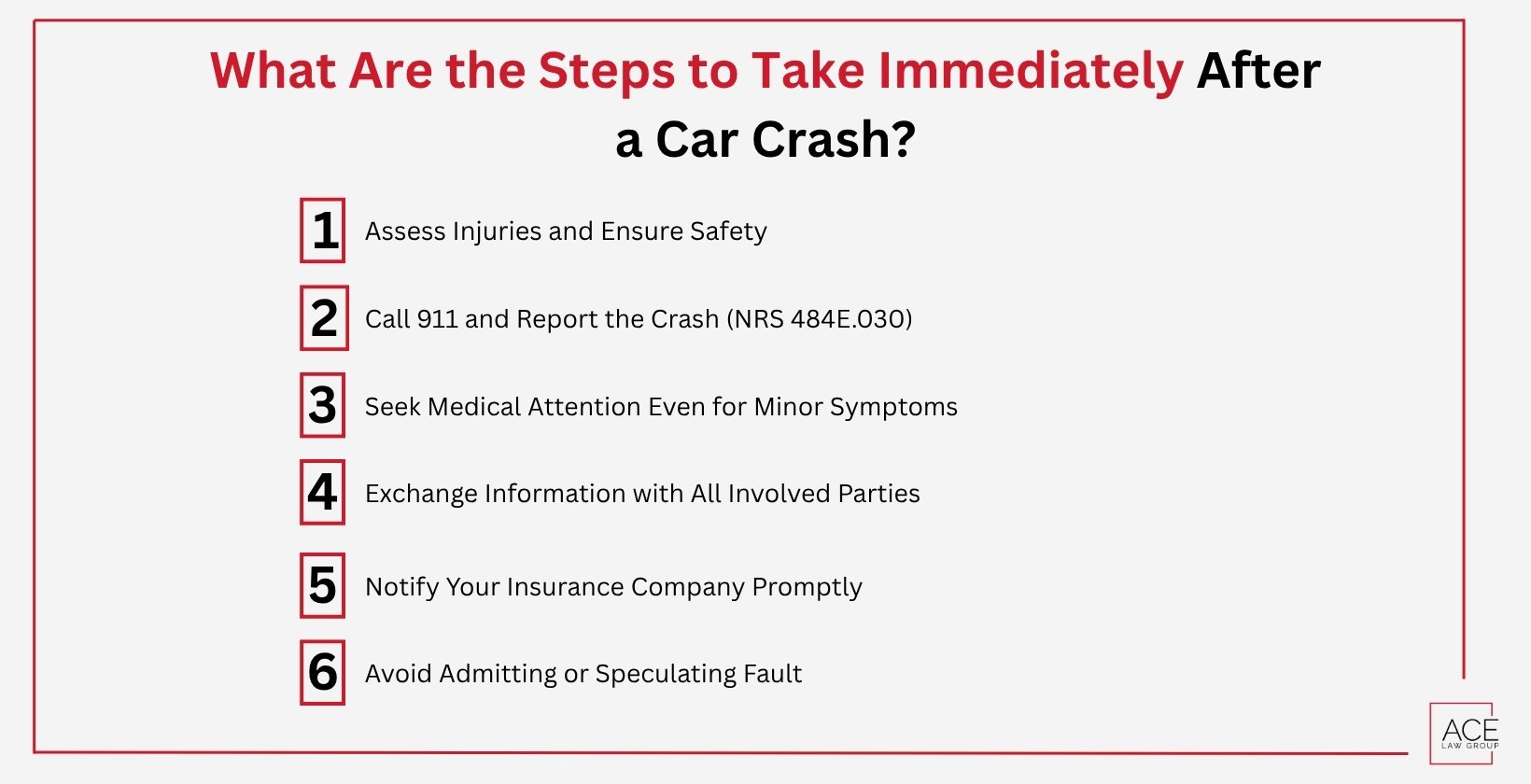
1. Assess Injuries and Ensure Safety
Look around and make sure everyone is okay, including yourself. If anyone is injured, call for help right away. Don’t move someone who’s unconscious or can’t move unless there’s a direct danger, like fire or fuel leakage.
If it’s safe to do so, turn on your hazard lights and move your vehicle out of traffic. But if the car is heavily damaged or someone is trapped, leave it where it is and wait for emergency responders.
2. Call 911 and Report the Crash (NRS 484E.030)
Under Nevada law, drivers involved in a crash must stop at the scene, exchange information, and render reasonable aid. If a crash involves injury or death, or if law enforcement is needed to document the collision, contact police or emergency services. If an officer does not investigate the crash at the scene, Nevada requires the accident to be reported afterward.
Stay on the line with the dispatcher until help arrives. Before leaving the scene, get the case number or report ID from the officers.
If law enforcement does not investigate the crash at the scene, Nevada drivers are required to file a written accident report with the Nevada DMV within 10 days if the crash involved injury, death, or 750 dollars or more in damage to any one vehicle or property.
Failing to file this report can result in license suspension or other penalties.
3. Seek Medical Attention Even for Minor Symptoms
Immediately after a crash, adrenaline often masks pain and symptoms. Many people decline medical care at the scene because they feel fine in the moment, only to experience pain or neurological symptoms hours or days later.
Insurance companies regularly point to early statements or refusals of treatment to question injury severity, which is why getting checked as soon as possible protects both your health and your claim.
4. Exchange Information with All Involved Parties
While you’re waiting for the police or paramedics, exchange the following with the other driver:
- Full name
- Driver’s license number
- Vehicle registration
- Insurance policy details
- Contact phone number
If anyone saw the crash happen, ask for their name and number as well. Witness statements can help clarify what really happened.
5. Notify Your Insurance Company Promptly
Once you’re safe and off the scene, report the accident to your insurance company, ideally on the same day. Most policies in Nevada require prompt notice.
Give them only the basic facts: time, location, and who was involved. Avoid giving opinions or accepting blame. Early reporting keeps your claim moving and protects your coverage.
Property damage claims and injury claims follow separate tracks, even though they come from the same accident. Resolving vehicle repairs does not close an injury claim, and medical recovery often continues long after the car is fixed. Understanding this distinction helps avoid premature settlements.
6. Avoid Admitting or Speculating Fault
Stick to the facts. Don’t apologize or make statements like “I didn’t see them” or “I should’ve stopped.” Even innocent comments can be used to shift blame onto you.
If an insurance adjuster asks for a recorded statement, you’re not required to give one right away. Wait until you’ve spoken with a Las Vegas car accident lawyer, especially if there’s a chance you could be blamed or injured.
Recent Case Result
We secured a $5 Million settlement for a client injured in a car crash.
Our legal team fought to recover full compensation for medical expenses, lost wages, and pain and suffering.
Call Us Now: (702) 333-4223How Do You Document a Car Accident Properly?
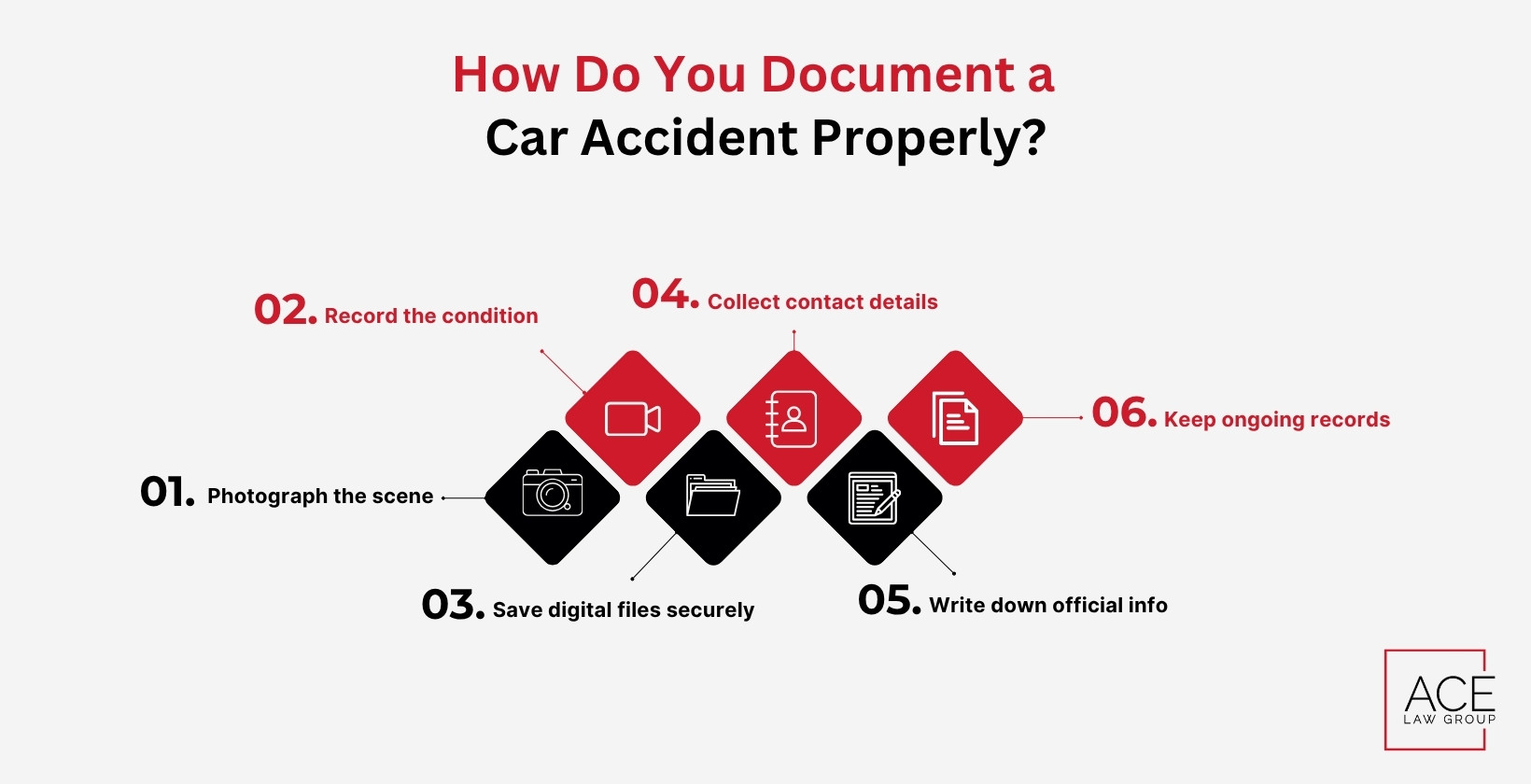
Accurate documentation is one of the most important parts of handling an auto accident. It helps establish what happened, supports your claim, and gives your case more weight if fault or damages are disputed.
Start collecting evidence at the scene and continue to keep records during your recovery:
- Photograph the scene, including vehicle damage, license plates, injuries, road signs, skid marks, traffic signals, and anything unusual.
- Record the condition time of day, weather, road surface, traffic flow, and visibility.
- Save digital files securely, back up all photos and videos, and make sure timestamps are visible.
- Collect contact details, names, and phone numbers of all drivers and any witnesses.
- Write down official info, police report number, case ID, badge number, and claim reference if available.
- Keep ongoing records of medical visits, treatment summaries, missed workdays, repair receipts, and any communication with insurance companies.
Continue documenting pain levels, missed workdays, or other impacts related to your car crash injury, as these details can strengthen your personal injury claim later.
What If the Other Driver Flees the Scene or Is Uninsured?
Under Nevada law, drivers involved in a crash must stop, stay at the scene, and offer help if needed. Leaving without doing so is considered a hit-and-run under NRS 484E, and the penalties can include fines, license suspension, and possible jail time.
What to do: Stay where you are, call 911, and report the incident immediately. Let the dispatcher know the other driver left the scene, and request police response.
Nevada also requires all drivers to carry minimum liability insurance. If the other driver is uninsured or cannot be identified, you can use your own Uninsured/Underinsured Motorist (UM/UIM) coverage to help pay for medical bills, vehicle repairs, and other crash-related costs.
Next steps: Contact your insurance company as soon as possible, provide the police report number, and file a UM claim to begin the recovery process.
When Are You Allowed to Move Your Vehicle After a Crash?
You should only move your vehicle after a crash if it’s clearly safe to do so. The goal is to prevent further collisions and avoid blocking traffic unnecessarily.
If the accident is minor, no one is seriously injured, and the car can still be driven, it’s reasonable to move it to a nearby parking lot or side street. Before doing so, take photos or video of the damage and the position of the vehicles.
When not to move the vehicle:
- There are serious injuries or a fatality, the scene may be treated as a crime scene.
- The car is severely damaged (e.g., broken wheel, fluid leaks, smoke, or fire).
- There’s a dispute about who’s at fault, and significant damage is involved.
Should You Talk to the Other Driver’s Insurance Adjuster?
No. You are not legally required to speak with the other driver’s insurance adjuster, and in most cases, doing so can damage your claim. Communicating with the insurer before getting legal guidance creates unnecessary risk.
Insurance adjusters work for the insurance company, not for you. Their questions are structured to limit liability and reduce payouts. Statements can be framed in ways that minimize injuries, shift fault, or create inconsistencies that weaken your case.
If you are asked to provide a recorded or written statement, consult an attorney first. If you do not yet have legal representation, keep any communication brief and factual. Do not speculate, assign blame, or discuss injuries beyond what is immediately known.
Once a recorded statement is given to an insurance company, it cannot be taken back or revised later. Even small misstatements or incomplete answers can be used to limit or deny a claim. This is why many people choose to wait until they understand their injuries and legal position before providing any formal statement.
Do not speak to the insurance adjuster without legal guidance. Call us now.What Legal Rights Do You Have After a Car Accident in Nevada?
After a car accident in Nevada, you have the legal right to protect your interests financially, medically, and legally. These rights help ensure you’re treated fairly, even if the insurance company pushes back or the fault is disputed.
You’re entitled to:
- Pursue full compensation for medical bills, property damage, lost income, and pain and suffering.
- Refuse to speak with the other driver’s insurer or to sign any documents you don’t fully understand.
- Consult a lawyer before accepting any settlement or making a formal statement.
- Reject low settlement offers that don’t reflect the actual impact of the accident.
- Recover compensation even if you were partly at fault, as long as your share of fault is not greater than the other party’s fault under Nevada’s modified comparative negligence rule.
Knowing and using your rights early in the process can help you avoid common mistakes and protect the value of your car accident claim.
What Evidence Helps Prove Fault in a Las Vegas Car Accident?
Fault in a car accident is determined by what the evidence shows – how the crash happened, who was involved, and whether traffic laws were violated. Certain types of evidence carry more weight when assigning liability.
Here are the most reliable sources that investigators, insurers, and courts may rely on:
From the scene:
- Photos and videos of the vehicles, injuries, skid marks, road signs, and weather conditions.
- Official police report with officer observations and initial fault assessment.
- Eyewitness or bystander statements with names and contact details.
While police reports are important, they do not automatically determine fault in a Nevada car accident claim. Officers document observations and statements, but insurers and courts still review physical evidence, medical records, and witness accounts independently. This is why thorough documentation matters even when a police report exists.
From technology and records:
- Dashcam footage or nearby surveillance video.
- Vehicle Event Data Recorder (EDR) downloads.
- Cell phone records showing possible distracted driving.
- Toxicology or BAC results if alcohol or drugs are suspected.
From post-accident investigation:
- Medical records showing the extent and timing of injuries.
- Expert analysis from accident reconstruction specialists.
- Repair reports showing impact points and damage location.
Start gathering and organizing this evidence as early as possible. It can make the difference between a denied claim and full compensation especially when fault is contested.

Supporting Evidence That Strengthens Settlement Assessment
Insurers assign higher value to claims supported by consistent evidence that validates the injury, clarifies liability, and proves financial impact. Key evidence types include:
- Medical treatment and imaging records
- Police crash reports and fault diagrams
- Photos of the vehicle and physical injuries
- Witness statements and scene descriptions
- Expert opinions and long-term care assessments
The evidentiary strength of a claim often determines the credibility of the multiplier and influences insurer negotiation strategy.
What Is the Deadline to File an Insurance Claim or Lawsuit in Nevada?
Most legitimate injury claims do not resolve in weeks. Early settlement pressure often benefits the insurance company, not the injured person. Allowing time for medical treatment and proper documentation is usually necessary to understand the true value of a claim.
If you’re injured in a car accident in Nevada, you have:
- 2 years from the date of the crash to file a personal injury claim.
- 3 years to file a property damage claim for vehicle repairs or replacement.
These are strict legal deadlines under Nevada’s Statute of Limitations. If you miss them, you lose your right to sue, even if your case is strong.
Keep in mind: insurance companies often have much shorter reporting deadlines, sometimes just a few days after the crash. File your claim as soon as possible to avoid delays, denials, or coverage issues.
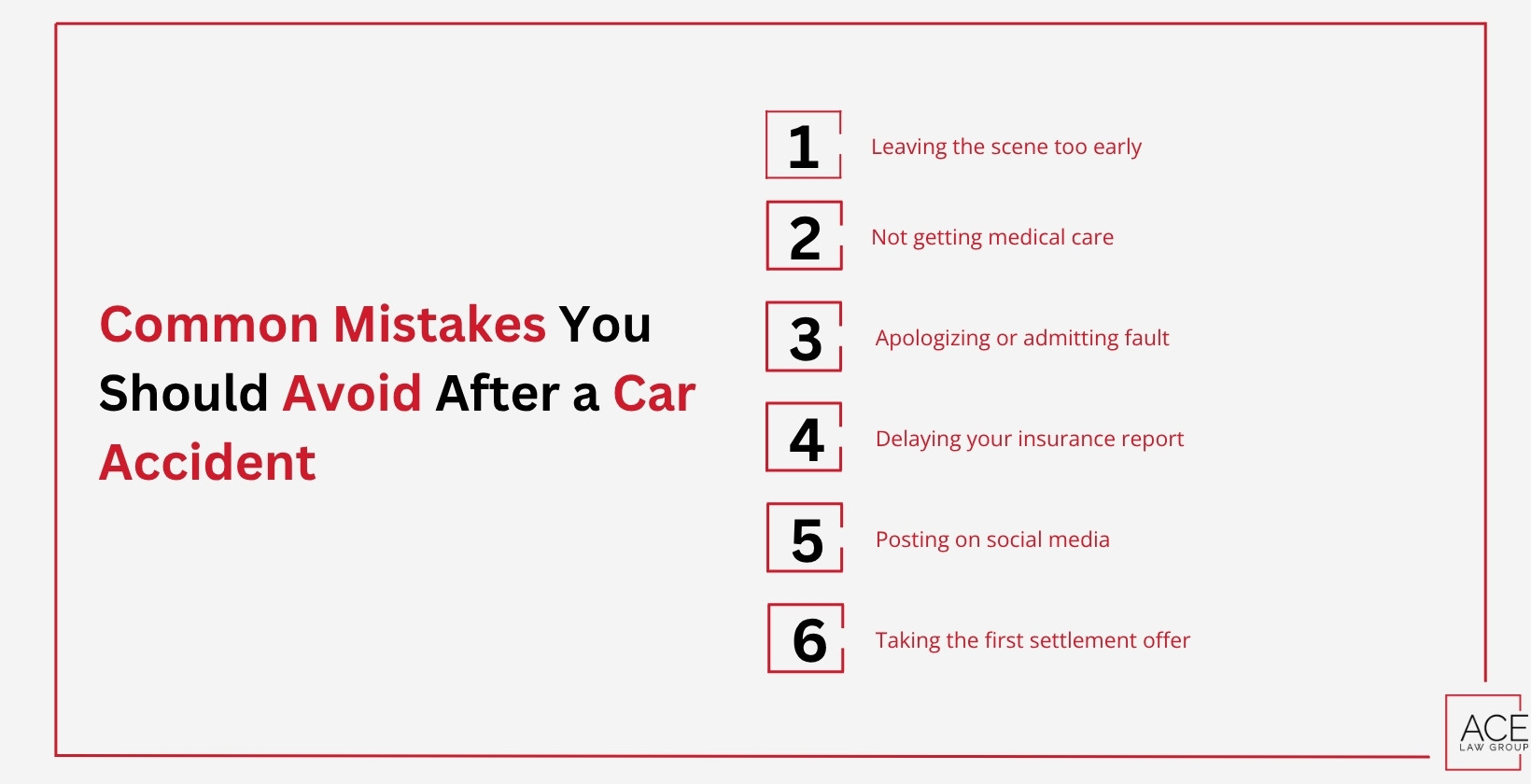
Common Mistakes You Should Avoid After a Car Accident
Even small mistakes after an accident can lead to denied claims, reduced compensation, or legal trouble. Being aware of what not to do can help protect your rights and your recovery.
Avoid these common errors:
- Leaving the scene too early: Even minor crashes must be reported and documented.
- Not getting medical care: Untreated injuries can weaken your claim and delay recovery.
- Apologizing or admitting fault: Your words may be misinterpreted as a legal admission
- Delaying your insurance report: Most policies require prompt notice after a crash.
- Posting on social media: Even harmless updates can be used to downplay your injuries.
- Taking the first settlement offer: Early offers often undervalue the real cost of your accident.
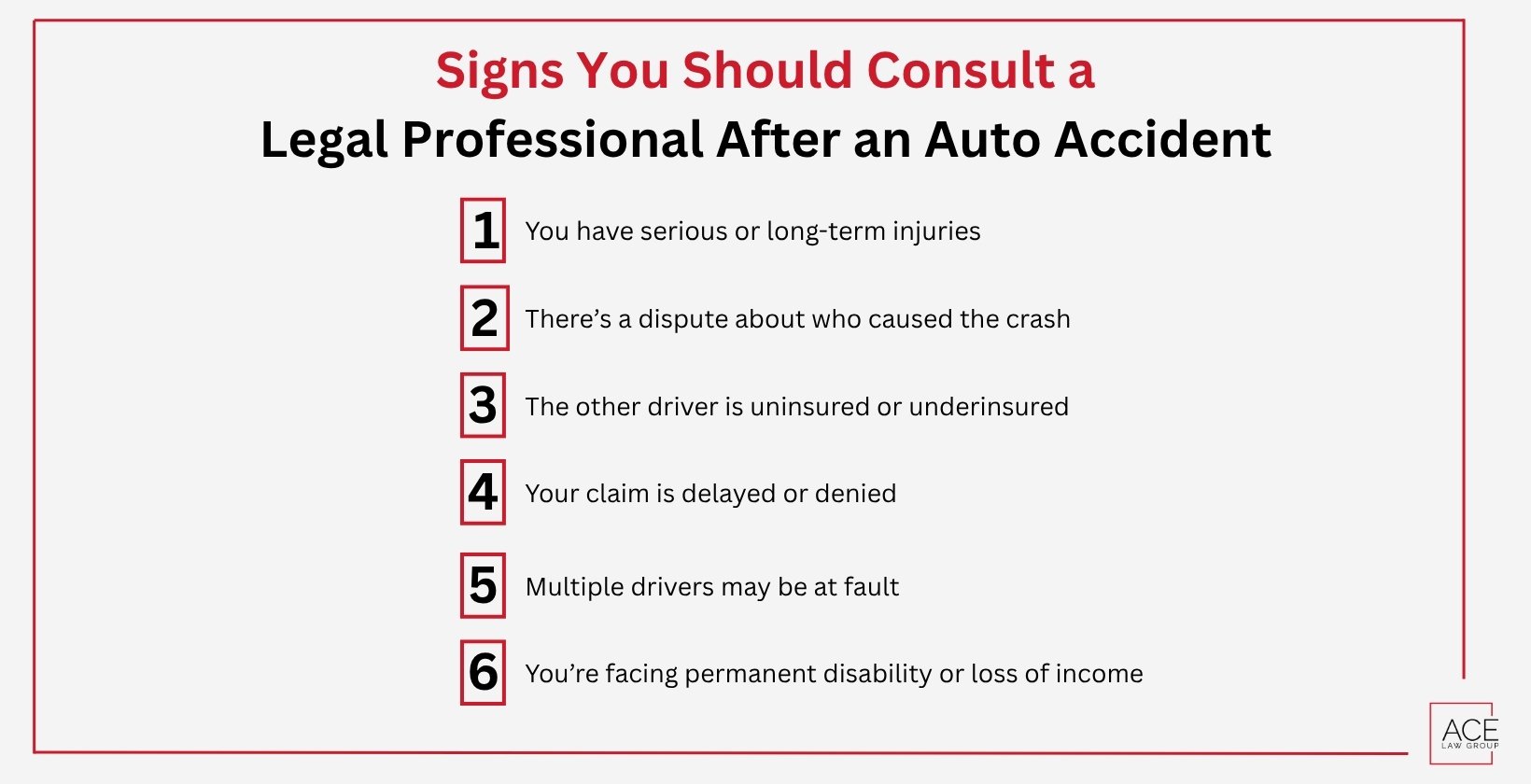
Signs You Should Consult a Legal Professional After an Auto Accident
Not every accident requires a lawyer, but some situations are too risky to handle alone. If any of the following apply, it’s worth speaking with a legal professional who handles car accident claims regularly:
- You have serious or long-term injuries treatment is ongoing, or recovery is taking weeks or months.
- There’s a dispute about who caused the crash or the police report doesn’t reflect what actually happened.
- The other driver is uninsured or underinsured and your own coverage may need to fill the gap.
- Your claim is delayed or denied and you’re not getting clear answers from the insurer.
- Multiple drivers may be at fault making liability and settlement more complicated.
- You’re facing permanent disability or loss of income and need help calculating future damages.
Legal guidance early on can help protect your claim, avoid paperwork mistakes, and give you a clearer path forwardespecially when the stakes are high.
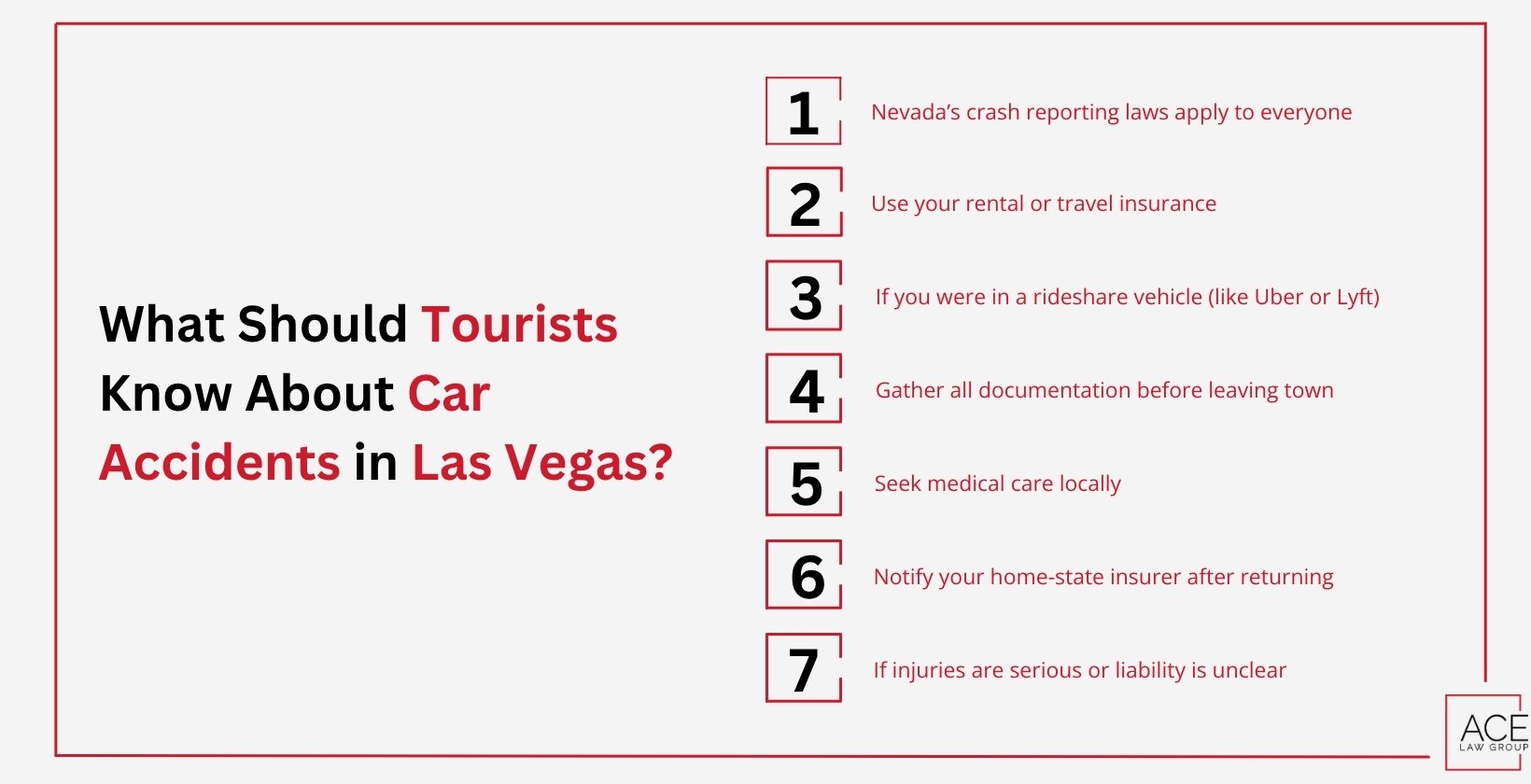
What Should Tourists Know About Car Accidents in Las Vegas?
In Las Vegas, many crashes involve tourists, rental vehicles, rideshare drivers, or out of state insurance carriers. These factors often slow claims, complicate liability investigations, and create coverage disputes. Local experience matters because Nevada procedures and insurer practices differ from many other states.
Key points to remember:
- Nevada’s crash reporting laws apply to everyone, including nonresidents.
- Use your rental or travel insurance to report the accident as soon as possible.
- If you were in a rideshare vehicle (like Uber or Lyft), document the driver’s info and report the crash through the app.
- Gather all documentation before leaving town, including the police report and insurance details.
- Seek medical care locally, so your injuries are documented under Nevada’s legal system.
- Notify your home-state insurer after returning, and share all records from the scene.
- If injuries are serious or liability is unclear, it’s smart to speak with a local attorney who understands Nevada’s fault-based insurance rules.
Car Accident Resources
How to Get Access to a Car Accident Report in Las Vegas?
Car Accident Determining Fault By Location of Damage
Recovering Lost Wages After a Car Accident in Las Vegas
Are Car Accident Insurance Settlements Taxable?
How to Settle a Car Accident Claim Without a Lawyer?
Causes of Car Accidents in Las Vegas
What Happens If You Total a Leased Car in Nevada?
Frequently Asked Questions About Car Accident Settlements in Las Vegas
Is Nevada a no-fault or at-fault state for car accidents?
Nevada is an at-fault state for car accidents, meaning the driver who caused the crash is responsible for paying for damages, medical bills, and losses related to the accident.
What happens if you don’t report a car accident to the DMV in Nevada?
If you don’t report a car accident to the DMV within 10 days (when injuries or damages exceed $750), it may lead to license suspension or criminal charges under Nevada law (NRS 484E.070).
How long does it take to settle a car accident claim in Nevada?
Settling a car accident claim in Nevada usually takes a few months, but if injuries are serious or liability is unclear, the process can extend over a year due to negotiations or litigation.
Can I recover lost wages after a car accident in Las Vegas?
Yes, you can recover lost wages after a car accident in Las Vegas if your injuries prevent you from working. This includes current lost income and, in some cases, future earning capacity as part of your injury claim.
Can I reopen a car accident claim after settling in Nevada?
No, you cannot reopen a car accident claim in Nevada once a final settlement is signed. Even if additional injuries appear later, the claim is considered legally closed in most cases.
How can you check if a car accident report was filed in Las Vegas?
To check if a car accident report was filed in Las Vegas, request a copy from the Las Vegas Metropolitan Police Department (LVMPD) or the Nevada DMV, either online or by visiting in person.
Can passengers file separate injury claims after a car accident?
Yes, passengers can file separate injury claims after a car accident. They may file against the at-fault driver’s insurance or, in some cases, access multiple applicable insurance policies.
Are dashcam recordings admissible in Nevada car accident cases?
Yes, dashcam recordings are admissible in Nevada car accident cases if the footage is clear, relevant, and has not been edited. Courts often accept it as strong supporting evidence when proving fault.
Why Legal Guidance Can Make a Difference After an Accident?
You might never expect to be in a serious crash until it happens. And when it does, the rules feel stacked in favor of the people who’ve done this before: the insurance companies, the adjusters, the defense lawyers.
That’s what legal guidance is for not to create conflict, but to give you someone who understands how this works, and makes sure you’re not left guessing.
When someone’s protecting your interests from day one, the process feels less chaotic. And the outcome? It’s not just more compensation, it’s confidence that nothing important got missed.
If you’re unsure about your next move, clarity is just a conversation away. Call our auto injury lawyers at 702-333-4223. Or, you can visit us at 6480 W Spring Mountain Rd Suite 1, Las Vegas, NV 89146.