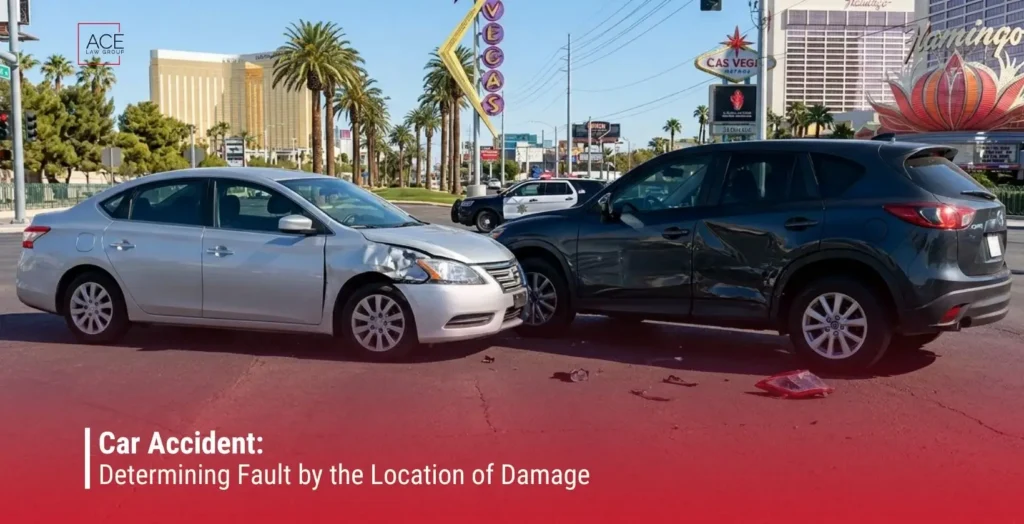
When two Las Vegas drivers argue over fault after a crash, determining who is liable by the location of damage on the cars can help reveal the truth. Front-end, rear, and side impact patterns, along with paint transfer and impact zones, can reconstruct the collision even when witness accounts conflict or footage is missing.
In Nevada, that evidence can affect how fault is assigned under the comparative negligence rule. If you are 51% or more at fault, you recover nothing. That is why insurers often lean heavily on damage analysis when evaluating a claim.
At Ace Law Group, our Las Vegas car accident lawyers have challenged insurer fault narratives for injured drivers across Nevada for years.
Explore how damage is read and analyzed in different types of collisions, and what that may mean for your case.
Key Takeaways
- Damage location reveals key details like point of impact, collision angle, and force, helping establish fault in accidents.
- Insurance adjusters and legal professionals use damage analysis to determine liability, estimate compensation, and dispute false claims.
- Nevada follows modified comparative negligence, allowing partial compensation if you’re under 50% at fault.
- Technology such as dashcams, black boxes, and crash reconstruction tools supports accurate fault analysis.
- The amount of damage doesn’t always indicate fault; driving behavior, road rules, and supporting evidence are also critical.
Recent Case Result
We secured a $5 Million settlement for a client injured in a car crash.
Our legal team fought to recover full compensation for medical expenses, lost wages, and pain and suffering.
Call Us Now: (702) 333-4223Why the Location of Damage Matters in Car Accidents
Damage location can provide insights about how the collision happened and help determine the fault. It provides clear evidence that helps with liability decisions and supports insurance claims and legal proceedings.
How Damage Location Helps Identify Fault
Damage patterns follow predictable physical rules that investigators use to establish fault. Four factors are analyzed:
- Point of impact identifies where the first contact occurred and which vehicle was struck, establishing the direction of the crash.
- Angle of collision reveals whether the impact was direct, angled, or glancing. This information changes how fault is assigned in intersection and merging disputes.
- Extent of damage assesses the force involved, which reflects the approximate speed and whether evasive braking occurred before contact.
- Damage comparison between the two vehicles identifies inconsistencies between driver statements and physical evidence. When a driver claims they were stationary, but the crush profile shows a moving impact, the physical record contradicts their account.
Legal and Insurance Implications of Damage Patterns
Insurers and legal professionals rely on damage patterns to resolve claims by:
- Determining fault based on impact location and assigning responsibility accurately
- Calculating compensation by assessing damage and estimating repair and medical costs
- Challenging false claims with factual evidence and ensuring fair claim settlements
- Supporting legal cases with documented proof and strengthening arguments in disputes
For guidance on how damage patterns may affect your claim, call our Las Vegas auto accident attorney for a clear assessment of your legal options.
The Process of Fault Determination in Nevada Car Accidents
Determining fault in a Nevada car accident requires analyzing state laws, police reports and available evidence to establish liability and support insurance claims.
How Fault is Determined Under Nevada Law
Nevada’s car accident laws provide a framework for identifying faults by outlining driver responsibilities and legal obligations. Key factors considered include:
- Right-of-way violations: Identifies which driver had legal priority.
- Excessive speeding: Determines if speed played a role in the accident.
- Traffic signal violations: Checks for failure to stop at lights or signs.
- Improper lane usage: Examines unsafe lane changes or drifting.
- Nevada’s modified comparative negligence rule (NRS 41.141): Allows compensation only if your fault is 50 percent or less. At 51 percent or more, you recover nothing.
The Role of Nevada Law Enforcement in Fault Analysis
Law enforcement officers play a vital role in determining fault by gathering essential evidence and documenting their findings. Their responsibilities include:
- Assessing vehicle positions to understand how the collision occurred.
- Interviewing involved parties and witnesses to collect firsthand accounts.
- Examining physical evidence such as skid marks, debris, and property damage.
- Issuing citations when a driver is found to have violated traffic laws.
- Preparing official reports that provide a detailed summary of the accident.
Traffic Collision Reports reflect an officer’s initial observations, yet they are not legally binding regarding civil liability. Independent car accident claim evidence can effectively challenge and contradict these findings.
Role of Technology in Fault Determination
Technology plays an essential role in analyzing accident details and supporting fault determination through various tools, including:
- Dashcams that provide real-time footage of the moments leading up to the crash.
- Surveillance cameras that capture external views from intersections and roadways.
- Accident reconstruction software that analyzes data to recreate the collision.
- Vehicle black box data that records speed, braking, and steering inputs.
- GPS tracking systems help determine vehicle movements and locations.
Las Vegas has abundant technological evidence from casino security, traffic cameras, and frequent dashcam use. Because many systems overwrite data within days, your lawyer must quickly request footage preservation following a crash.
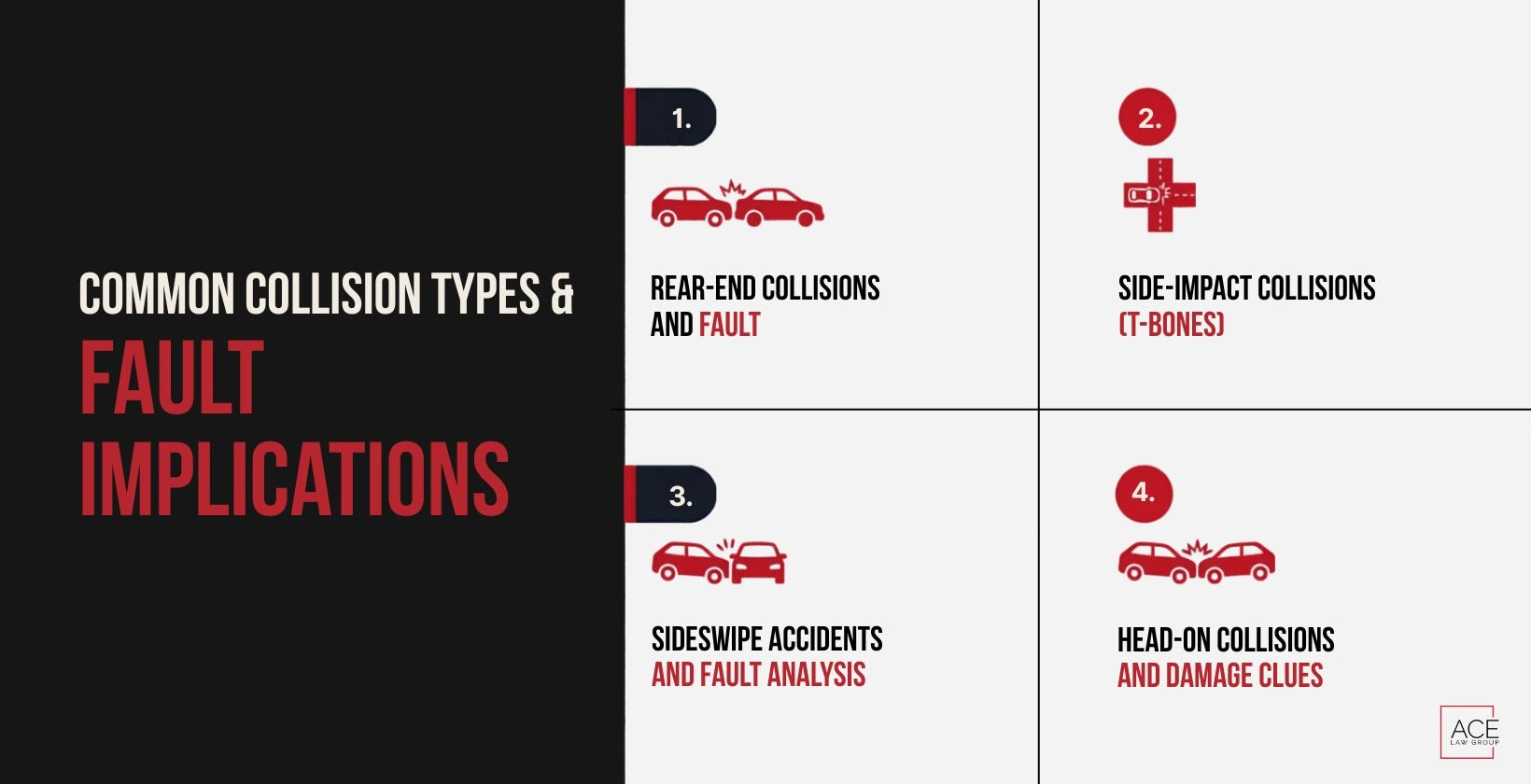
Common Collision Types and Fault Implications
Understanding common collision types helps identify faults by analyzing damage patterns and traffic rule violations.
Rear-End Collisions and Fault
Nevada law typically presumes the trailing driver is at fault in rear-end collisions for failing to maintain a safe distance. Front-to-rear impact is the most identifiable damage pattern, providing clear physical evidence of liability. However, Nevada courts recognize exceptions if the lead driver brake-checks, merges unsafely, or has malfunctioning brake lights. In these disputes, investigators analyze skid marks, CDR data, and witness statements to determine if fault should shift to the front driver.
Side-Impact Collisions (T-Bones)
T-bone accidents often result from failing to yield or running traffic signals. Fault is typically assigned to the driver who violated right-of-way rules. Vehicle speed, traffic signals, and witness accounts help determine responsibility. T-bone collisions are common at congested Las Vegas intersections like Tropicana Avenue, Flamingo Road, and Las Vegas Boulevard. Determining right-of-way in these disputes usually requires traffic camera footage and witness accounts to supplement physical damage evidence.
Sideswipe Accidents and Fault Analysis
Sideswipe accidents often occur due to unsafe lane changes or failure to check blind spots. Fault is assigned based on improper lane usage, lack of signaling, or drifting between lanes. Road conditions and vehicle positioning are also considered. An unsafe lane change attorney in Las Vegas can use specialized forensics to analyze paint transfer and impact angles, providing the objective proof needed to overcome conflicting driver accounts.
Head-On Collisions and Damage Clues
Head-on collisions usually indicate wrong-way driving or reckless behavior. Damage patterns and impact points are often dispositive in revealing which vehicle crossed the center line. When establishing fault, investigators also evaluate evidence of driver impairment, distracted driving, and signage violations. A qualified head-on collision lawyer can leverage these forensic clues to hold the negligent party accountable and secure fair compensation.
What Specific Damage Locations Reveal About Fault
| Damage Location | Likely Collision Type | Key Fault Clue |
|---|---|---|
| Front-End (Full) | Head-on collision | Indicates cross-lane travel; debris fields pinpoint the impact zone. |
| Front-End (Offset) | Angled/Turning | Common in intersection disputes; often shows failure to yield right-of-way. |
| Rear-End | Trailing collision | Creates a clear fault presumption for the trailing driver’s failure to brake. |
| Front-Third Side | Merging/Lane Change | Suggests the other driver turned or pulled into your path. |
| Rear-Third Side | Merging/Lane Change | Suggests your vehicle moved into the path of the other driver. |
| Corner Impact | Sideswipe | Paint transfer confirms which vehicle initiated the contact. |
| Undercarriage/Rollover | Loss of Control | Often indicates excessive speed or reckless maneuvers. |
Analyzing Damage Patterns for Fault Determination
Damage patterns provide valuable information to help determine how a crash happened, who is responsible, and how one calculates the value of a claim.
How Investigators Use Damage to Determine Fault
Investigators examine vehicle damage to connect it with the events of a collision. Impact points, scrape marks, and crumple zones help reveal the direction and force of the impact. Comparing damage between vehicles helps identify which driver may have been at fault based on traffic laws and road conditions.
The Role of Crash Reconstruction Experts
Crash reconstruction experts analyze damage evidence to recreate accident scenarios. They assess skid marks, debris patterns, and vehicle deformation to determine impact speed, direction, and force. Tools such as 3D modeling and simulation software assist in providing accurate insights that help support legal and insurance cases.
Vehicle Damage and Insurance Claims
Damage reports help insurance companies assess liability and claim payouts. Inspecting the extent and location of damage allows them to verify accident details and determine repair costs. Consistent damage patterns support claims, while inconsistencies may result in further investigations or claim disputes.
Legal and Financial Implications of Fault Determination
Establishing fault in a Las Vegas car accident directly determines how much compensation you recover, whether your claim gets approved, and what happens to your insurance rates afterward.
How Fault Percentage Affects Your Compensation
Under Nevada’s NRS 41.141 modified comparative negligence rule, compensation decreases by your fault percentage. For instance, being 20% liable for $100,000 in damages nets you $80,000. However, if you are 51% or more at fault, you recover nothing, regardless of injury severity.
Fault also dictates claim approval. Insurers use these percentages to offer settlements or dispute liability entirely. High fault levels provide grounds to reduce or deny payouts, even for genuine car crash injuries.
How a Fault Finding Affects Your Insurance Premiums
Being found at fault in a Nevada car accident has financial consequences that extend beyond your immediate claim:
Higher premiums due to an increased risk assessment by your insurer
Loss of safe driver discounts, raising your overall policy cost
Additional surcharges applied to future policy renewals
Limited coverage options from insurers unwilling to offer full benefits
Extended financial impact, as elevated rates typically last three to five years, depending on your carrier and driving record
Fault and Its Impact on Insurance Premiums
Being found at fault in an accident can lead to financial consequences, including:
- Higher premiums due to an increased risk assessment by insurers.
- Loss of safe driver discounts resulting in higher overall costs.
- Additional surcharges are applied to future policy renewals.
- Limited coverage options from insurers unwilling to offer full benefits.
- Extended financial impact, as higher rates may last for years.

Addressing Fault Disputes
Disputes over fault determination can be addressed by taking the right steps to challenge inaccuracies.
Steps to Take If You Disagree with a Fault Determination
- Collect evidence such as photos, videos, and witness statements.
- Review police reports for errors or missing details.
- Consult an accident expert for an independent analysis.
- Submit a dispute with the insurer, along with supporting documents.
- Request a claim reassessment to present additional findings.
Legal Options for Disputing Fault in Car Accidents
Legal options can help pursue a fair outcome if insurance disputes remain unresolved. Examples include:
- Hiring a car accident lawyer at Ace Law Group to review damage reports, challenge the insurer’s fault assessment, and represent your interests through negotiation or litigation.
- Filing a civil lawsuit in the Nevada district court to have fault determined by a judge or jury based on all available evidence.
- Pursuing mediation through a neutral third party if both sides are open to a structured negotiation outside of court.
- Presenting expert testimony from a credentialed crash reconstruction specialist.
- Negotiating settlements to reach a fair agreement without litigation.
Strict Deadline: Nevada’s statute of limitations for car accident claims is two years from the date of the accident. Do not wait until evidence vanishes or time runs out. Call Ace Law Group at (702) 333-4223 now.
Common Myths About Fault and Damage Location
Misunderstandings about damage and fault determination can lead to incorrect assumptions about liability.
Is the Car with More Damage Always at Fault?
A car with more damage is not always at fault. A stationary or law-abiding driver can suffer significant damage if hit by another vehicle violating traffic laws. The fault is determined by analyzing driving behavior, road conditions, and right-of-way rules, not just the extent of the damage.
Can Fault Be Determined Solely by Damage?
Fault cannot be determined by damage alone. Investigators consider driver statements, witness accounts, traffic signals, and accident scene evidence. Relying only on damage patterns may overlook critical details that clarify responsibility.
Do Insurance Companies Always Agree on Fault?
Insurance companies do not always agree on fault. Each insurer conducts its investigation, which may lead to different conclusions based on available evidence and policyholder statements. Disagreements can arise, requiring further review or legal assistance to resolve disputes.
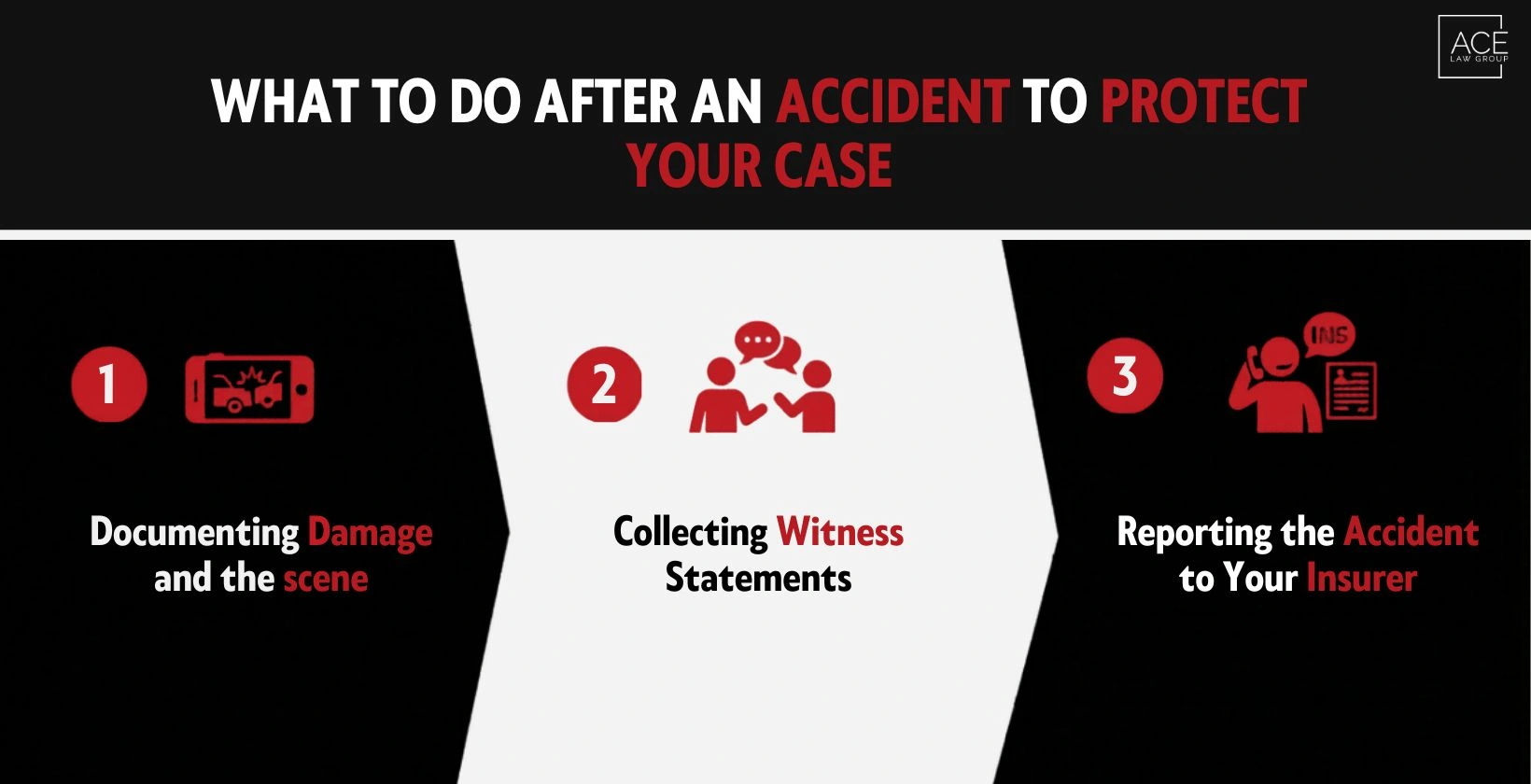
What to Do After an Accident to Protect Your Case
Taking the right steps after an accident helps preserve evidence and strengthens your case for insurance claims and legal matters.
Documenting Damage and the Scene
- Take clear photos of all visible damage from multiple angles.
- Capture skid marks and debris to show impact details.
- Include road signs and signals to highlight relevant traffic conditions.
- Note weather and lighting to provide context for the accident.
- Record vehicle positions before moving them, assuming it is safe to do so.
Collecting Witness Statements
- Ask witnesses for their contact details for future reference.
- Request a summary of what they saw and heard.
- Look for unbiased third parties not involved in the accident.
- Record statements promptly to ensure accurate recollection.
- Verify witness visibility to confirm their vantage point.
Reporting the Accident to Your Insurer
- Report the accident as soon as possible to start the claims process.
- Provide accurate details without admitting fault.
- Share evidence collected such as photos and witness contacts.
- Follow insurer instructions to avoid delays in claim approval.
- Keep copies of all reports for future reference.
Do not repair your vehicle, provide recorded statements, or accept any settlement offer until your Las Vegas personal injury attorney has evaluated the scene and documented your claim in full. Get a free consultation now.
Protect Your Claim Before Evidence Fades
Damage location plays a key role in determining fault and shaping the outcome of insurance claims and legal cases. Proper evaluation of damage patterns helps establish liability and ensures fair compensation. Taking immediate steps after an accident, such as documenting evidence and seeking legal guidance, can make a significant difference. Acting responsibly and staying informed about fault determination can help protect your rights and financial well-being.
If you’re struggling to determine fault, Ace Law Group is here to help. Contact Ace Law Group for legal guidance and support.
FAQs – Determining Car Accident Fault by Location of Damage
Who Determines Fault in a Car Accident?
Fault in a car accident is usually assessed by insurance companies, law enforcement, and, if needed, the courts. Each may consider damage patterns, witness statements, traffic laws, and other evidence differently.
Does More Vehicle Damage Mean More Fault?
Not necessarily. The amount of damage does not always show who caused the crash. Fault depends on the driving behavior, road conditions, traffic laws, and all available evidence.
How Long Do I Have to File a Car Accident Claim in Nevada?
You have two years from the date of the accident to file personal injury lawsuits and three years for property damage claims in Nevada. These legal deadlines are distinct from insurance reporting requirements. Failing to meet the statute of limitations permanently forfeits your right to compensation, regardless of liability.
Do I Need a Lawyer if the Fault Seems Clear From the Damage?
Yes, because even when the fault seems obvious from the damage, the insurance company may still dispute liability, minimize your injuries, or argue that other factors caused the crash. A lawyer can help preserve evidence, review the damage analysis, and protect your claim before you make statements or accept a low settlement offer.