
There is no single answer to this question because the duration of a Las Vegas slip and fall settlement is not a fixed number. Some cases resolve relatively quickly, within a few months, when liability is clear and the injury is contained. Others, however, can take considerably longer.
How long your case takes usually depends on five case-specific variables: how long your recovery takes, whether the property owner contests fault, who owns the property where you fell, how the insurance company handles your claim, and whether your case goes to trial.
If an insurer has already called you, your timeline has already started, and not in your favor. Talk to a Las Vegas slip and fall attorney before the evidence that determines your timeline disappears.
Key Takeaways
- Las Vegas slip and fall settlements range from a few months to several years, depending on injury severity, disputed liability, property type, insurer tactics, and whether the case goes to trial.
- You cannot accurately value your claim until you reach Maximum Medical Improvement (MMI). Settling before that point almost always means leaving money on the table.
- Nevada’s modified comparative negligence law allows you to recover compensation as long as you are 50% or less at fault, but insurers build fault arguments from the moment a fall is reported.
- Insurance companies use three specific tactics to delay and reduce your settlement: redundant documentation requests, medical causation disputes, and early lowball offers made before you have legal counsel.
- Nevada’s statute of limitations gives you exactly two years from the date of your fall to file a lawsuit in court; not to settle, not to negotiate, to file.
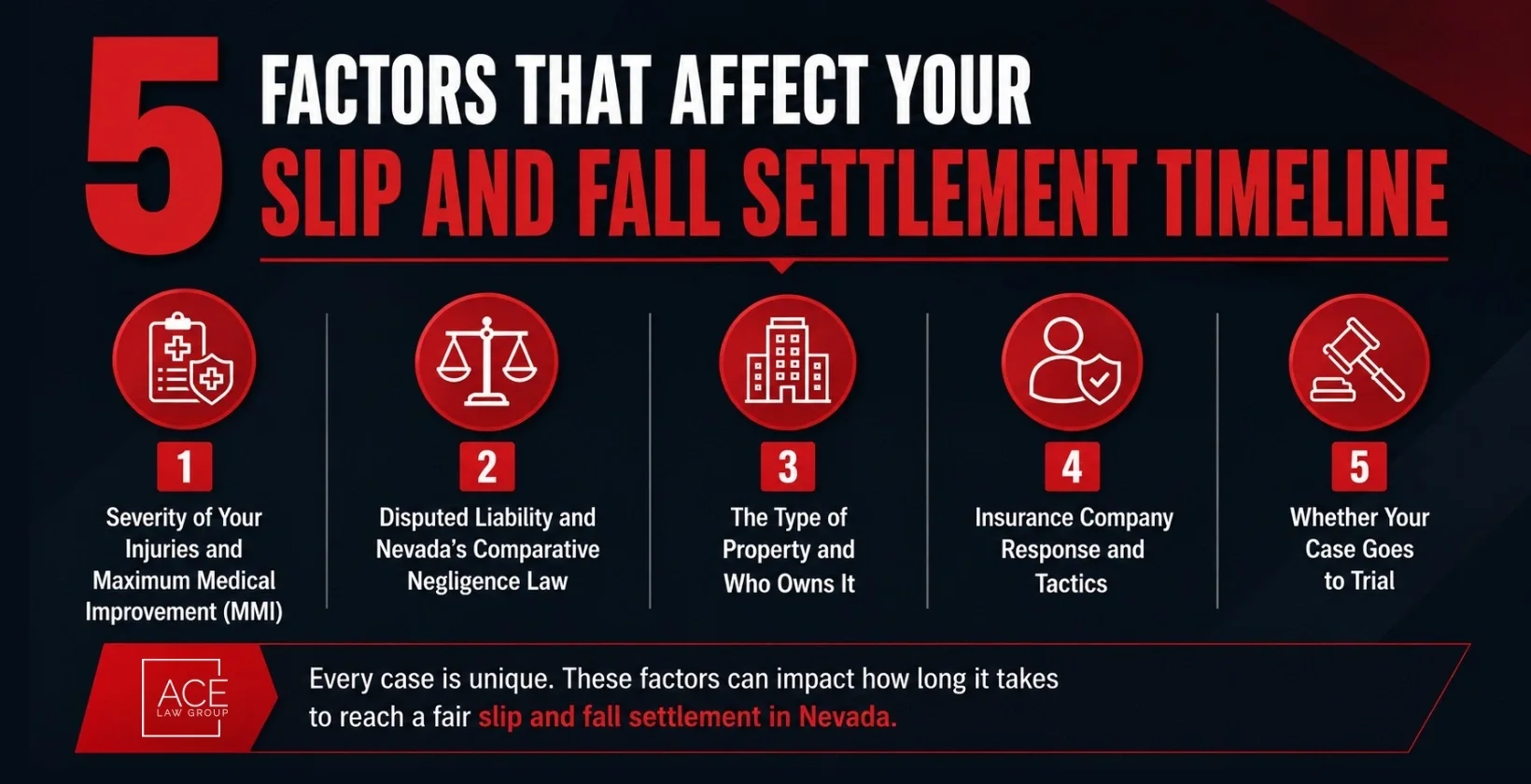
5 Factors That Affect Your Slip and Fall Settlement Timeline
The slip-and-fall settlement timeline is heavily influenced by the severity of injuries, the complexity of proving negligence, and insurance company negotiation tactics. Key factors impacting this timeline include:
1. Severity of Your Injuries and Maximum Medical Improvement (MMI)
Maximum medical improvement is the point at which your treating physician confirms your condition has stabilized and will not improve further. Until you reach it, your case cannot move forward, because no one, not your attorney, not the insurer, and not a judge, can accurately calculate what your injuries will cost over your lifetime.
This is why MMI is the single biggest driver of how long your settlement takes:
- Minor injuries that resolve quickly move cases toward settlement faster.
- Serious or catastrophic injuries requiring surgery, physical therapy, or specialist care extend the timeline until treatment stabilizes.
- Cases involving permanent disability or long-term impairment take the longest because the full scope of future costs takes time to document.
Insurance adjusters understand this better than most victims do. That is precisely why they call early, before you reach MMI, before you have legal counsel, and before you know what your case is worth. Settling at that stage closes your case at the lowest possible cost to them. Once you sign a release, that number is permanent regardless of what your recovery looks like six months later.
2. Disputed Liability and Nevada’s Comparative Negligence Law
When a property owner’s insurer disputes fault, your case does not just get harder. It gets longer. Liability disputes add a second negotiation track that runs in parallel with the damages discussion, and both have to resolve before your case can close.
Nevada’s modified comparative negligence rule is often the legal framework behind every fault dispute:
- You can recover compensation as long as you are 50% or less at fault for the fall.
- Your compensation is reduced proportionally by your share of fault.
- At 51% or more fault, you recover nothing.
Property owners and their insurers use this standard deliberately. The more fault they shift onto you, the less they pay. In Las Vegas, insurers of casinos, hotels, and large retailers build fault arguments from the moment a fall is reported, using incident reports, surveillance footage, and staff statements gathered in the hours immediately after the incident.
3. The Type of Property and Who Owns It
Not all slip and fall cases move at the same pace. The property where you fell determines who you are negotiating against, what procedural rules apply, and how much institutional resistance you will face.
Large hotel and casino properties are the most complex. Major Strip properties operate with in-house legal teams whose full-time job is defending claims exactly like yours. Surveillance footage at these properties is often overwritten within 24 to 72 hours. The moment a fall is reported, their legal infrastructure activates. Knowing what evidence you need to win your case before that window closes is critical to filing a competent and informed lawsuit.
Smaller commercial or private properties typically involve fewer institutional resources on the defense side. Without a dedicated legal team absorbing every claim as routine business, these cases generally move through negotiation more directly.
4. Insurance Company Response and Tactics
The insurer’s goal is not to resolve your claim fairly. It is to resolve it cheaply. Three specific tactics extend your timeline while that goal is pursued.
- Redundant documentation requests. Adjusters request the same records repeatedly in slightly different forms. Each cycle resets the response window without moving the negotiation forward. Weeks pass. Nothing changes except the calendar.
- Medical causation disputes. Insurers frequently argue that your injury predated the fall. A pre-existing back condition becomes their explanation for your herniated disc. A prior knee surgery becomes proof that your damage is degenerative, not traumatic. Every dispute of this kind has to be countered with medical evidence before settlement discussions can proceed.
- Early lowball offers. The first offer almost always arrives before you have reached MMI and before you have retained counsel. That timing is not coincidental. Most victims who hire a slip and fall lawyer after accepting an early offer discover the same thing: the number covered the immediate bills, and nothing beyond them.
5. Whether Your Case Goes to Trial
Most slip and fall cases settle before trial. But when an insurer refuses to offer fair value, litigation becomes the path to full compensation, and it adds the most significant time of any variable in this list.
Once a lawsuit is filed, the case enters discovery. Both sides exchange evidence, take depositions, and retain expert witnesses. Court scheduling in Clark County adds its own timeline on top of that. None of it moves quickly.
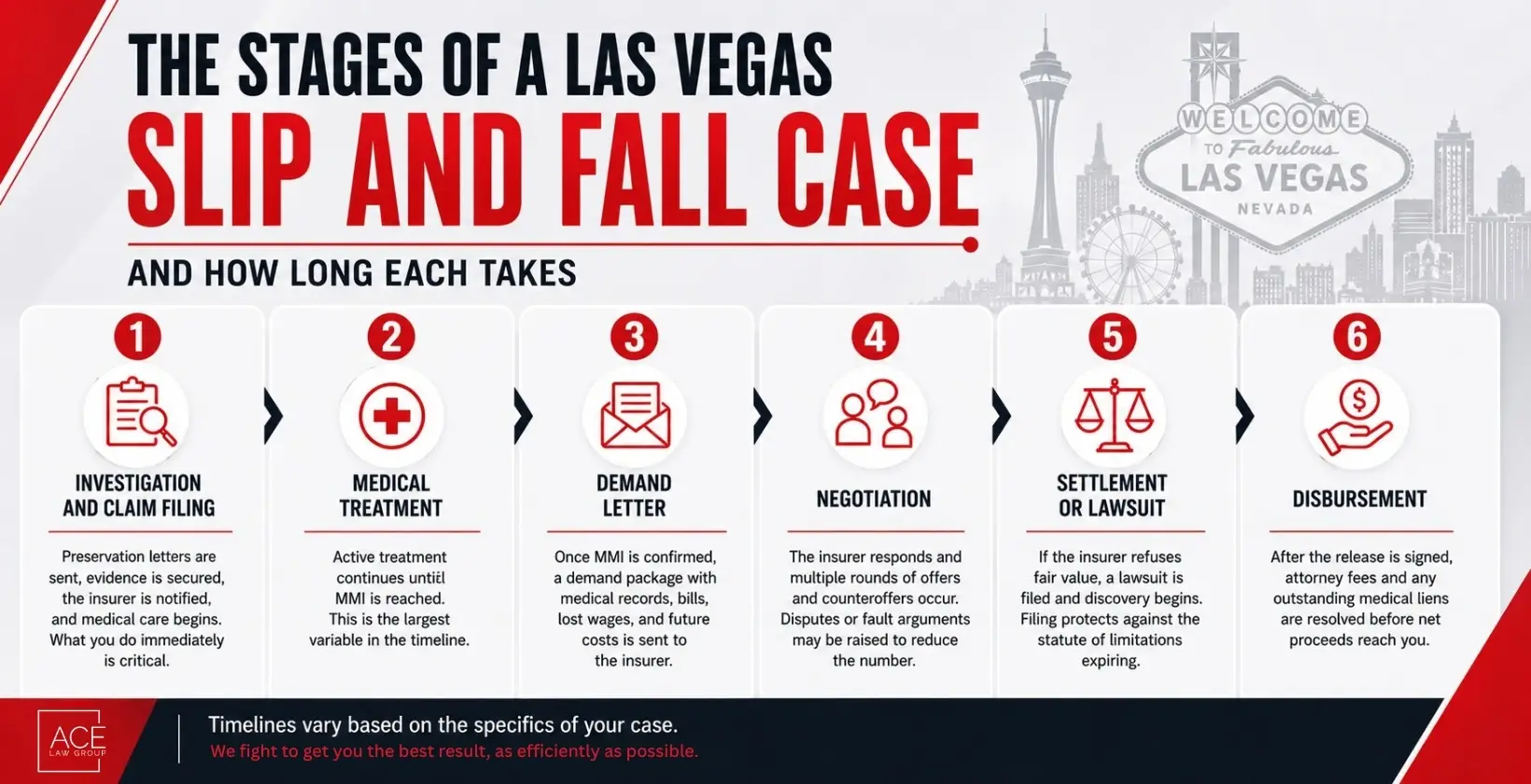
The Stages of a Las Vegas Slip and Fall Case and How Long Each Takes
Every slip and fall claim moves through the same sequence. Knowing where you are in that sequence tells you what comes next and what is still ahead.
Stage 1: Investigation and claim filing. Your attorney sends preservation letters to the property demanding surveillance footage, incident reports, and maintenance logs be retained. The insurer is notified. Medical care begins. This stage sets the foundation for everything that follows. What you do immediately after a slip and fall in these first hours determines what evidence survives.
Stage 2: Medical treatment. Active treatment continues until MMI is reached. This is the single largest variable in the entire timeline. It cannot be rushed without compromising the accuracy of your claim’s value.
Stage 3: Demand letter. Once MMI is confirmed, your attorney compiles the complete medical record, bills, lost wage documentation, and projected future costs into a formal demand package sent to the insurer.
Stage 4: Negotiation. The insurer responds. Multiple rounds of offer and counteroffer are standard. The insurer may raise causation disputes or fault arguments at this stage to reduce the number.
Stage 5: Settlement or lawsuit. If the insurer refuses fair value, a lawsuit is filed. Discovery begins. Filing also protects against the statute of limitations expiring during prolonged negotiations.
Stage 6: Disbursement. After the release is signed, attorney fees and any outstanding medical liens are resolved from the gross settlement before net proceeds reach you.
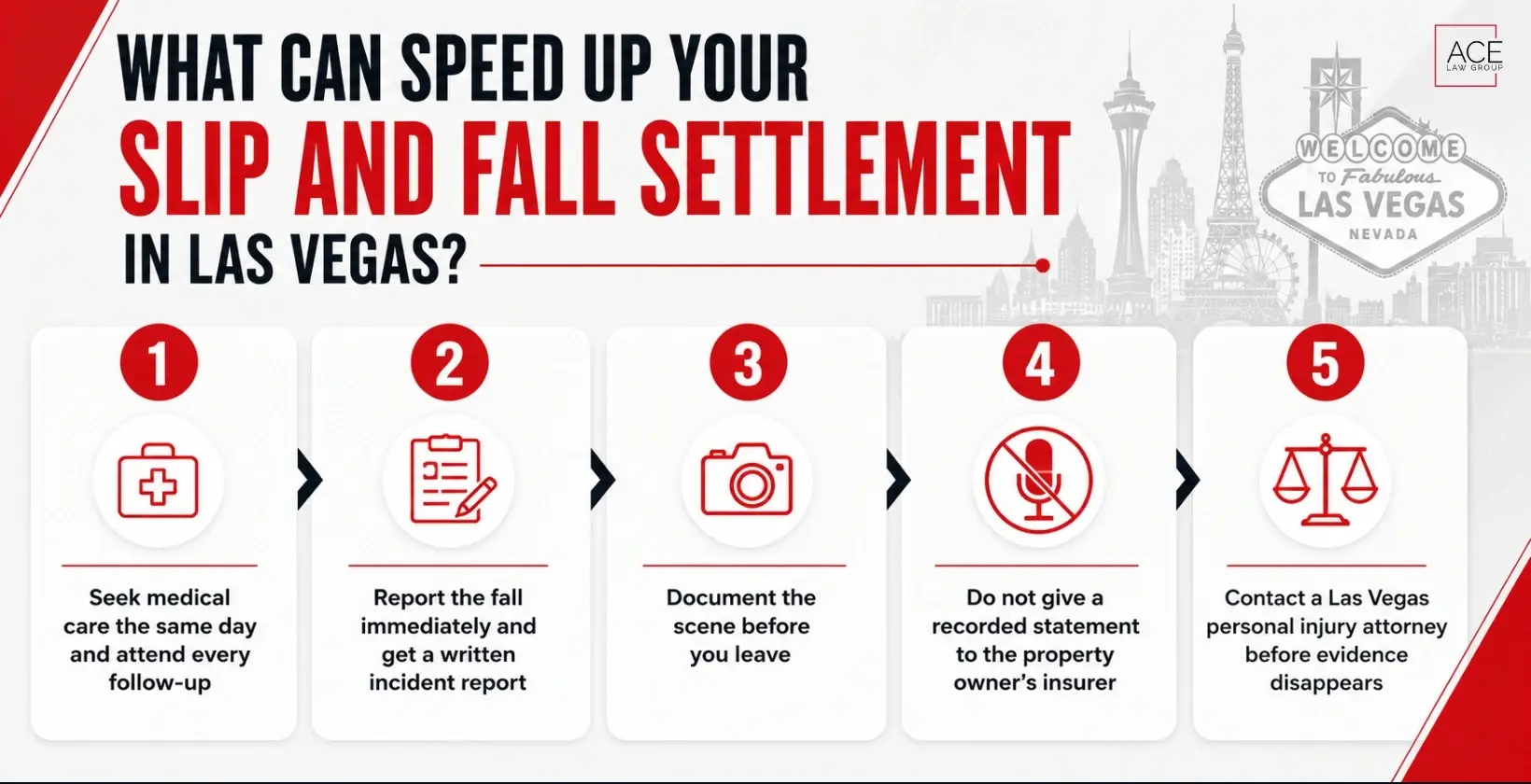
What Can Speed Up Your Slip and Fall Settlement in Las Vegas?
Some variables are outside your control. These are not.
- Seek medical care the same day and attend every follow-up. Gaps in your treatment record are the insurer’s primary argument for reducing claim value. A consistent medical timeline removes that weapon from their hands.
- Report the fall immediately and get a written incident report. Verbal acknowledgment from a property manager is not sufficient. You need a documented record that the incident occurred on their premises on that date.
- Document the scene before you leave. Photographs of the hazard, your footwear, your injuries, and the surrounding area. Witness names and contact details. In Las Vegas, witnesses are frequently tourists who fly home within days. Their account leaves with them if you do not capture it on the spot.
- Do not give a recorded statement to the property owner’s insurer. Adjusters are trained to ask questions that produce answers useful to their defense. A recorded statement made before you have legal counsel can limit your claim before its full value is understood.
- Contact a Las Vegas personal injury attorney before evidence disappears. Surveillance footage at Las Vegas properties is routinely overwritten within 24 to 72 hours. Preservation letters have to go out immediately. Every day without them is a day the property’s defense gets stronger, and yours gets weaker.
Nevada’s Statute of Limitations: The Strict Deadline You Cannot Miss
Nevada’s statute of limitations for slip and fall claims gives you two years from the date of your fall to file a personal injury lawsuit. Not two years to settle. Not two years to finish negotiating. Two years to file in court. Once that window closes, your case is dismissed permanently, regardless of how strong the evidence is.
Why Ace Law Group Handles Slip and Fall Cases Differently
Most personal injury firms negotiate slip and fall cases. Fewer are built to litigate them. That distinction matters more than most victims realize, because insurers know which firms will take a case to trial and which ones will not. That knowledge shapes every offer they make.
We know the playbook because we wrote it. Ace Law Group’s attorneys spent time on the insurance defense side before representing victims. They recognize the tactics adjusters deploy at each stage of your claim, not from reading about them, but from using them. That inside knowledge changes how quickly and how effectively your case moves.
Our results reflect trial readiness, not luck.
- $15 million jury verdict against the Cosmopolitan Hotel, Las Vegas
- $18.5 million premises liability settlement
- $38.8 million wrongful death jury verdict
- $44 million recovered for clients in 2025 alone
We have been recognized by Newsweek as one of the Top Injury Law Firms, and our firm is a member of the Multi-Million Dollar Advocates Forum, a distinction held by fewer than 1% of attorneys in the United States.
Your Next Step Costs Nothing. Talk to a Las Vegas Slip and Fall Lawyer.
Your timeline. Your evidence. Your right to full compensation. All of it starts with one call.
Reach Ace Law Group at 702-333-4223, any time of day. We handle everything. No upfront costs. No fees unless we win. Free case evaluations available 24/7 in English, Spanish, Korean, and Chinese.
Related Articles
- What to Do After a Slip and Fall in Las Vegas
- What Evidence Do You Need to Win a Slip and Fall Case in Las Vegas
- Understanding Nevada Premises Liability Law
- Statute of Limitations for Slip and Fall Claims in Nevada
- What Your Slip and Fall Claim Is Worth in Las Vegas
- When to Hire a Slip and Fall Lawyer in Las Vegas
- Top Causes of Slip and Fall Accidents in Las Vegas