The Nevada car accident lawsuit process typically begins with an insurance claim, and if that fails, you may need to file a lawsuit in the Nevada civil court to pursue compensation.
After a crash, victims are left dealing with injuries, medical bills, car repairs, and missed work. Most cases start with settlement negotiations against the at-fault driver’s insurer, but when those talks break down, filing a lawsuit becomes the next step. Entering civil court doesn’t always mean going to trial, but it does trigger strict deadlines, documentation requirements, and procedural rules that must be followed precisely.
Don’t wait and wonder, “What to do after a car accident in Nevada?” Know what to expect and protect your rights to maximum compensation, avoid costly filing mistakes, and make informed decisions for a full recovery.
Recent Case Result
We secured a $5 Million settlement for a client injured in a car crash.
Our legal team fought to recover full compensation for medical expenses, lost wages, and pain and suffering.
Call Us Now: (702) 333-42239 Legal Steps in the Nevada Car Accident Lawsuit Process
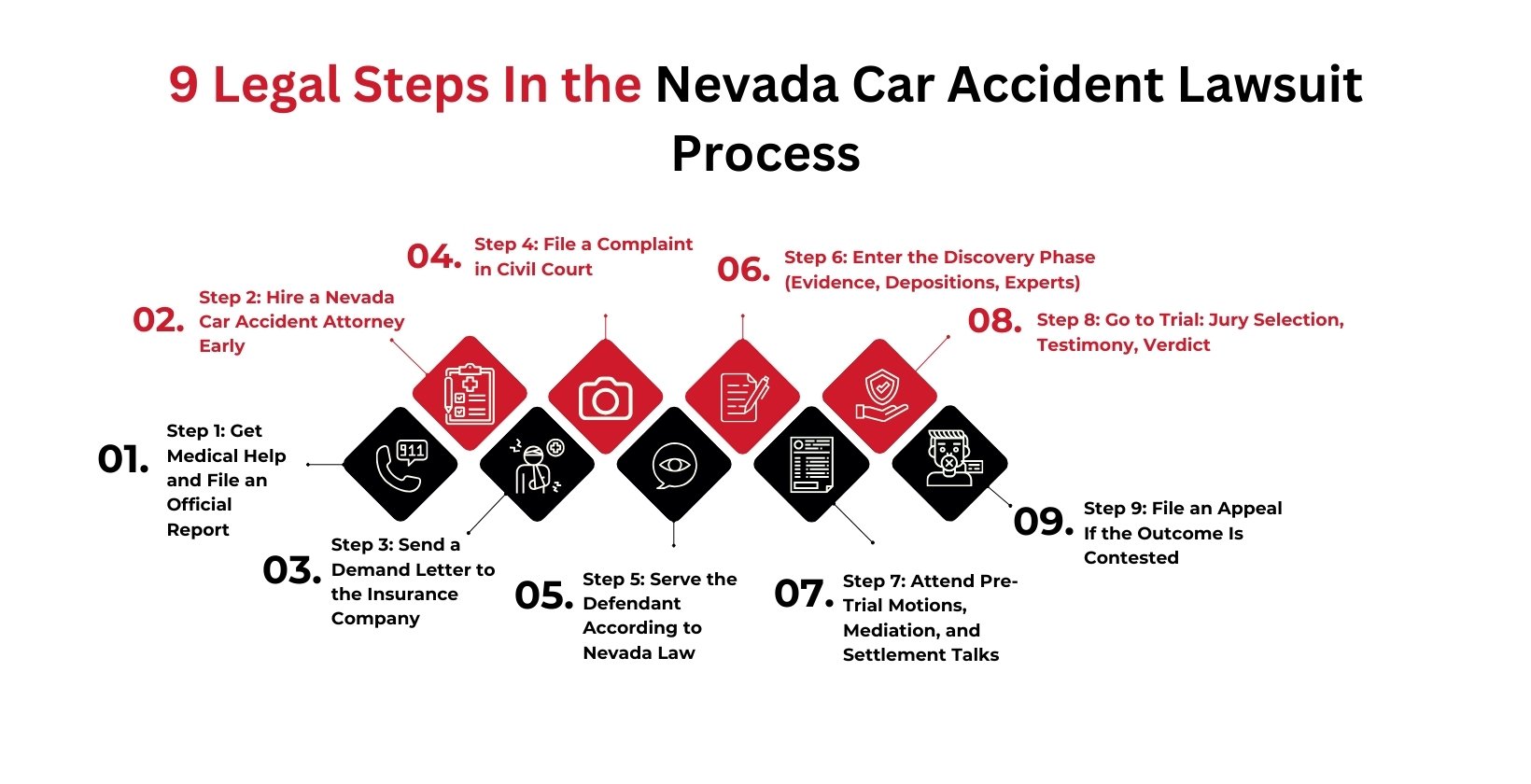
Whether you’re just initiating a claim or already facing insurance delays, the following 9 legal steps will show you how the car accident lawsuit timeline works in Nevada and what you need to do at each stage.
Step 1: Get Medical Help and File an Official Report
The initial step in any car crash case is not legal but medical. Immediate treatment not only ensures your well-being but also creates vital documentation for your case. Treatment delays can lead insurers to contend that your injuries are either unrelated to the accident or not severe enough to justify compensation.
Nevada car accident law requires you to file a police report to DMV within 24 hours if the crash results in injury, death, or more than $750 in property damage. That report becomes a key piece of evidence in any future bodily injury claim, especially if fault is disputed.
In short, to protect your health and your legal rights:
- Get emergency care immediately, and don’t assume your injuries are minor.
- Request a police report and get the report number before leaving the scene.
- Document everything with videos and photos of the vehicles, visible injuries, road conditions, and witness contact info.
Step 2: Hire a Nevada Car Accident Attorney Early
Dealing with pressuring insurance companies and tracking legal deadlines is exhausting when you’re also recovering from injuries. This is why knowing when to get a lawyer after a car accident is crucial. The answer is simple: as early as possible. Early legal involvement preserves evidence, prevents procedural mistakes, and protects you from saying something to adjusters that could weaken your case.
To help your Nevada car accident lawyer fully understand your situation, bring the following to your initial consultation:
- Police report or its event number
- Photos and videos from the accident scene
- Medical records and bills from your treatment
- Contact information for the other driver and any witnesses
- Any correspondence from the insurance company
For trusted representation, you can contact Ace Law Group. Our experienced car accident attorneys are available to review your case, explain your legal options, and start protecting your rights immediately. Call us at 702-333-4223.
| Process | What It Covers | Deadline |
|---|---|---|
| Lawsuit | Filing in the Nevada civil court | 2 years for injury, 3 years for property damage |
| Insurance Claim | Reporting to your own or another driver’s insurer | “Prompt notice” (varies by policy, often days or weeks) |
Step 3: Send a Demand Letter to the Insurance Company
Before filing an accident suit, your attorney typically begins by sending a car accident pre-litigation demand letter. This formal notice, addressed to the at-fault driver’s insurance company, outlines your injuries, damages, and the legal basis for holding their policyholder responsible.
This demand letter serves 2 key purposes: it opens negotiations for a potential settlement and creates a documented record, indicating that you offered the insurer an opportunity to resolve the claim without litigation.
Submitting a clear, well-supported demand letter often results in an out-of-court resolution. However, if the insurer delays, denies the claim, or offers an inadequate amount, this initial step establishes the groundwork for moving into formal litigation.
Step 4: File a Complaint in Civil Court
If the insurance company refuses to settle fairly, it may become necessary to formally file a car accident lawsuit. This is the moment your attorney drafts and files a formal complaint with the appropriate civil court in Nevada. This document is a public record that officially starts the litigation process.
Under the Nevada Rules of Civil Procedure, your complaint must include specific sections:
| Section | Description |
|---|---|
| Caption | Lists the court, case number, and party names |
| Parties | Identifies the plaintiff(s) and defendant(s) involved |
| Jurisdiction | Explains why the court has the authority to hear the case |
| Causes of Action | Lists legal claims (e.g., negligence, reckless driving) and supporting facts |
| Prayer for Relief | States what compensation you’re asking the court to award |
Step 5: Serve the Defendant According to Nevada Law
Once you submit the complaint, the defendant must be formally notified that a court case has been initiated against them. This is known as service of process, which gives the defendant legal notice so they have an opportunity to respond, typically within 20 days.
Serving legal documents in Nevada must follow specific procedures outlined in Rule 4 of the Nevada Rules of Civil Procedure.
Common service methods under Nevada law include:
- Personal Service: The most common method, where a process server personally delivers the summons and complaint to the defendant.
- Substituted Service: If personal service is not possible, the documents may be left with a person of suitable age and discretion at the defendant’s residence or place of business.
- Certified Mail: Service can sometimes be completed via certified mail, requiring a return receipt signed by the defendant.
If service is done incorrectly, the court can dismiss the case, no matter how strong your claim is.
Step 6: Enter the Discovery Phase (Evidence, Depositions, Experts)
The discovery phase is the longest and most intensive process in a litigation, where both sides exchange evidence to build their respective car accident cases. During this, your attorney uses formal tools to request and examine information, ensuring nothing is missed or concealed by the defense.
Here is a breakdown of the key tools used during the discovery process in car accident lawsuits:
| Discovery Tool | What It Does | Role in Auto Lawsuits |
|---|---|---|
| Interrogatories | Written questions sent to the other party | Clarify facts, injuries, and versions of the crash |
| Document Requests | Demand for records, photos, bills, reports | Builds proof of damages, fault, and medical history |
| Depositions | Sworn testimony taken outside of court | Lock in witness accounts, challenge experts, expose contradictions |
Your lawyer may also bring in expert witnesses to strengthen your standing, such as accident reconstructionists, medical specialists, and financial loss experts.
Step 7: Attend Pre-Trial Motions, Mediation, and Settlement Talks
This stage serves as a bridge between the discovery stage and the courtroom itself, usually opening opportunities for resolutions. Your attorney may file pre-trial motions, which are formal requests to the judge to make a ruling on a specific legal issue before the trial starts.
This is also the time for alternative dispute resolution, such as:
- Mediation: A neutral third party, the mediator, facilitates communication and helps both sides reach a voluntary, non-binding settlement. This is the most common resolution method.
- Arbitration: Similar to mediation, but the arbitrator makes a binding decision on the case. It is an alternative to a traditional trial.
- Direct Negotiation: Your attorney continues to negotiate with the defendant’s counsel or the insurance company to try and reach a settlement agreement.
Car accident statistics indicate that nearly 90% of all traffic accident lawsuits settle at the pre-trial stage through settlements without ever going to trial.
Step 8: Go to Trial: Jury Selection, Testimony, Verdict
If settlement efforts fail, the case proceeds to the courtroom. The trial process in a car crash lawsuit is the most formal and structured stage, with strict rules of evidence and court procedure. A Nevada car accident trial generally follows this order:
- Jury selection (voir dire): Your attorney and the opposing counsel question potential jurors to ensure a fair panel is chosen.
- Opening Statements: Your attorney presents an overview of the case, outlining the facts they intend to prove.
- Presentation of Evidence: Your attorney presents evidence and calls witnesses to testify, including you, medical professionals, and experts. The opposing side has the opportunity to cross-examine each witness.
- Closing Arguments: Both sides summarize the evidence and argue why the jury should rule in their favor.
- Jury Deliberation & Verdict: The jury retires to deliberate and deliver a verdict, determining fault and the amount of damages to be awarded.
A trial can be a very long process, lasting anywhere from a few days to several weeks, depending on the complexity of the case.
Step 9: File an Appeal If the Outcome Is Contested
If the losing party disagrees with the verdict in a car accident trial, they can file an appeal. An appeal is not a new trial; instead, the Nevada appellate court examines the case record for any legal errors that might have influenced the original outcome. The steps in the appeal process typically involve:
- File a Notice of Appeal: This must be done within a strict legal deadline after the final judgment is entered.
- Submit Legal Briefs: Both sides file written legal arguments explaining their positions to the appellate court.
- Oral Arguments: A short hearing where attorneys argue their case before a panel of judges.
- Decision: The appellate court issues a written opinion that can either affirm the trial court’s decision, reverse it, or remand the case back to the trial court for a new trial.
Valid grounds for an appeal might include a judge improperly admitting or excluding key evidence or giving the jury incorrect instructions.
What Compensation Can You Claim in a Nevada Car Accident Lawsuit?
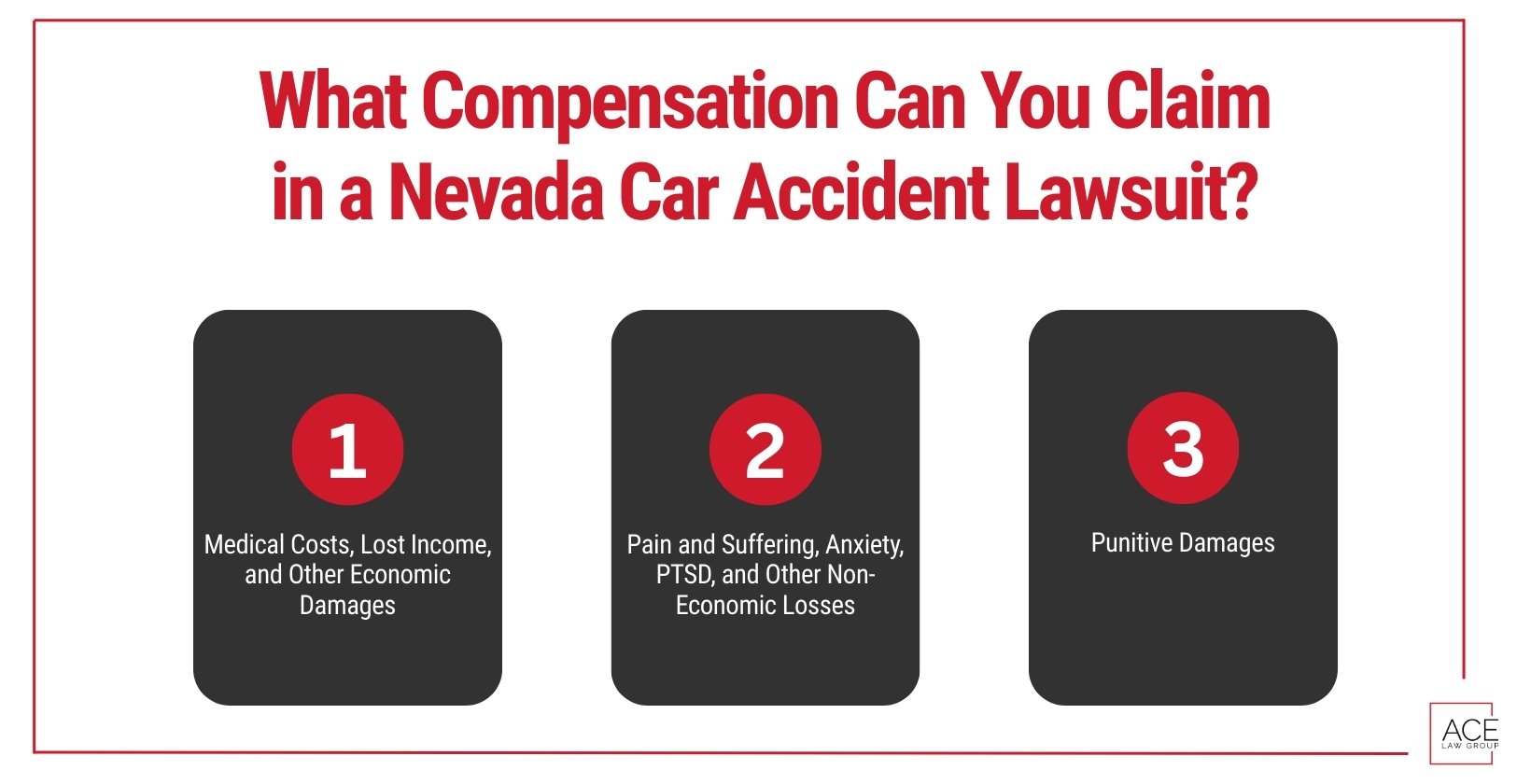
Victims of serious traffic crashes are entitled to recover different categories of car accident damages under Nevada law. These include direct financial losses, compensation for emotional harm, and, in rare cases, damages meant to punish reckless conduct.
Let’s break these down into the following categories:
Medical Costs, Lost Income, and Other Economic Damages
Economic damages in a car accident cover financial losses tied directly to the crash. Tangible financial losses include:
- Hospital bills and emergency care
- Ongoing treatment, therapy, or rehabilitation
- Lost income and reduced earning capacity
- Vehicle or property damage
Documentation such as medical records, pay stubs, and repair invoices helps prove these claims.
Pain and Suffering, Anxiety, PTSD, and Other Non-Economic Losses
Non-economic damages address the human side of injury. Nevada courts often rely on medical testimony and personal accounts to determine fair amounts. A pain and suffering car accident claim may recover intangible damages such as:
- Physical pain and permanent discomfort
- Emotional distress or anxiety
- Post-traumatic stress disorder (PTSD)
- Loss of enjoyment of daily life
When Do Nevada Courts Award Punitive Damages?
Nevada courts award punitive damages when the defendant acted with gross negligence, such as reckless driving or DUI, intentionally injuring others. Beyond ordinary damages, punitive damages in a car accident case are rare and not meant to compensate the victim. Instead, they are designed to punish the at-fault party for particularly egregious behavior and to deter others from similar conduct.
When Does a Nevada Car Accident Escalate Into a Lawsuit?
Many car crash claims resolve through insurance negotiation or through alternative methods like mediation. However, when settlement talks stall, the question of settlement vs trial in a car accident case becomes critical. Certain disputes or delays push cases into court, and knowing when a claim escalates helps victims act before deadlines expire.
Key Reasons a Car Accident Claim Becomes a Lawsuit
Common triggers that turn a claim into a lawsuit include:
- Disputed liability when the at-fault driver shifts blame to you
- Severe or permanent injuries requiring long-term and expensive care
- Low settlement offers that don’t cover all types of losses
- Uncooperative insurers who deny or delay valid claims
Signs That a Settlement Alone May Not Be Enough
Victims should consider filing a civil lawsuit when:
- You receive an unfair initial offer that does not cover all losses
- The insurance company denies liability for the crash
- Injuries worsen or require future treatment
- Adjusters use bad-faith tactics to pressure acceptance or delay settlement
- Fault is shifted unfairly under Nevada’s comparative negligence law
If you recognize any of these signs, don’t wait too long. Responding early is the only way to preserve your legal rights.
Legal Deadline to File: Nevada’s Statute of Limitations
Under NRS 11.190, auto accident victims have 2 years from the crash date to file a personal injury lawsuit and 3 years for property damage claims. Missing the critical statute of limitations in car accident claims bars recovery permanently. Very limited exceptions exist, but timely action supported by legal guidance avoids the risk of a missed deadline.
How Long Does the Car Accident Lawsuit Process Take in Nevada?
The time a car accident lawsuit takes to resolve varies significantly from case to case and depends on the complexity of the case and the legal phases it must pass through.
In Nevada, a typical car accident lawsuit generally takes between 12 and 24 months to resolve, from the initial filing to the final resolution.
The average estimated timeline for a lawsuit in Nevada looks something like this:
Timeline From Filing to Resolution
| Stage | Estimated Duration |
|---|---|
| Filing and service | 1–2 months |
| Discovery phase | 6–12 months (often the longest part of the process) |
| Pre-trial motions and mediation | 2–4 months |
| Trial process | Several days to weeks (depends on the case’s complexity) |
Factors That Delay or Expedite the Lawsuit
| What delays a car accident lawsuit | What can expedite the process |
|---|---|
|
|
Differences Between Fast-Track Settlements and Full Trials
| Aspect | Fast-Track Settlement | Full Trial |
|---|---|---|
| Timeline | Resolution within weeks to a few months | Resolution often taking a year or more |
| Complexity | Informal negotiation; less complex | Formal court procedures; highly complex |
| Cost | Lower legal fees and expenses | Higher costs due to court fees, expert witnesses, and extended legal work |
| Outcome | Greater control over the outcome | Outcome decided by a jury or judge, often less predictable |
How Legal Representation Strengthens Your Nevada Car Accident Lawsuit
Handling a car accident lawsuit in Nevada without legal counsel is risky. Insurers take advantage of unrepresented victims, and small filing mistakes can cost you your entire case. Experienced representation protects your claim from the very beginning.
How Attorneys Handle Evidence, Experts, and Legal Deadlines?
An attorney manages the entire lawsuit process for you. They understand the specific procedures, rules, and deadlines that govern personal injury cases in Nevada. Your lawyer handles the complex tasks on your behalf, ensuring your case is built on a strong, factual foundation. This includes:
- Preserving medical records and accident reports
- Subpoenaing video, phone, or black box data before it’s lost
- Retaining medical and economic experts to prove damages
- Tracking all filing deadlines under Nevada’s statute of limitations
Why Representation Can Affect Settlement Amounts
Insurers are often willing to settle fairly when a trial-ready lawyer is involved. Studies and legal data consistently show that claimants with an attorney receive 3.5 times higher settlement offers than those who represent themselves.
Here’s why legal representation can impact how much you recover:
- Fear of Trial: Insurance companies know we are prepared to fight for a fair verdict in court.
- Stronger Documentation: A solid case with comprehensive evidence makes it difficult for the insurer to dispute the claim.
- Legal Leverage: Lawyers use Nevada’s legal framework to the claimant’s advantage, forcing the insurer to negotiate in good faith.
Mistakes That Can Harm Your Nevada Car Accident Case
Proceeding with a car accident lawsuit can be challenging, where even minor errors can severely jeopardize your case. Understanding pitfalls to avoid is as crucial as knowing the correct steps to take.
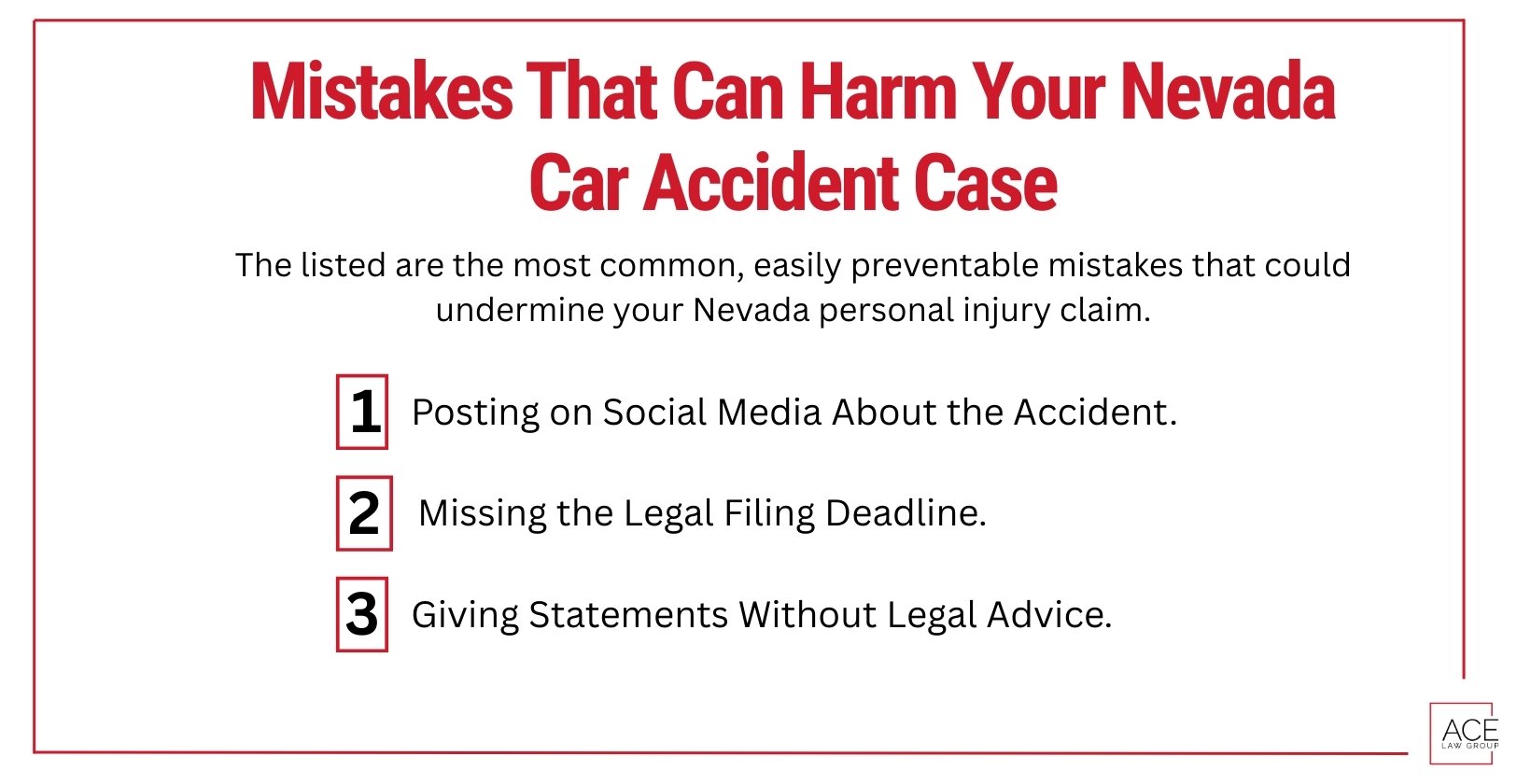
The listed are the most common, easily preventable mistakes that could undermine your Nevada personal injury claim.
- Posting on Social Media About the Accident: Insurers monitor posts for evidence to dispute injuries. Even casual posts, such as photos or videos of yourself after the incident (vacations, workouts, social outings) or updates on your recovery, can be used in court to reduce compensation.
- Missing the Legal Filing Deadline: Nevada law gives you a limited time to file a claim, and waiting till it expires almost always results in claim dismissal.
- Giving Statements Without Legal Advice: Insurance adjusters often ask for recorded statements and may later misinterpret your remarks as damaging admissions. Always speak with a Nevada car accident attorney before making any on-the-record statements.
How Nevada’s Comparative Negligence Law Impacts Your Lawsuit?
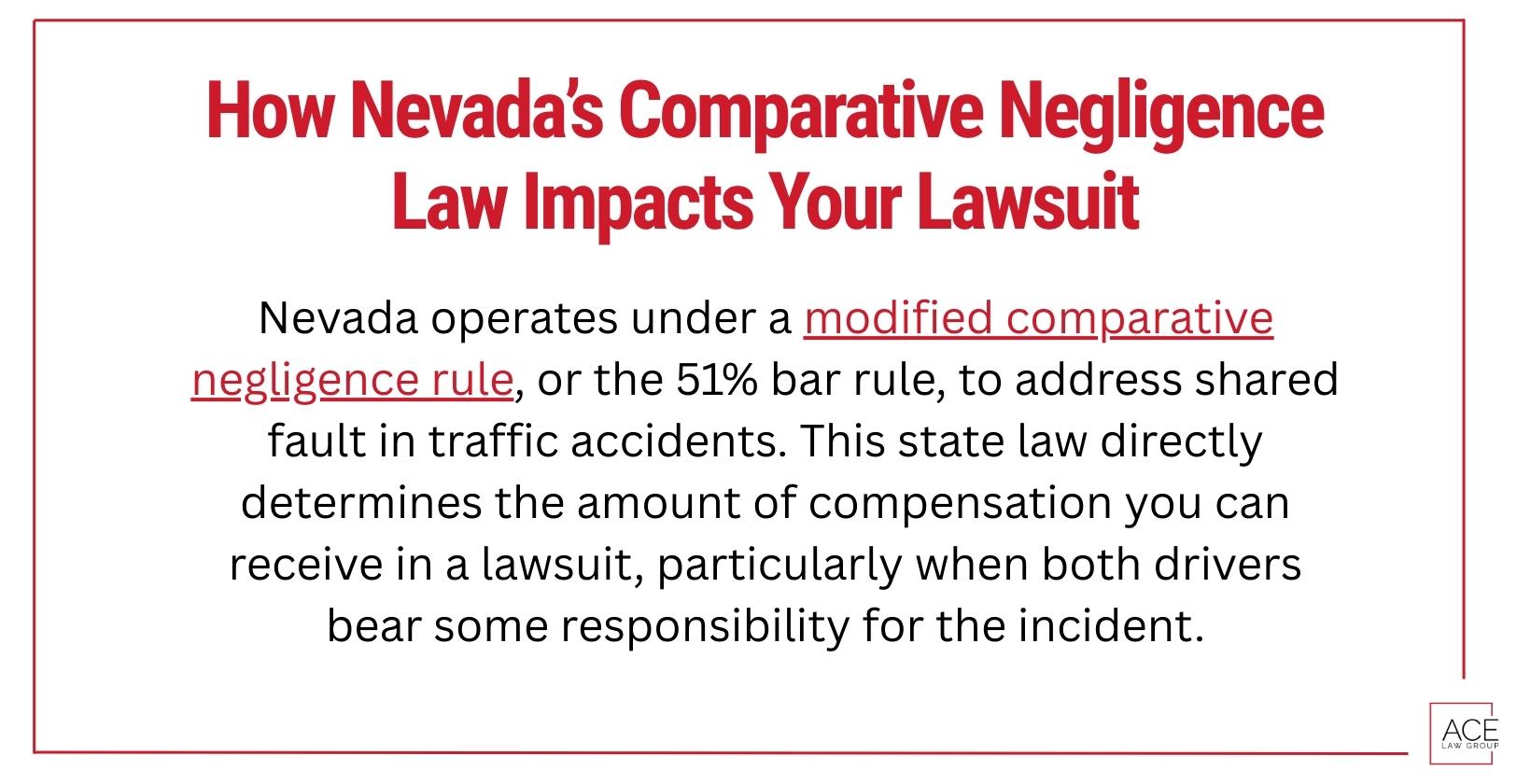
Nevada operates under a modified comparative negligence rule, or the 51% bar rule, to address shared fault in traffic accidents. This state law directly determines the amount of compensation you can receive in a lawsuit, particularly when both drivers bear some responsibility for the incident.
How Percentages of Fault Affect Payouts?
If you are found to be 50% or less at fault, your total compensation will be reduced by your percentage of blame. For example, if a jury awards you $100,000 in damages but finds you were 20% at fault, your final payout will be reduced to $80,000.
Who Holds the Burden of Proof in Nevada Car Accident Cases?
The burden of proof in accident lawsuits falls on the plaintiff (the injured party). The victim and their attorney must prove that the other driver was negligent and that their negligence resulted in damage. Victims must prove that it is “more likely than not” (a standard known as a preponderance of the evidence) that their version of events is true.
What Happens If You’re Partially at Fault?
If you are found to be partially at fault for the accident, you can still recover damages as long as your percentage of fault is 50% or less. If a court or a jury determines that you are 51% or more at fault, you are legally barred from recovering any settlement, even if the other driver was also negligent.
Car Accident Resources
How to Get Access to a Car Accident Report in Las Vegas?
Car Accident Determining Fault By Location of Damage
Recovering Lost Wages After a Car Accident in Las Vegas
Are Car Accident Insurance Settlements Taxable?
How to Settle a Car Accident Claim Without a Lawyer?
Causes of Car Accidents in Las Vegas
What Happens If You Total a Leased Car in Nevada?
FAQs About the Car Accident Lawsuit Process in Nevada
What if the insurance company denies my car accident claim?
If the insurance company denies your car accident claim, your attorney can review the denial reasons and determine if it was made in bad faith. If so, they can negotiate with the insurer and, if necessary, file a lawsuit to pursue the compensation you deserve.
What if the other driver doesn't have insurance?
If the other driver doesn’t have insurance, you have an option to file a claim against your own uninsured or underinsured motorist (UIM) coverage, which is designed for this exact situation. You may also file a lawsuit directly against the at-fault driver to collect damages from their personal assets.
Can I sue for emotional distress after a car accident in Nevada?
Yes, you can sue for emotional distress after a car accident in Nevada. Emotional distress falls under the category of non-economic damages, which are meant to compensate you for the subjective, non-financial harm you have suffered. Your attorney can help you document and prove your emotional distress with medical records and expert testimony.
How is fault proven in a Nevada car accident lawsuit?
Fault is proven in a Nevada car accident lawsuit by gathering and presenting evidence of the at-fault driver’s negligence. This evidence includes police reports, witness statements, photos of the accident scene, medical records, and expert testimony. Your attorney uses this information to hold the negligent driver responsible for the accident and resulting injuries.
What should I bring to my first legal consultation?
To your first legal consultation, you should bring every document related to your case. This includes the police report, photos or videos from the scene, all medical bills and records, and any correspondence you’ve had with the insurance companies. This information will help your lawyer get a quick and clear understanding of your case.
Can I still sue if my injuries appeared weeks after the accident?
Yes, you can still sue if your injuries appeared weeks after the accident. Many serious injuries, like whiplash or concussions, have delayed symptoms. The key is to seek medical attention as soon as you notice any pain or symptoms and inform your doctor that they are related to the recent car accident. This establishes a clear medical link.
What happens if the defendant ignores the lawsuit?
If the defendant ignores the lawsuit and fails to respond within the legal timeframe, your attorney can file for a default judgment. This means the court will likely rule in your favor without a trial, as the defendant has failed to contest the allegations.
Is it difficult to win a car accident lawsuit in Nevada?
Winning a car accident lawsuit in Nevada depends on the specifics of the case. A strong case filed within the statute of limitations with clear evidence of negligence, serious injuries, and proper legal representation has a high chance of success.
Key Takeaways Before Filing a Car Accident Lawsuit in Nevada
The suing process after a crash in Nevada involves strict legal stages: demand, complaint, discovery, pre-trial, and sometimes trial or appeal. Each step has rigid rules, deadlines, and strategies that directly impact your recovery.
Now that you know the timeline and pitfalls to avoid, you’re no longer in the dark about what to expect. With the help of a trusted Nevada car accident attorney, you can protect your rights, navigate court procedures, and pursue the full compensation you deserve. Contact us.