
The Las Vegas Strip hosts tens of millions of visitors every year. Major hotels don’t just rely on hospitality to manage that volume; they rely on aggressive litigation management. Whether it is a wet casino floor, a crumbling pool deck, or an unlit stairwell, property hazards are a reality. When an injury occurs, the hotel’s response is immediate, coordinated, and not designed to benefit you. Hotel staff draft incident reports to favor the business. The property’s risk team reviews surveillance footage privately. Insurance adjusters are on alert within minutes.
You were hurt on someone else’s property. That property’s legal team is already working against your claim. Patrick W. Kang, founder of Ace Law Group and our lead Las Vegas hotel injury lawyer, has seen exactly how that process works from the inside. Here is what you need to do before the evidence disappears.
Key Takeaways
- Report the injury to hotel management before you leave the property. Get a written incident report. Write down the name of the person who took it.
- Get medical care the same day. Adrenaline masks serious injuries, including concussions, internal bleeding, and hairline fractures.
- Photograph the hazard, your injuries, your clothing, and your shoes before anything is cleaned up or repaired.
- Collect witness contact information immediately. Las Vegas draws 41.7 million visitors a year, and witnesses board flights within hours.
- Preserve your clothing and shoes in separate bags, unwashed. They are physical evidence.
- Do not give recorded statements to the hotel’s insurance company. Let your attorney handle all insurer communication.
- Send a written surveillance footage preservation demand the same day. Most Las Vegas hotel systems overwrite footage within 24 to 72 hours.
- File within two years. Nevada’s statute of limitations for personal injury claims (NRS 11.190(4)(e)) gives you exactly two years from the date of injury to file a lawsuit. The evidence window closes within hours of the incident.
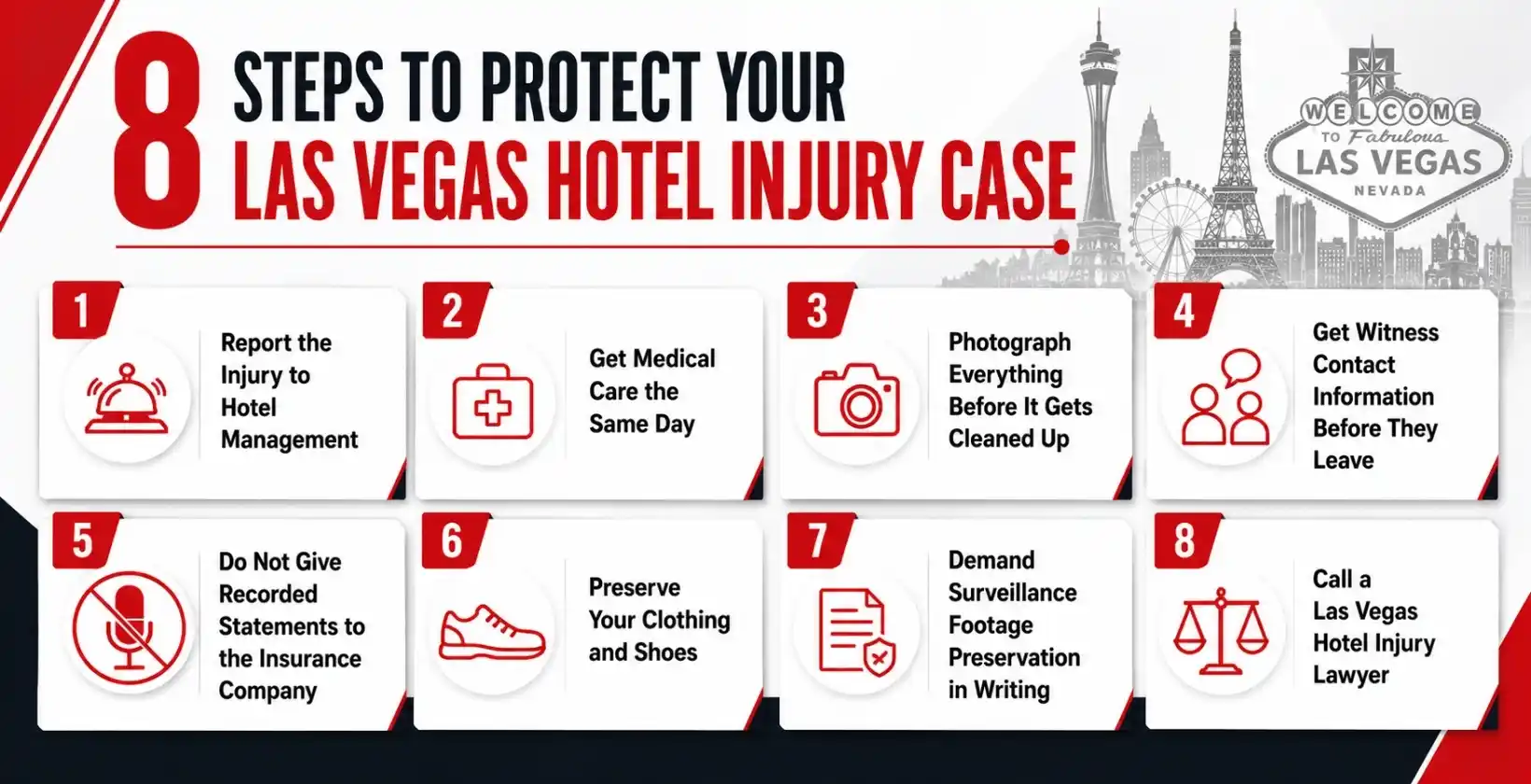
8 Steps to Protect Your Las Vegas Hotel Injury Case
Every hour after a hotel injury shifts the balance further in the property’s favor. Immediately following an accident at a Las Vegas hotel, casino, resort, or commercial property, follow these steps to protect your claim.
If your injury involved a slip, trip, or fall, also review our guide on what to do after a slip and fall accident in Las Vegas.
Step 1: Report the Injury to Hotel Management
Tell the front desk, floor supervisor, or duty manager what happened before you leave the property. Request a written incident report. Get the full name and job title of the person who takes it. Ask for a copy.
Hotel staff document incidents in language that protects the property. Words like “guest reported slipping” instead of “standing water on tile with no warning sign” are not accidental. Your presence while the report is written changes what ends up on paper. If management refuses to create a report, document the refusal on your phone: the date, the time, and the name of the person who said no. That refusal is evidence.
Step 2: Get Medical Care the Same Day
Go to an emergency room or urgent care clinic before you do anything else, even if you feel fine. The two closest trauma centers to the Strip are University Medical Center (UMC) at 1800 W. Charleston Blvd and Sunrise Hospital & Medical Center at 3186 S. Maryland Pkwy.
Adrenaline can mask pain. Concussion symptoms surface hours later. Internal bleeding is invisible at the scene. Hairline fractures do not announce themselves until the swelling sets in. The gap between your injury and your first doctor visit is the single most exploited weakness in Las Vegas hotel injury claims.
Step 3: Photograph Everything Before It Gets Cleaned Up
Take photos immediately, before anyone cleans up. Shoot the exact hazard: a wet floor with no warning cone, broken tile, an unlit stairwell, or a cracked pool deck. Get wide shots showing the surrounding area, then close-ups of the condition itself.
Las Vegas hotels run cleaning crews 24 hours a day. The hazard that caused your fall can be gone before you make it back to your room. Photograph your injuries, your clothing, and your footwear. Every item matters in a premises liability claim. Your on-scene photos, combined with the incident report, are the core of the evidence you need to win a slip-and-fall case in Las Vegas.
Step 4: Get Witness Contact Information Before They Leave
Names, phone numbers, and email addresses. Get them before anyone walks away.
Las Vegas welcomes an average of 40 million visitors a year. The person who watched you fall on a casino floor or hotel pool deck may be on a flight home by midnight. Once they leave, they are unreachable. Their account of the hazard, the absence of warning signs, and what they witnessed is gone with them. If a hotel employee witnessed the incident, get their name and employee ID. Staff can be located through discovery. Civilian witnesses cannot.
Step 5: Do Not Give Recorded Statements to the Insurance Company
The hotel’s insurer will call fast. Do not give a recorded statement. Adjusters handling Las Vegas hotel accident claims are trained to ask questions that produce answers useful to the defense. “Were you wearing high heels?” “Had you consumed alcohol at the casino?” “Did you see any warning signs near the area?” These are not courtesy questions. Every answer becomes part of the claim file used to reduce or deny your hotel injury compensation. Every communication with the hotel’s insurance company goes through your attorney.
Step 6: Preserve Your Clothing and Shoes
Do not wash what you were wearing. Do not discard it. Bag your clothing and shoes separately and store them untouched.
Your shoes are physical evidence of whether the hotel surface created an unreasonable fall risk or whether the defense can argue your footwear was inadequate for the conditions. Your clothing carries physical residue from whatever substance was on the floor. These items can be tested and examined by experts retained in your hotel negligence case. Once washed, that evidence is gone permanently.
Step 7: Demand Surveillance Footage Preservation in Writing
Las Vegas hotel and casino camera systems cover every casino floor, corridor, pool deck, elevator bank, and parking structure. That footage shows what the floor condition looked like before you fell, whether warning signs were present, how long the hazard existed, and whether any hotel staff member walked past it without addressing it.
Most systems overwrite in a loop every 24 to 72 hours. A verbal request to preserve footage accomplishes nothing. A written preservation demand delivered to the hotel’s general manager and legal department creates a record of the request. A hotel that destroys footage after receiving that written demand faces a spoliation of evidence finding in Nevada courts, which allows a jury to draw an adverse inference against the property. Your attorney sends that letter the same day you call. Every hour without it narrows the window.
Step 8: Call a Las Vegas Hotel Injury Lawyer
Contact our hotel injury lawyers immediately after you are treated. Whether it was a slip and fall, a pool deck accident, a guest room injury, or an assault in a parking structure, we send written preservation demands to the hotel the same day you call, targeting surveillance footage, incident reports, maintenance logs, and housekeeping records. We take over all communication with the insurer. We handle the hotel negligence investigation from day one.
Surveillance footage disappears in 72 hours. Witnesses fly home. Call Ace Law Group at (702) 333-4223 for a free consultation. There is no fee unless we win.
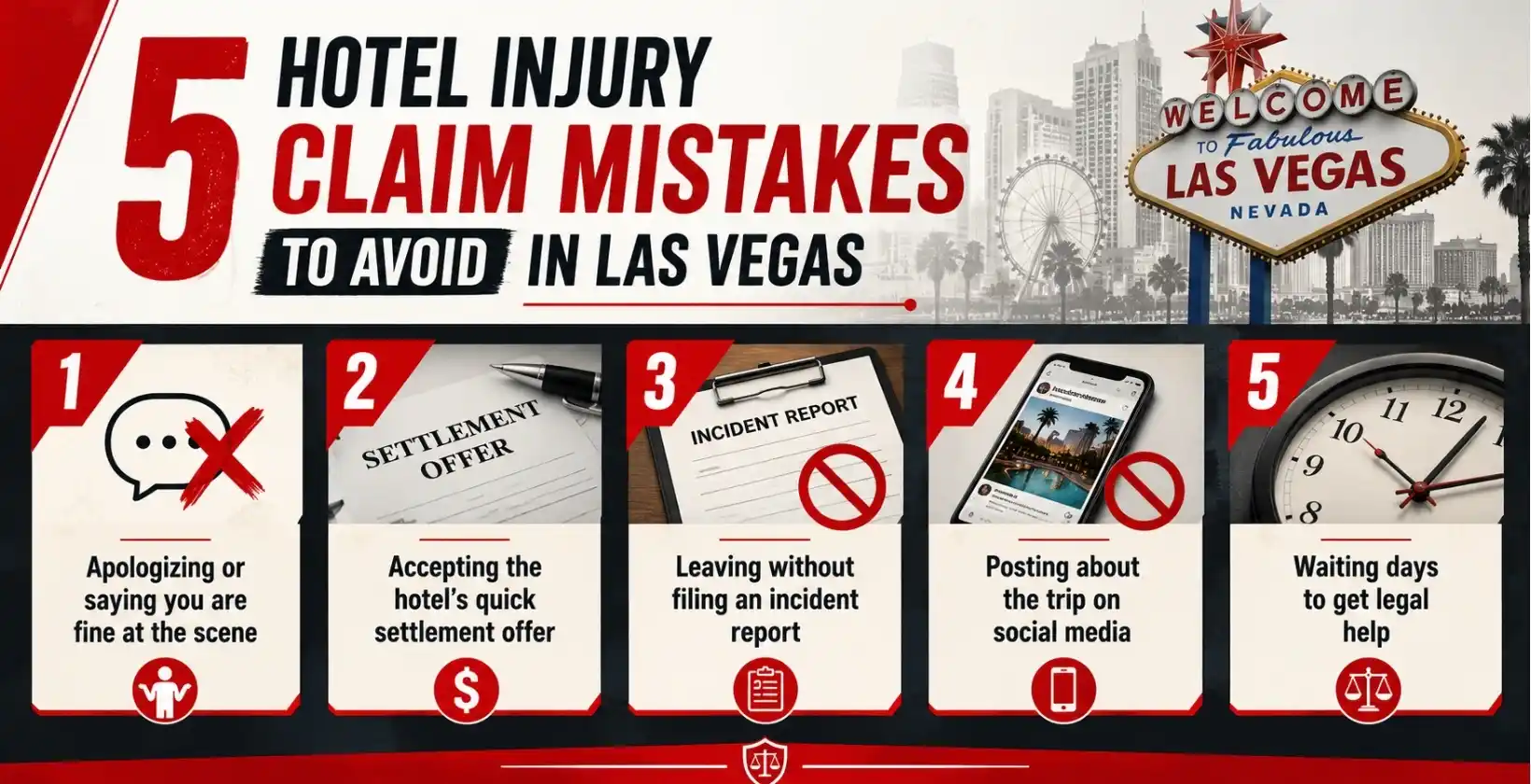
5 Hotel Injury Claim Mistakes to Avoid in Las Vegas
One mistake in the hours after a hotel accident can hand the insurer the evidence they need to deny your claim.
- Apologizing or saying you are fine at the scene. It is a reflex. Those words get written into the incident report verbatim and cited against you. Do not say it.
- Accepting the hotel’s quick settlement offer. It comes with a release form that permanently waives your right to pursue further compensation. Never sign before you have seen a doctor.
- Leaving without filing an incident report. No report means no record of the injury that happened on the property. The hotel will deny knowledge of the incident, and you will have nothing to contradict them.
- Posting about the trip on social media. A photograph of you at a show or restaurant the day after your hotel accident becomes Exhibit A in their argument that you are not seriously hurt. Post nothing.
- Waiting days to get legal help. Surveillance footage overwrites in 24 to 72 hours. Every day without a preservation demand in the hotel’s hands is a day that evidence is gone.
Can You Sue a Las Vegas Hotel for Your Injury?
Most hotel guests hurt on Las Vegas property have a viable premises liability claim under Nevada law. As a paying guest, you are classified as a business invitee, the highest level of legal protection Nevada extends to any visitor on private property.
To win, you must prove 3 things: the hotel owed you a duty of care, they breached that duty by allowing a hazardous condition to exist, and that breach caused your injuries.
Nevada courts recognize 2 theories of breach. Actual notice means the hotel knew about the hazard and failed to act. Constructive notice means the hazard existed long enough that routine inspection would have found it. Both are equally actionable. The length of time the condition existed is the central argument, which is why surveillance footage covering the period before your fall carries as much legal weight as footage of the fall itself.
Out-of-state visitors have the same legal rights. Nevada law governs the claim. Your location is not a barrier.
Still unsure whether you have a valid claim? A legal consultation will give you a clear answer with no obligation. Talk to a Las Vegas premises liability lawyer or schedule a free case review.
What Kinds of Hazards Cause Hotel Injuries in Las Vegas?
Las Vegas hotel properties concentrate hazard types that most cities never encounter at this scale. Each one carries a specific negligence theory under premises liability. Experienced Las Vegas hotel accident lawyers identify the liable party and the applicable standard from the conditions alone.
- Casino Floors and Gaming Area Injuries: Casino injuries on polished stone and marble tile are among the most common on the Strip. Unaddressed beverage spills during peak hours, dim lighting, and uneven carpet-to-hard-floor transitions at gaming pit entrances produce the most documented casino floor slip and fall incidents in Las Vegas.
- Hotel Pool Decks and Spa Areas: Hotel pool accidents occur when surfaces lack the non-slip coating required by Nevada safety codes. Pool injury risks include standing water from inadequate drainage, missing floor mats at entry points, and delayed hazard correction during off-peak hours. Spa injuries involve additional hazards, including chemical burns, equipment failure, and scalding water from improperly maintained hot tubs.
- Corridors, Lobbies, and Stairwells: Mopped floors without warning signs and uneven thresholds at elevator banks are the most common corridor hazards. Structural risks include stairwells with worn treads, poor lighting, missing handrails, and torn carpeting in high-traffic areas.
- Elevators and Escalator Accidents: Uneven elevator landings create tripping hazards, and escalators with dangerous step gaps or worn treads require strict maintenance schedules. Sensor failures cause doors to close prematurely on guests. These systems are subject to Nevada’s mandatory inspection requirements.
- Parking Structures, Valet Areas, and Negligent Security: Poorly lit lanes and deteriorating pavement, including cracks and potholes, are frequent hazards. These cases often involve layered liability between the hotel owner and third-party parking contractors. Hotels that fail to provide adequate security in parking structures can also be held liable when that failure results in criminal acts against guests.
- Hotel Guest Rooms: Bathroom tiles without non-slip mats and broken furniture that collapse during normal use are documented fall hazards in guest rooms. Other risks include balcony railings that fail structural standards and mold exposure from poor ventilation or water intrusion.
- Restaurants and Entertainment Venues: Spilled liquids and food debris during service hours, poorly lit stairways in multilevel venues, and uneven pavers or broken decking on outdoor patios each carry a distinct premises liability theory under Nevada law.
- Bed Bug Infestations: Nevada law requires hotels to provide clean bedding and sanitary guest rooms. Bedbug bites cause painful welts, itching, scarring, and, in severe cases, lasting psychological distress, including anxiety and sleep disorders. Guests can also recover the cost of replacing infested luggage, clothing, and personal belongings. Hotels that knew or should have known about an infestation and continued renting the room face liability for negligence. Bed bug complaints have been reported at numerous Strip properties in recent years, and multiple Las Vegas hotels currently face active lawsuits from bitten guests.
Large Strip operators like Caesars Palace, Wynn and Encore Resort, the Cosmopolitan, Bellagio, Aria, and Planet Hollywood maintain large in-house legal teams and control the surveillance systems that document every inch of their properties. The attorney you hire on day one determines whether that evidence still exists.
The Cosmopolitan of Las Vegas’s risk management team responded immediately: fast, coordinated, and with the property’s interests as the only priority. Our client slipped on a spilled drink and broken glass at the Chandelier Bar. The fall produced complex regional pain syndrome, a chronic and debilitating condition that permanently altered the course of her life.
Ace Law Group preserved the surveillance footage before it was overwritten, built the liability record against one of the most litigated properties on the Strip, and took the case to a Clark County District Court jury. The verdict came back at $15 million.
Large hotels count on guests not having the right lawyer on day one. This case is what happens when they do.
Prior results do not guarantee a similar outcome. Every case is unique, and the value of any claim depends on its specific facts.
Injured at one of these Las Vegas hotels? Ace Law Group represents guests hurt on casino floors, pool decks, hotel corridors, and resort parking structures. Call (702) 333-4223 or schedule a free case review.
Can Out-of-State Visitors File a Hotel Injury Claim in Las Vegas?
Yes. You do not need to be a Nevada resident to sue a Las Vegas hotel. Your case would be filed in Clark County under Nevada law, regardless of where you live.
Most cases settle without trial, so you likely will not need to return to Las Vegas. Depositions and meetings can be handled remotely. You would only need to appear in person if your case goes before a jury.
The biggest challenge for tourists is evidence preservation. Surveillance footage overwrites within days. Witnesses leave town. Medical records are split between Las Vegas and your home state. Contact a Las Vegas hotel injury attorney before you fly home to secure evidence while it still exists.
How Serious Are Las Vegas Hotel Injuries?
A hotel fall is not a minor incident you shake off. Depending on how you land and what surface you hit, injuries range from soft tissue damage and sprains to fractured hips, herniated discs, spinal cord injuries, and traumatic brain injuries.
Falls are the leading cause of injury death for adults 65 and older in the United States, according to the CDC. Hip fractures require surgery in most cases. Treatment costs, including hospitalization, surgery, and rehabilitation, routinely run into six figures. Spinal cord and traumatic brain injuries sustained in hotel falls carry even higher lifetime care costs, often exceeding seven figures when long-term rehabilitation and lost earning capacity are factored in.
In the most serious cases, a hotel injury becomes a wrongful death claim when the injuries prove fatal.
Las Vegas Hotel Injury Laws You Need to Know?
Nevada statutes and legal doctrines directly determine whether you can file a claim and the total compensation you can recover. These laws apply to every hotel and casino on the Las Vegas Strip.
- The Two-Year Filing Deadline: Nevada’s statute of limitations for hotel injury claims gives you exactly 2 years from the date of injury to file. Miss it, and the court dismisses your case permanently. Hotel injury cases filed in the final weeks before the deadline are weaker cases.
- Hotel Premises Liability Standard: Nevada classifies hotel guests as business invitees under the Nevada premises liability law, imposing the highest duty of care on the property. Hotels must inspect for hazards, repair them, or warn guests. Failure to do so constitutes a breach of that duty.
- Modified Comparative Negligence, The 51% Bar: Nevada’s 51% bar rule means your compensation drops by your percentage of fault. At 51% or higher, you recover nothing. The hotel’s insurer will argue wrong footwear, restricted area, or distraction. Every photograph and maintenance log your attorney secures fights that percentage down.
- Specific Hotel and Casino Liability: Nevada holds lodging operators to a direct statutory duty of care for foreseeable incidents on Strip properties. This gives your attorney a statutory basis for the negligence claim independent of common law arguments.
- The Open and Obvious Defense: Hotels routinely argue that the hazard was clearly visible. Nevada courts treat this as a comparative negligence question, not an automatic bar. It reduces your recovery percentage; it does not eliminate your claim.
- Government Property Notice of Claim: Injuries on government-controlled property near hotels, including pedestrian bridges and transit areas on or near the Strip, require a formal Notice of Claim within 180 days. That window closes well before the 2-year statute applies.
What Compensation Can You Recover After a Las Vegas Hotel Injury?
Nevada hotel injury claims recover 2 categories of damages. Neither has a statutory cap.
Economic damages cover every loss with a dollar figure: emergency room costs, specialist treatment, imaging, surgery, physical therapy, lost wages, projected future medical expenses, transportation to medical appointments, and personal property damaged in the fall.
Non-economic damages cover what the bills do not: chronic pain, emotional distress, lost sleep, and the permanent inability to return to activities that defined your life before the injury. In severe Las Vegas hotel injury cases, non-economic damages frequently exceed the economic ones.
What your hotel injury claim is worth depends on 4 factors: the severity of your injuries, the cost of your treatment and lost income, the degree of fault the hotel bears, and the quality of the evidence.
For guests hurt in a hotel fall, our guide on what your slip and fall claim is worth in Las Vegas breaks down how Nevada courts calculate compensation by injury type.
Contact an Experienced Las Vegas Hotel Injury Lawyer
You know what is at stake. You know what the hotel’s legal team is already doing. The next step is one call. We will take it from there.
Ace Law Group sends preservation demands without delay, secures surveillance footage before it gets overwritten, takes over all insurer communication, builds the premises liability record, and litigates if the hotel refuses a fair settlement. You pay $0 to start. No fee unless we win.
Call (702) 333-4223 for a free case review, 24 hours a day, 7 days a week.

Frequently Asked Questions
Should I Use My Health Insurance or Wait for the Hotel to Pay?
Use your health insurance now. Do not wait for the hotel to accept responsibility. Hotels rarely pay medical bills upfront, and waiting creates gaps in your treatment records that hurt your case. Get the care you need, keep all receipts and records, and your attorney will pursue reimbursement from the hotel or their insurer as part of your claim.
What If I Already Signed a Hotel Form or Gave a Statement?
Your case is not over. Many forms hotels ask you to sign after an accident are not valid releases under Nevada law. Even recorded statements can be challenged if they were taken while you were in pain, on medication, or before you understood your injuries. Contact an attorney to review what you signed. We can often work around early mistakes.
Do I Have to Return to Nevada If I Live Out of State?
Probably not. Most hotel injury cases settle without going to trial. Depositions and meetings can be handled remotely. You would only need to return to Las Vegas if your case goes before a jury, and that is rare. We handle everything from our end and keep you updated throughout the process.
How Long Do Hotel Injury Claims Take in Las Vegas?
Straightforward cases with clear liability and documented injuries often settle in 3 to 6 months. Cases involving serious injuries, disputed fault, or large Strip properties with aggressive legal teams take 12 to 18 months or longer. The biggest factor is reaching maximum medical improvement. We cannot calculate your full damages until your doctors know the extent of your recovery.