
A truck’s black box is a device installed in most commercial trucks that records vehicle performance, driver behavior, and operational history data. If a commercial truck just hit you, the truck’s computer almost certainly recorded what the driver was doing before the crash happened. Not an estimate. Not a summary. A machine-generated, second-by-second record of speed, braking, throttle input, and how long that driver had been behind the wheel.
Black box data is one of the strongest forms of evidence in most 18-wheeler accident cases because it replaces every disputed account with an objective, machine-recorded fact. The driver cannot revise it. The trucking company cannot coach the numbers. The problem is that this data belongs to the carrier. It can overwrite itself in as little as 30 days, and trucking companies have no legal obligation to hand it over.
Attorney Patrick Kang and the Las Vegas truck accident attorney team at Ace Law Group represent truck accident victims across Las Vegas, Henderson, Reno, and Nevada. Getting that data before the window closes is one of the first things we do. Call 702-333-4223 for a free case review.
Key Takeaways: What a Truck’s Black Box Means for Your Case
- A truck’s black box is three separate systems: the ECM (maintenance history), the ELD (driving hours), and the EDR (crash-moment data).
- EDR data can begin overwriting in as little as 30 days. Once overwritten, recovery is rarely possible.
- The trucking company owns the black box data and has no legal obligation to hand it over without a formal preservation demand.
- A spoliation letter sent by an attorney creates a legal obligation to preserve all records. Carriers that destroy evidence after receiving one face sanctions at trial.
- ELD data can prove a property-carrying driver exceeded the 11-hour federal driving limit under 49 CFR 395.3, extending liability to the carrier that permitted or failed to prevent the violation.
- Nevada’s two-year filing deadline does not protect evidence. Only prompt legal action does.
What a Truck’s “Black Box” Actually Is
“Black box” is informal shorthand for three separate electronic systems installed in different parts of the truck. Each one captures a different layer of evidence, and each one proves a different category of fault.
Electronic Control Module (ECM)
The ECM is the truck’s central computer, and in a crash investigation, it functions as the carrier’s own written record against themselves. It stores long-term operational history: hard braking events, engine speed patterns, cruise control usage, fuel system faults, and mechanical codes that indicate problems the carrier was required to fix. If that truck had a documented brake fault weeks before it hit your vehicle and the carrier failed to address it, the ECM has that history. That record turns a driver negligence claim into a carrier maintenance liability claim.
Electronic Logging Device (ELD)
The ELD exists because driver fatigue is a documented federal safety concern, and handwritten logbooks were too easy to falsify. Under 49 CFR Part 395, the FMCSA limits most commercial drivers to 11 hours of driving within a 14-hour on-duty window, after completing 10 consecutive hours off duty. The ELD records ignition cycles, GPS coordinates, and exact driving time with no room for manual adjustment. A driver who had already been on the road for 13 hours when the crash happened cannot dispute what the ELD logged. Neither can the carrier that dispatched them.
Event Data Recorder (EDR)
The EDR is the device closest to what most people imagine when they think of a black box. It records real-time data in the seconds immediately before and during a crash event: speed, brake application, throttle position, steering input, airbag deployment, and seatbelt status. When a defense attorney tells a jury the driver “did everything right,” the EDR is either the confirmation of that claim or the evidence that ends it.
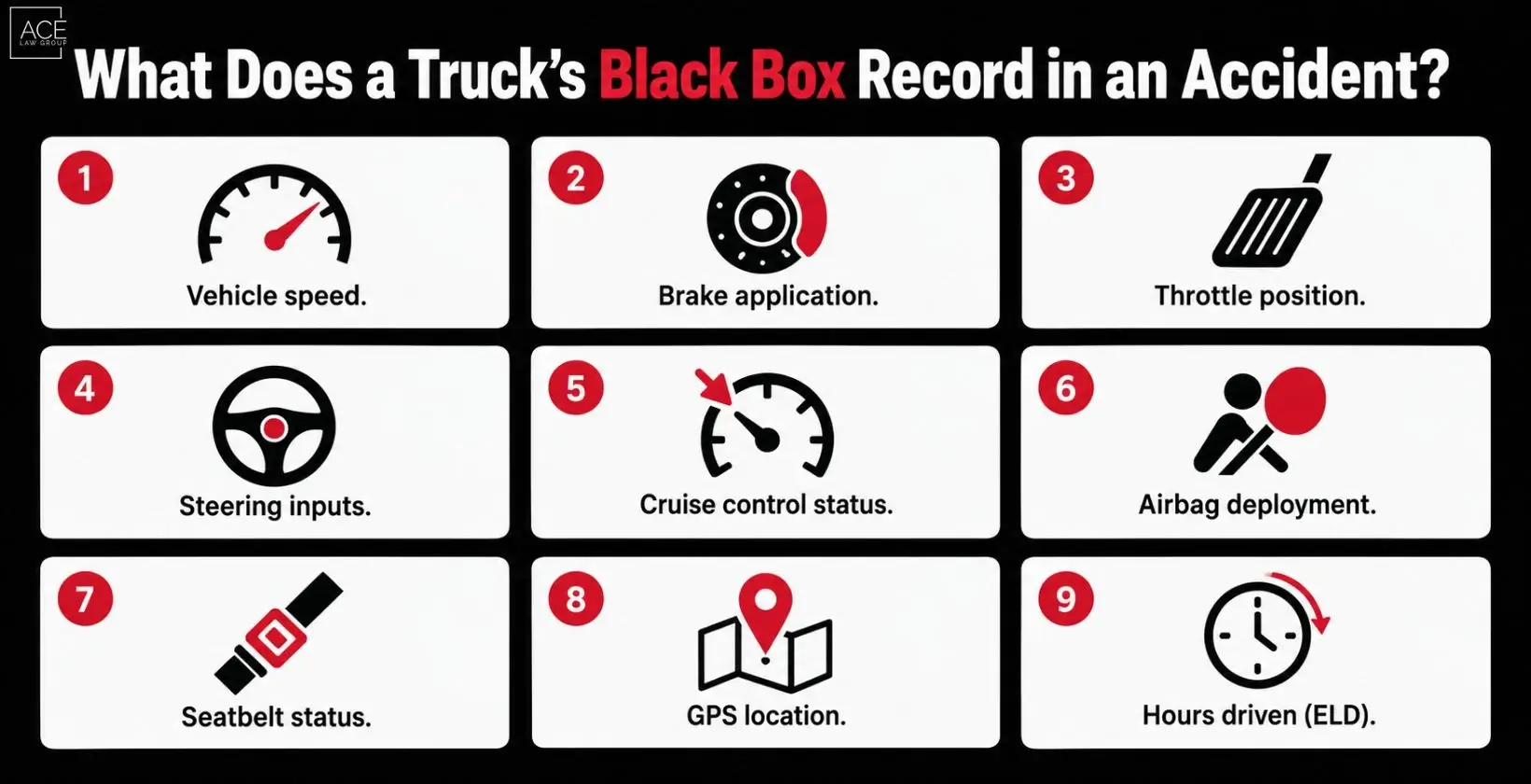
What Does a Truck’s Black Box Record in an Accident?
The EDR captures the seconds immediately before and during impact. The ELD records cumulative driving hours leading up to the crash. Together, they produce the data record that determines fault, and what the trucking company’s insurance team most wants to keep off the record.
- Vehicle speed. The exact speed the truck was traveling before and at the moment of impact. If the EDR shows the driver exceeded the limit, that single data point can settle a liability dispute on its own.
- Brake application. Whether the driver applied the brakes at all, how hard, and how many seconds before impact. A driver who claims they tried to stop but whose EDR shows zero brake input has a significant problem in court.
- Throttle position. Whether the driver had their foot on the accelerator at the time of the crash. An 80,000-pound truck that was still accelerating into a collision tells a very specific story about driver awareness.
- Steering inputs. Sudden lane changes or sharp evasive maneuvers in the seconds before impact can indicate the driver saw the hazard and reacted too late, or that erratic handling caused the crash itself.
- Cruise control status. Whether cruise control was active and at what speed. A driver on cruise control above the posted limit cannot later claim they were managing speed manually.
- Airbag deployment. Confirms collision severity and the precise timing of impact, as well as whether airbags were deployed defectively.
- Seatbelt status. Driver compliance at the moment of impact, which can affect the carrier’s negligence argument.
- GPS location. The exact position of the truck, cross-referenceable with posted speed limits, construction zone designations, and road conditions at that point.
- Hours driven (ELD). Cumulative driving time before the incident, which determines whether federal fatigue regulations were violated before the truck ever reached your vehicle.
Commercial trucks involved in Nevada crashes on I-15, US-95, or I-80 are subject to these same federal data standards regardless of where the carrier is headquartered. The crash triggers the recording. What the recording shows is what matters in your claim. For a breakdown of how this data fits within the broader evidence picture in a truck accident case, see our guide on evidence needed to win a truck accident case.
How Black Box Data Helps Prove Fault in a Nevada Truck Accident
Black box data changes a truck accident case because it eliminates the single most contested element in almost every claim: whose account of what happened is true. When the EDR and ELD speak, they have no interest in the outcome. That objectivity is what makes this evidence so difficult for carriers and their insurers to fight, and it is why an experienced attorney moves immediately to secure it.
Proving the Driver Was Speeding
Excessive speeding by a commercial truck is not a mere traffic infraction. At the size and weight of a loaded semi, it is the difference between a survivable crash and a catastrophic one. If the EDR confirms the truck was traveling above the posted limit or at a speed unsafe for road conditions, no amount of opposing testimony changes that number. Ace Law Group know how insurers try to contextualize or minimize speed data, because our team previously represented insurance companies. We know the arguments and we know how to counter them.
Proving Hours-of-Service Violations and Driver Fatigue
Under federal law, a driver who operates a commercial truck beyond the 11-hour driving limit is not just fatigued; the carrier that permitted or failed to prevent that violation is also liable. The ELD record transforms what might otherwise be an unprovable fatigue argument into a documented federal violation. That shift, from driver negligence to carrier liability, typically involves far greater insurance coverage and opens the door to punitive damages. It changes the scale of the case.
Proving Brake Failure or Negligent Maintenance
If the EDR shows no brake application before a rear-end collision, or a brake response too weak for the vehicle’s speed, the investigation moves immediately to the truck’s maintenance history inside the ECM. Carriers are required under 49 CFR Part 396 to maintain commercial vehicles in a safe operating condition. When the ECM reveals a documented brake fault that was never repaired, the negligent maintenance claim is already in writing. The carrier wrote it themselves.
Proving Reckless or Distracted Driving
Sudden steering corrections, unexplained lane departures, or a throttle still open when impact became unavoidable are patterns in the EDR that indicate a driver who was distracted or not paying attention. Paired with cell phone carrier records, black box evidence has supported overly aggressive or reckless driving findings in truck accident cases where the driver initially denied any phone use. The phone does not lie either.
Why Trucking Companies Don’t Want You to See This Data
The moment a commercial truck is involved in a serious accident, the carrier’s insurance response team is activated. These teams exist specifically to reach the crash scene, assess the damage, and manage the narrative before attorneys for injured parties can get involved. Part of that assessment is knowing what the black box recorded.
If the data is harmful to the carrier, which in most serious crashes it is, the carrier has every incentive to let the natural overwrite cycle run its course. EDRs in most commercial trucks overwrite stored data after approximately 30 days of new operation. The carrier does not have to delete anything. They simply have to wait.
Trucking companies are not legally required to hand over black box data voluntarily. The data is their property. Without a formal legal demand, it will not reach you.
Understanding the dangers of commercial trucks on Nevada roads is one thing. Having the evidence to prove what a specific truck did on a specific highway on the day it hit your vehicle is something only the black box can provide. Once that 30-day window closes, the case becomes harder to prove, and settlement offers reflect that.
How a Truck Accident Attorney Secures the Black Box Before It’s Gone
This is where the speed of legal response matters more than anything else in the early stages of your case. An attorney cannot reverse an overwritten EDR. They can only prevent it from happening.
The Spoliation Letter
Within hours of taking a truck accident case, an attorney sends a formal spoliation letter to the trucking company, the driver, and any third-party data service provider. This letter is a legal demand requiring immediate preservation of all electronic records, including ECM data, ELD logs, and EDR event data. Under Nevada law, a carrier that destroys evidence after receiving this letter may face sanctions ranging from adverse jury instructions to default judgment, depending on the degree of willful destruction.
That consequence is the one that moves carriers toward settlement. A judge who instructs a jury to assume the destroyed data was harmful to the carrier has effectively ended that carrier’s defense. Every day without a preservation demand is a day the overwrite cycle runs unopposed.
Subpoena and Court Order
If the carrier ignores the spoliation letter or claims the data is unavailable, an attorney can compel production through a court subpoena. This is a formal legal process requiring the carrier to produce all specified electronic records under penalty of contempt. Carriers who stall or produce incomplete records open themselves to additional sanctions that further strengthen the injured party’s position.
Accident Reconstruction Analysis
Once the data is secured, it goes to a certified accident reconstruction expert who translates raw EDR and ELD numbers into a precise sequence of events. That reconstruction becomes the foundation of every argument in the case, from initial demand letters to trial testimony. Insurance companies negotiating against objective reconstruction data behave very differently than they do when the evidence consists of vehicle damage photographs and conflicting witness statements.
The data is there. The question is whether someone demands it fast enough.
What Black Box Evidence Means for Your Nevada Truck Accident Claim
In Nevada, injured parties have two years from the date of the accident to file a personal injury lawsuit under NRS 11.190(4)(e). Two years sounds like a long time. The black box does not have two years. Nevada’s personal injury filing deadline does not protect evidence. Only prompt legal action does.
If you were injured by a commercial truck anywhere in Nevada, our Nevada truck accident lawyer at Ace Law Group can begin evidence preservation the same day you call.
When black box data establishes the carrier’s liability, compensation types in a Nevada truck accident case can include:
- Medical expenses, current and future
- Lost wages and reduced earning capacity
- Pain and suffering and emotional distress
- Property damage
- Punitive damages in cases involving gross negligence, including documented hours-of-service violations that the carrier knew about and failed to correct
Attorney Christian Z. Smith spent years at prominent Las Vegas insurance defense firms before joining Ace Law Group. That background means the team understands exactly how adjusters evaluate truck accident claims and where they routinely undervalue them. Our verdicts and settlements include a $38.8 million wrongful death jury verdict.
Can the Black Box Data Work Against You?
The black box records everything, including data that can work against you. If the EDR shows your vehicle contributed to the crash, that evidence is available to both sides. Nevada follows a modified comparative negligence standard under NRS 41.141, meaning your compensation is reduced in proportion to your percentage of fault. You can still recover damages as long as you are found to be 50% or less at fault.
This is exactly why black box data should be reviewed by an attorney before any settlement discussions begin. A carrier that knows your vehicle’s data is neutral or favorable to you will settle differently than one facing unambiguous evidence of driver fault. An experienced truck accident attorney evaluates all data before making strategic decisions about how and when to present it.
Frequently Asked Questions
Is a Black Box Required by Law in Commercial Trucks?
Yes, for most commercial carriers. ELDs have been federally mandated since 2017, and EDRs are standard equipment on virtually all modern commercial vehicles. Any commercial truck built after model year 2000 almost certainly has one.
Who Owns the Truck’s Black Box Data?
The trucking company owns it. The ECM, ELD, and EDR are installed in the vehicle, and the data belongs to the carrier. They control access, they decide whether to preserve it, and they have no legal obligation to hand it over voluntarily. Without a formal preservation demand from an attorney, they can let the 30-day overwrite cycle run and face no consequence.
How Long Does a Truck’s Black Box Record Data?
EDRs typically retain crash-event data until the storage buffer fills and begins overwriting, a process that can start within 30 days of a collision. Assume that window and act accordingly. An attorney can send a legal preservation demand the same day they take your case.
Your Black Box Evidence Has a 30-Day Window. Call Now.
The truck’s data is already running on a countdown. If the carrier’s response team has already been to the crash scene, they know what the black box shows. You should, too.
Ace Law Group represents truck accident victims across Las Vegas, Henderson, Boulder City, Reno, and throughout Nevada. Lead attorney Patrick Kang and his team work on contingency, meaning there is no fee unless we recover compensation for you. Call 702-333-4223 or contact our Las Vegas area truck accident attorneys online for a free consultation. We will review your case, explain what the evidence shows, and tell you exactly what your next steps are after your accident.
Real Injuries. Real Lawyers. Real Justice.