Yes, you can sue a Las Vegas hotel for a slip and fall if the hotel’s negligence caused or contributed to your injuries.
Under Nevada premises liability law, hotels owe guests a duty to keep the property reasonably safe. That includes fixing dangerous conditions they knew about, or should have found through reasonable inspections, and warning guests about hazards that are not obvious.
A hotel may be liable if a dangerous condition, such as an unmarked wet floor, poor lighting, or an unrepaired walkway, caused your fall and injuries. Many people feel overwhelmed dealing with large hotel or casino properties, especially when risk managers and insurance adjusters get involved. Still, Nevada law gives injured visitors the right to pursue a claim when unsafe property conditions lead to harm.
Key Takeaways
- You may have a claim against a Las Vegas hotel if unsafe property conditions caused your fall and injuries.
- A valid claim requires proving 4 liability elements: duty, breach, causation, and damages.
- Liability generally falls on the entity that controlled the area where your injury occurred.
- In most cases, Nevada gives you two years to file an injury lawsuit.
- If you share fault, your compensation may be reduced under Nevada’s comparative fault rules.
Did you know? Our hotel injury attorneys secured a $15 million verdict for a client who suffered a life-changing hamstring injury in a slip and fall at the Cosmopolitan Hotel in Las Vegas. If a Las Vegas hotel’s negligence injured you, we know how to build and fight these claims. Call 702-333-4223 to speak with our attorneys.
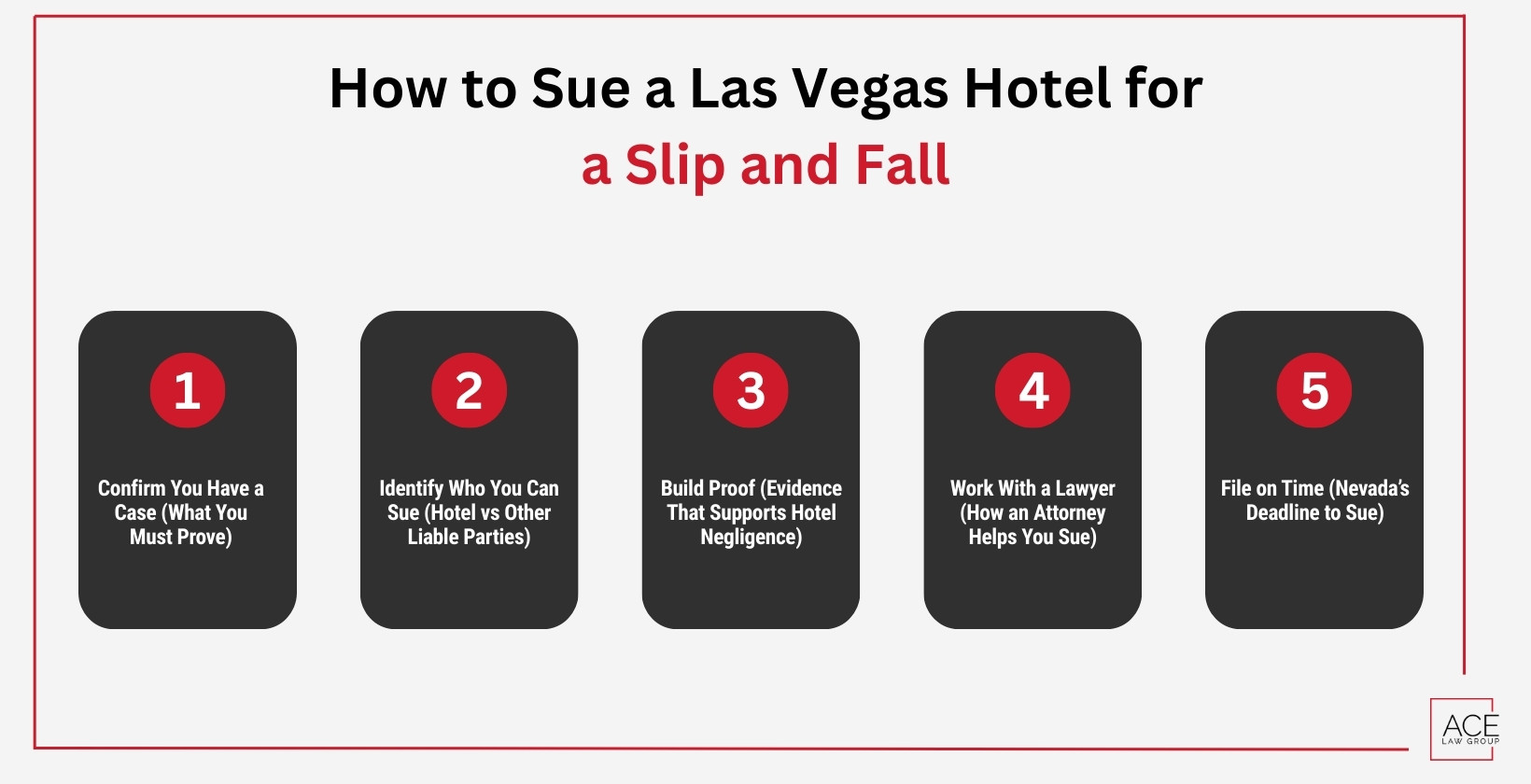
How to Sue a Las Vegas Hotel for a Slip and Fall
Hotel slip and fall cases often come down to the details. Focus on whether the hotel may be responsible, preserving key evidence, and identifying who controlled the area where you fell.
Step 1: Confirm You Have a Case (What You Must Prove)
A slip and fall claim against a hotel is based on negligence. Simply falling on the property is not enough. To have a valid claim, you must prove four elements:
- Damages: You suffered actual losses, such as medical bills, lost income, or lasting physical limitations.
- Duty of Care: The hotel had a legal duty to keep the premises reasonably safe for guests.
- Breach of Duty: The hotel failed to fix a dangerous condition or failed to warn guests about a hazard that was not obvious.
- Causation: That unsafe condition was a direct cause of your fall and injuries.
Step 2: Identify Who You Can Sue (Hotel vs Other Liable Parties)
It’s not always the property owner who is liable for an accident on their premises. Who you can sue depends on who was responsible for the area and the hazard that caused your fall. Large Las Vegas hotels and casino resorts often operate through multiple business entities, which can make liability less obvious at first.
- Hotel-controlled areas: If the dangerous condition was in a lobby, hallway, pool deck, or another area operated by the hotel, the hotel entity is usually the primary defendant.
- Leased or independently operated spaces: Many resorts lease space to restaurants, shops, and entertainment venues. If the fall happened inside one of those businesses, the tenant operator may be responsible instead of the hotel.
- Equipment or structural defects: If the fall involved an elevator, escalator, flooring defect, or another maintenance issue, liability may also involve a contractor, maintenance company, or product manufacturer.
In some cases, more than one party may share responsibility. Our Las Vegas premises liability lawyer can help you identify every party who may be liable for your injuries.
Step 3: Build Proof (Evidence That Supports Hotel Negligence)
To establish fault, you need evidence showing what the hazard was, how long it existed, and whether the hotel knew or should have known about it. Helpful evidence often includes:
- Photos or videos documenting the exact location, the hazardous conditions (e.g., wet floors, slippery walkways, broken handrails, uneven floorboards), and visible injuries.
- Hotel surveillance and security footage.
- Incident, security, or internal reports created by the property.
- Witness statements and contact information of hotel patrons who saw the incident.
- Medical records connecting your injuries directly to the fall.
- Maintenance records or cleaning logs for the area.
- Documentation of similar prior accidents in the same location (if available).
- The footwear or clothing you were wearing at the time of the fall.
After an incident, evidence proving liability can quickly vanish. Floors get cleaned, hazards get repaired, camera footage gets overwritten, and witnesses become harder to reach. Early documentation can make a major difference in showing what happened and who was responsible.
Step 4: Work With a Lawyer (How an Attorney Helps You Sue)
Hotel slip and fall claims can become complicated quickly. Hotels and casinos often involve risk management teams, insurance adjusters, and defense lawyers early in the process.
A slip and fall attorney in Las Vegas can help you by:
- Investigate the incident and identify all potentially liable parties.
- Send preservation requests to protect video footage and records.
- Obtain incident reports, maintenance logs, and witness statements.
- Calculate damages and estimate settlement value.
- Handle communications with insurance adjusters and defense counsel.
- File a lawsuit if the claim is denied or undervalued.
You can file a claim without a lawyer, but legal representation is often important in hotel cases because the property usually has experienced defense teams and layered insurance coverage.
Step 5: File on Time (Nevada’s Deadline to Sue)
Meeting Nevada’s filing deadline is a mandatory step in suing a Las Vegas hotel for an injury. Nevada’s statute of limitations, specifically NRS § 11.190(4)(e), gives you two years from the date of the incident to file a lawsuit for most personal injury cases.
If you miss this two-year period, courts will likely dismiss your case, even if the hotel was clearly at fault. Waiting also makes it harder to prove the claim because evidence and witnesses may no longer be available.
How Hotels Defend These Claims (Partial Fault and Blame Shifting)
Hotels and their insurers often defend these claims by arguing that you were partly responsible for the fall. Nevada follows a modified comparative negligence rule.
That means:
- Your compensation can be reduced by your percentage of fault.
- You usually cannot recover damages if you are found to be more than 50% at fault.
Common defense arguments include:
- The hazard was so “open and obvious” that you should have noticed it.
- Distraction, inattention, or intoxication contributed to the fall.
- Inappropriate footwear or personal behavior caused the incident.
- You were in an area where guests are not permitted.
Because fault allocation directly affects the value of a claim, this issue is often one of the biggest disputes in hotel slip and fall cases.
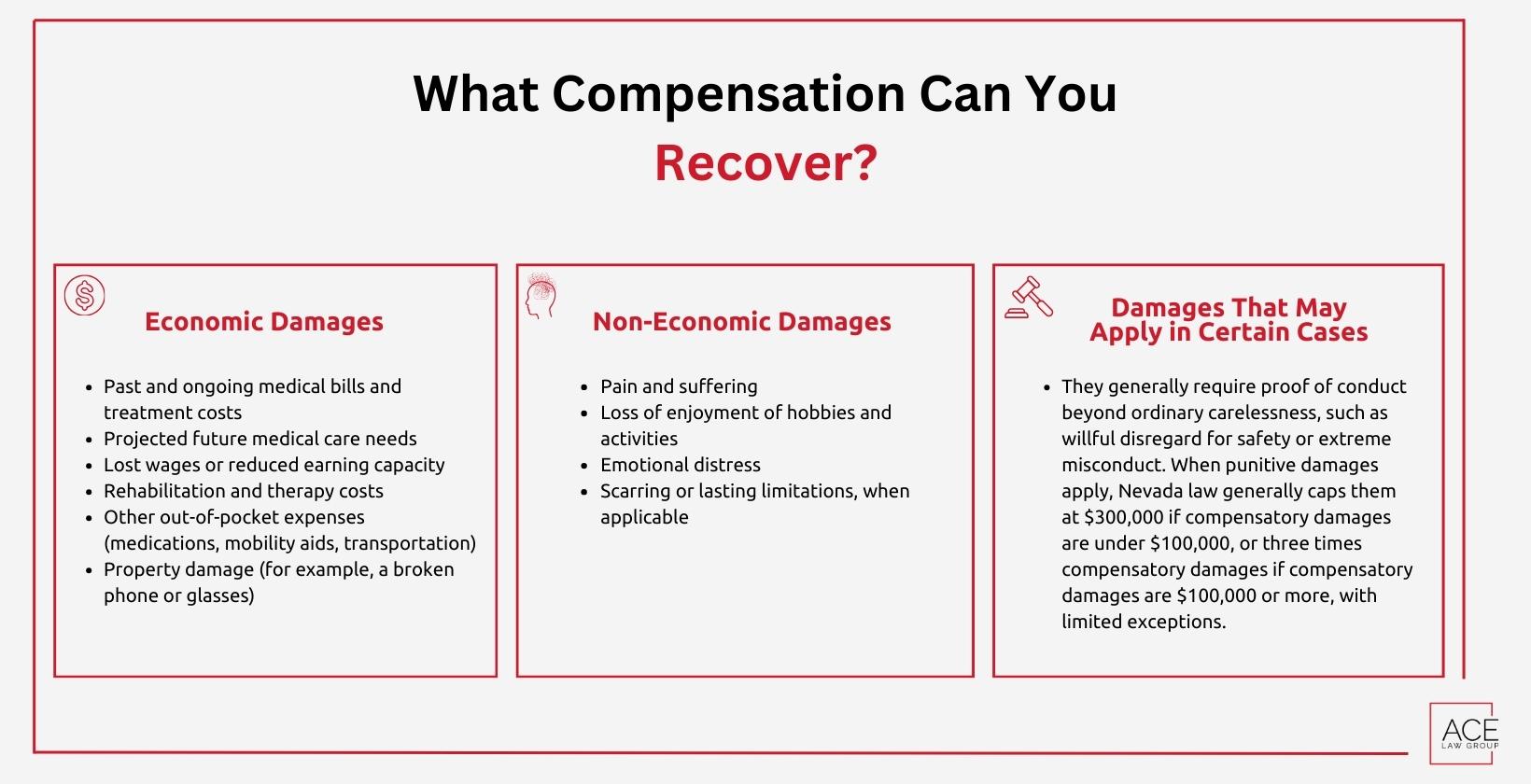
What Compensation Can You Recover?
If your claim succeeds, you can seek compensation for the losses your fall caused. In most hotel slip and fall cases, damages fall into two categories:
- Economic Damages (Financial Losses):
- Past and ongoing medical bills and treatment costs
- Projected future medical care needs
- Lost wages or reduced earning capacity
- Rehabilitation and therapy costs
- Other out-of-pocket expenses (medications, mobility aids, transportation)
- Property damage (for example, a broken phone or glasses)
- Non-Economic Damages (Human Impact) :
- Pain and suffering
- Loss of enjoyment of hobbies and activities
- Emotional distress
- Scarring or lasting limitations, when applicable
Punitive Damages (Rare): In unusual cases, punitive damages may be available, but they are not common in slip and fall claims. They generally require proof of conduct beyond ordinary carelessness, such as willful disregard for safety or extreme misconduct. When punitive damages apply, Nevada law generally caps them at $300,000 if compensatory damages are under $100,000, or three times compensatory damages if compensatory damages are $100,000 or more, with limited exceptions.
Consult a Las Vegas Hotel Injury Lawyer from Ace Law Group
If a Las Vegas hotel’s negligence contributed to your slip and fall, you may have more legal options than you realize. A Las Vegas hotel injury lawyer can assess how Nevada law applies to your situation, identify who may be responsible, and explain what documentation could support your claim.
Ace Law Group has specific experience handling slip and fall claims at some of Las Vegas’s largest resort properties. If your injury occurred at one of the properties below, we know the ownership structures, liability considerations, and insurance arrangements that can directly affect your case:
- Caesars Palace slip and fall accidents
- Cosmopolitan slip and fall accidents
- Wynn / Encore Resort slip and fall accidents
- Aria Resort & Casino slip and fall accidents
- Planet Hollywood slip and fall accidents
- Bellagio Resort & Casino slip and fall accidents
- Vdara Hotel & Spa slip and fall accidents
Request a free and confidential consultation to understand your legal options.