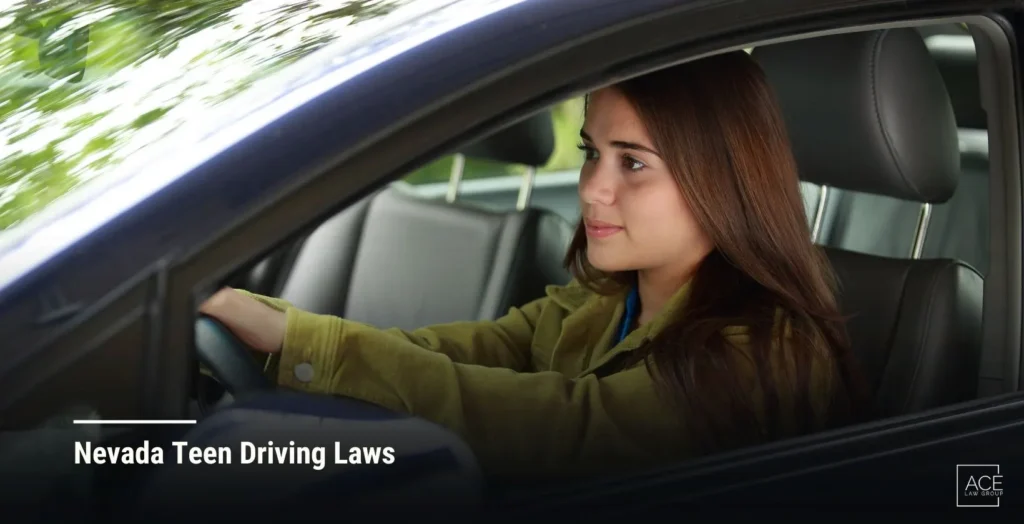
Nevada uses a Graduated Driver License (GDL) program to reduce teen crash risk by introducing driving privileges in three stages. Every Las Vegas teen driver moves through an instruction permit, an intermediate license, and a full unrestricted license, each with specific age requirements, supervised driving hours, passenger restrictions, and nighttime driving rules.
According to the NHTSA, novice teen drivers are twice as likely as adult drivers to be in a fatal crash, and passenger vehicle driver fatalities among 15- to 18-year-olds increased 16 percent between 2014 and 2023. The main reasons are inexperience, distraction, and risky driving behaviors like speeding and tailgating.
Understanding Nevada’s GDL rules matters because violations can lead to license suspension, and teen-driver crashes can create serious financial exposure for families, a reality our Las Vegas auto accident lawyers see regularly throughout Clark County.
Key Takeaways:
- Nevada uses a three-stage licensing program. Teens must progress through an instruction permit at age 15 and a half, followed by an intermediate license at 16, before obtaining a full unrestricted license.
- Supervised driving is mandatory for permits. Permit holders must complete 50 hours of supervised driving, including 10 hours at night, with a licensed driver who is at least 21 years old and has one year of experience.
- Intermediate licenses carry strict restrictions. For the first six months of holding an intermediate license, teens generally cannot transport passengers under 18 unless they are immediate family members.
- Parents face unlimited liability for negligence. Under Nevada law, parents or vehicle owners are jointly and severally liable for both economic damages and non-economic damages caused by a teen driver’s negligence, such as speeding or distracted driving.
- Teens can still recover compensation if injured. A teen driver is not automatically at fault due to inexperience; they may pursue a personal injury claim as long as their fault for the crash is 50 percent or less.
Nevada GDL Requirements: Three Stages Explained
Nevada’s Graduated Driver License program, administered by the Nevada DMV, introduces driving privileges in three stages, each with increasing independence and decreasing restrictions. Here is what each stage requires under Nevada law as of 2026:
- Driver’s Permit or Instruction Permit (Stage 1): Once a teen is at least 15 and a half years old, they may apply for an instruction permit by passing a written knowledge and vision test. During this stage, the teen must drive under the supervision of a licensed driver who is at least 21 years old and has at least one year of driving experience. Nevada requires 50 hours of supervised driving, including 10 hours at night, for teens who complete a certified driver education course. Teens whose course is not offered within 30 miles of their residence must complete 100 hours instead.
- Intermediate License (Stage 2): After turning 16 and holding the instruction permit for at least six months, a teen may apply for an intermediate license. This is a restricted license that generally allows unsupervised driving except between 10 PM and 5 AM. For the first six months, the teen generally may not transport passengers under 18, except immediate family members.
- Full Unrestricted License (Stage 3): A teen may qualify for a full unrestricted license at 18, or earlier, after holding the intermediate license for one year without driving violations. The full license removes all GDL restrictions.
Of course, these are the minimum restrictions under Nevada law. Parents may choose to impose additional household rules, such as limiting nighttime driving even when the law would allow it.
Parental Liability When a Teen Driver Causes an Accident in Nevada
When a teen driver causes a crash in Nevada, parents face liability under two separate statutes depending on whether the conduct was negligent or intentional.
- Negligent Driving (NRS 41.440): When a family member drives a vehicle with the owner’s permission and causes a crash through negligence, liability is imposed jointly and severally on the vehicle owner. This covers the most common teen crash scenarios: distracted driving collisions, speeding accidents, and failure to yield. There is no dollar cap on liability under this statute.
- Willful Misconduct (NRS 41.470): When a minor commits willful misconduct that injures another person or damages property, that conduct is imputed to the parent or guardian having custody and control. Parental liability under this statute is capped at $10,000 per incident. Parents who negligently entrusted a vehicle to a teen known to be an unsafe driver may face additional liability beyond that cap.
- Intermediate License: Upon turning 16 and after holding the instruction permit for at least six months, a teen can apply for an intermediate license. This license is a restricted license. This license allows them to drive unsupervised except during nighttime hours (between 10 PM and 5 AM). Beyond that, for the first six months that a teen holds this license, they are not allowed to have any passengers under the age of 18 in the car, except for their own siblings.
- A Full License: A teenager in Nevada will receive a full unrestricted license once they turn 18 years of age. Alternatively, they can apply for a full license if they hold an intermediate license for one year without any driving violations.
Of course, these restrictions are merely the minimum mandatory GDL restrictions as imposed by Nevada law. Parents have every right to impose additional restrictions on their teen driver. For example, a parent could decide that a teen with an intermediate license cannot use the car without supervision after dark at all—even though the law allows them to drive until 10:00 PM.
Teen Drivers Have a Right to Seek Compensation through a Claim
With Nevada being a fault-based state, the driver responsible for a crash bears financial liability for the other party’s injuries and damages.
A teen driver is not automatically at fault simply because of their age or inexperience. Every crash must be evaluated on the accident evidence, including damage patterns, witness statements, traffic camera footage, and police reports.
If your teen was injured in a crash caused by another driver in Las Vegas, they have the same legal right to pursue a personal injury claim as any adult and may seek compensation for accident-related losses.
Under Nevada’s modified comparative negligence rule, compensation is reduced by the teen’s assigned fault percentage, but recovery is not barred as long as that percentage is 50 percent or less.
Why Rely on Ace Law Group for a Teen Driver Case?
Teen driver crash cases in Las Vegas involve overlapping legal issues, including GDL violations, parental liability, insurance coverage disputes, and comparative fault.
At Ace Law Group, we handle every aspect of these claims on behalf of injured clients and families throughout Clark County.
- $44+ million recovered for injured Nevada clients in 2025 alone
- $175+ million recovered overall
- Rating of 4.7 based on over 400 verified reviews
- Former judge on our legal team
- Fluent in English, Spanish, Chinese, and Korean
- Available 24/7
- No fee unless we win
Past results do not guarantee future outcomes.
Contact Our Las Vegas Car Accident Lawyers
If your teenager was injured in a crash or if your family has been named in a claim following a teen driver accident, contact Ace Law Group before speaking with any insurance company. Call (702) 333-4223 or contact us online for a free, no-obligation case review. We represent injured clients and families throughout Las Vegas and Clark County. No fee unless we win.