Choosing a truck accident lawyer in Las Vegas means evaluating a lawyer against a different standard than you would for a general injury attorney. Crashes involving 18-wheelers, semi-trucks, and big rigs differ from car accident claims in four ways: commercial carriers, multiple insurance policies, federal trucking regulations, and higher-value damages that follow crashes on congested corridors like I-15, US-95, the Spaghetti Bowl, and the 215 Beltway.
A Las Vegas truck accident lawyer’s familiarity with these four factors shapes how your claim is built and which liable parties are identified. That familiarity breaks down into seven criteria you can verify before hiring a truck accident attorney in Las Vegas.
Quick Overview: 7 Criteria to Choose a Truck Accident Lawyer
- Confirm the attorney focuses specifically on commercial truck cases, not just personal injury in general.
- Verify that they understand FMCSA regulations and can explain which rules apply to your specific crash.
- Ask about their trial record in truck accident cases in Nevada, not just their settlement history.
- Confirm how they preserve evidence and what investigative resources they have for expert witnesses.
- Understand how the fee structure works: contingency-based, with the firm advancing litigation costs, though you may remain responsible for certain expenses depending on the outcome.
- Check their communication and accessibility, including whether they personally handle your case.
- Verify their credentials and bar status directly through the State Bar of Nevada.
The sections below unpack each of these criteria in enough detail to help you evaluate any attorney you speak with.
Confirm They Specialize in Commercial Truck Cases
Trucking accident cases require specialized legal and technical knowledge. Unlike standard auto accidents, commercial vehicle crashes involve complex federal regulations, time-sensitive electronic evidence, and multi-layered corporate liability.
Trucking companies operate under a different federal regulatory framework administered by the Federal Motor Carrier Safety Administration (FMCSA). This framework governs driver hours-of-service limits, mandatory vehicle inspection intervals, and cargo securement standards. Violating these rules can establish trucking company negligence, but only if your attorney knows which logs to audit and how to connect those violations directly to your crash.
Commercial truck crashes frequently involve multiple liable parties. Depending on the facts, responsibility can rest with the truck driver, the fleet carrier that employed them, the cargo broker, or the third-party contractor responsible for maintenance.
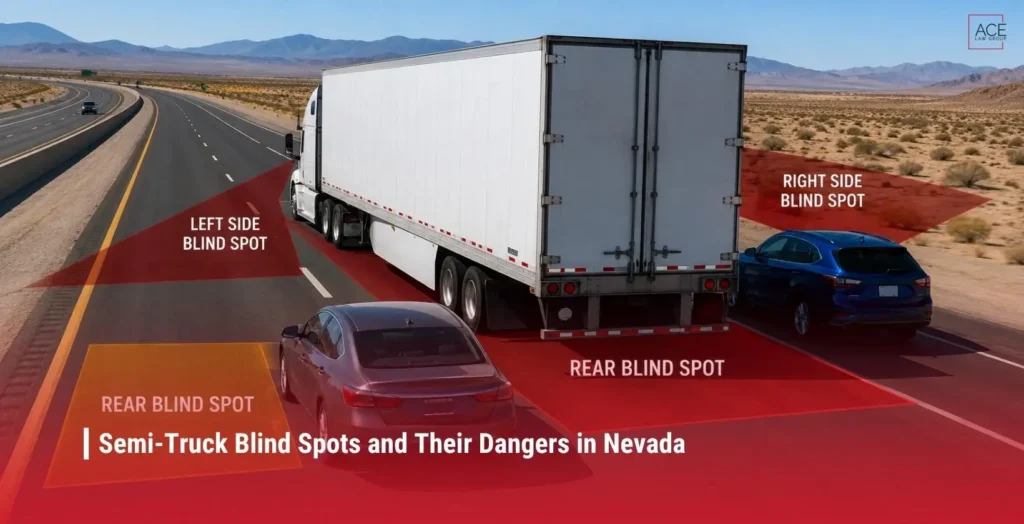
An attorney who primarily handles standard auto claims often focuses solely on the driver, missing significant corporate insurance policies. Specialized attorneys already understand how blind spot hazards, brake fade, and fatigue create identifiable liability patterns, allowing them to build your case without learning trucking physics on the fly.
Verify Their Knowledge of FMCSA and Nevada Trucking Regulations
Before hiring an attorney, test their knowledge of FMCSA and state-level trucking laws. Ask which specific FMCSA regulations apply to your crash type. Nevada adds state-level requirements beyond the federal minimums, including gross vehicle weight limits, vehicle length restrictions, and commercial vehicle registration requirements.
For example, a fully loaded semi-truck exceeding Nevada’s gross vehicle weight limit on I-15 creates a documentable regulatory violation. An attorney can cite this as independent evidence of negligence, separate from driver error at the scene. An attorney who only knows federal rules without understanding Nevada’s state-specific codes provides incomplete representation.
Ask About Their Trial Record, Not Just Their Settlement History
A truck accident attorney’s trial record directly shapes the settlement offer a carrier makes before negotiations even begin. Trucking carriers and their insurance defense teams track which plaintiff attorneys settle every case and which ones try cases in front of a Clark County jury.
A high settlement count in standard car accident cases does not impress commercial insurers. Trucking litigation involves complex corporate discovery, federal mandates, and multiple defense teams working simultaneously. Ask directly how many commercial truck cases, not general injury cases, the attorney has taken to verdict in Nevada.
Assess Their Evidence Preservation Process
Ask how an attorney preserves evidence and what investigative resources they have before hiring them. A commercial truck’s electronic control module, known as the black box, records speed, braking force, and engine data in a rolling buffer. Dashcam and telemetry data can overwrite within days or weeks depending on the vehicle’s usage and system configurations. That evidence can easily be lost unless a spoliation letter is issued immediately. Sending a preservation demand puts the carrier on formal notice, triggering a legal duty to halt routine deletion and safeguard all physical and digital records.
That evidence can easily be lost unless a spoliation letter is issued immediately. Sending a preservation demand puts the carrier on formal notice, triggering a legal duty to halt routine deletion and safeguard all physical and digital records.
Evidence alone does not build a case. Gathering complex truck accident evidence requires accident reconstructionists, digital forensics experts, and economic damages professionals, and these specialists cost real money to hire. Confirm the attorney has established relationships with these experts and the financial resources to retain them when the case requires it.
Understand How Truck Accident Lawyer Fees Work
Truck accident lawyer fees in Nevada work on a contingency fee structure. The attorney collects an agreed-upon percentage of the recovery, meaning you pay no attorney fee unless the case succeeds, though you may remain responsible for certain administrative and expert costs and expenses depending on the outcome.
Expert witness fees, court filing costs, and accident reconstruction expenses add up fast once a case moves into discovery. A properly structured retainer agreement states that the firm advances all litigation costs, reimbursed only from a winning settlement or verdict. Confirm this detail in writing before you sign, because a retainer that stays silent on cost advancement could leave you responsible for litigation expenses during the case.
Check Communication and Accessibility, Not Just Results
Results mean little if you cannot reach your legal team. A named attorney who personally manages your file responds differently than a paralegal or case manager working from a template.
During your initial consultation, ask whether the attorney who signs you up is the same attorney who works your file through settlement or trial, because at high-volume firms, a case often passes to junior staff after the initial consultation. Confirm the expected response time for calls and emails, and ask how often you receive case updates during active litigation. An attorney who cannot define their communication standards clearly has built a sales pipeline, not a client service process.
Verify Their Credentials and Bar Status
Always independently confirm an attorney’s standing before signing a retainer. An active Nevada State Bar license is the baseline requirement. You can confirm any attorney’s current license status, standing, and disciplinary history directly through the State Bar of Nevada’s attorney search.
Active membership in the Nevada Justice Association is a second credential worth checking, since that organization represents trial lawyers who work for injured individuals rather than insurance corporations. While national trial awards offer helpful context, they cannot replace localized experience handling major claims in the Eighth Judicial District Court of Clark County.
Ask These Qualifying Questions in Your Consultation
Use these targeted questions during your initial consultation to quickly distinguish a commercial trucking specialist from a general personal injury lawyer:
- How many commercial truck accident cases have you handled in Nevada, and what were the trial or settlement outcomes? General personal injury experience does not substitute for trucking-specific results.
- Which FMCSA and Nevada trucking regulations apply to my crash, and how will you prove the violation caused it? A specific answer names the regulation and the evidence connecting it to the crash; a general answer names neither.
- What is your evidence-preservation process in the first 72 hours after I sign? The answer should include a spoliation letter to the carrier and an independent investigator dispatched to the scene.
- Will the firm advance litigation costs for experts and filing fees? Confirm you face no out-of-pocket costs during the case, not just at its resolution.
- Will you personally handle my case, or will it be assigned to an associate or paralegal? At high-volume firms, your file often reaches a named attorney only at settlement or trial, not before.
Frequently Asked Questions on Hiring a Truck Accident Attorney
How Long Do I Have to File a Truck Accident Claim in Nevada?
You have two years to file a truck accident claim in Nevada under NRS 11.190’s statute of limitations. That two-year deadline covers the lawsuit itself. Evidence like electronic logging data and dashcam footage disappears within days, so the practical deadline for building your case starts much sooner.
What If the Truck Driver Was Employed by a Large Corporation?
When a large commercial carrier is involved, their rapid-response defense team often arrives at the accident scene before the vehicles are towed. They gather evidence, interview witnesses, and construct a defense narrative to minimize corporate exposure. An experienced plaintiff’s attorney anticipates these defense tactics and moves just as quickly to preserve objective digital evidence.
What Happens During a Truck Accident Case Consultation?
A thorough truck crash case consultation focuses on evaluating the crash facts, identifying the motor carrier, reviewing your medical diagnoses, and assessing immediate evidence requirements. The attorney should evaluate your claim’s legal viability and outline the specific steps required to investigate it.
What Does It Cost to Hire a Truck Accident Lawyer?
It costs nothing upfront to hire a truck accident lawyer under a contingency arrangement. The attorney is paid a percentage of the recovery only if the case succeeds, though you may remain responsible for certain costs and expenses depending on the outcome. The firm typically advances litigation costs until then.
What Are Red Flags When Hiring a Truck Accident Lawyer?
Major red flags include a firm that avoids trial-experience questions, cannot name the FMCSA violations tied to your crash, hesitates to advance expert witness costs, or delegates your case entirely to non-attorney staff after intake.
Next Steps: Schedule Your Free Consultation
Commercial trucking claims require legal advocates who understand exactly what is at stake before the first demand letter is drafted. Founding attorney Patrick W. Kang and the legal team at Ace Law Group bring direct insurance-defense experience to your case, helping anticipate and counter carrier defense strategies.
Call 702-333-4223 to speak directly with a member of our legal team today. Consultations at Ace Law Group are completely free, confidential, and carry no obligation.
Learn more about why clients choose Ace Law Group to represent them in major truck accident claims.
Find Localized Truck Accident Legal Help in Nevada:
- Las Vegas Truck Accident Lawyer
- Henderson Truck Accident Lawyer
- North Las Vegas Truck Accident Attorney
- Reno Truck Accident Attorney
- Summerlin Truck Accident Lawyer
- Spring Valley Truck Accident Attorney
- Enterprise Truck Accident Attorney
- Sunrise Manor Truck Accident Attorney
- Paradise Truck Accident Attorney
- Whitney Truck Accident Lawyer
- Mesquite Truck Accident Lawyer
- Boulder City Truck Accident Lawyer
- Nevada Truck Accident Lawyer (Statewide)