Quick Answer: A Nevada truck accident lawyer investigates the crash, secures time-sensitive evidence, identifies every party responsible for your injuries, handles all communications with commercial insurers and defense attorneys, and pursues full compensation under Nevada law. Truck accident claims operate at a different level of complexity than standard car accident cases. They involve federal carrier regulations, multiple insurance policies, and defense teams hired by well-funded corporations. The insurance company already has a legal team working on the case. You need one too.
Within hours of a serious commercial truck crash, the trucking company’s insurer typically dispatches investigators to the accident scene and assigns defense counsel to the file. By the time most injured people have received emergency treatment, the other side already has photographs, a recorded statement from the truck driver, and a legal strategy underway. The gap between when the crash happens and when you retain a lawyer is not neutral.
Our personal injury attorney, Patrick W. Kang, founded Ace Law Group in 2009 and has helped recover more than $175 million for injured Nevada clients. If you were injured in a commercial truck crash, call us at 702-333-4223. When you call, we tell you specifically what evidence is still recoverable, who may be responsible, and what the claim could realistically be worth. There is no charge and no obligation. Our Las Vegas truck accident lawyers are available 24 hours a day to take your call.
The first hours after a truck crash determine what evidence will be available when your case reaches a negotiation or a courtroom. A lawyer’s first job is to stop necessary evidence from disappearing before it can be used.
Sending Preservation Letters Before Evidence Is Overwritten
A spoliation letter is a formal legal notice sent to every party that may hold relevant records, requiring them to preserve all materials related to the crash. We send these notices to the trucking company, the motor carrier, any freight broker involved in the shipment, cargo handlers, and maintenance contractors, within the first 24 hours when possible.
These letters create a legal obligation to preserve the truck’s electronic control module data, electronic logging device records, dashboard camera footage, driver qualification files, dispatch communications, maintenance logs, and inspection reports. When a party destroys truck accident case evidence after receiving a preservation notice, courts may draw adverse inferences against that party at trial. Early notice is not a formality.
Downloading Black Box and Electronic Logging Device Data
The truck’s electronic control module, commonly called the truck’s black box, records the vehicle’s speed, braking behavior, throttle input, and engine load in the seconds before impact. This data frequently contradicts what the driver reported to the police. On many commercial trucks, this data can be overwritten within 30 to 60 days following a crash.
The electronic logging device captures how many consecutive hours the driver worked before the collision. Under 49 CFR Part 395, commercial truck drivers are limited to 11 hours of driving within a 14-hour window and must take mandatory rest periods. ELD data showing a driver exceeded those limits is direct evidence of a federal Hours of Service violation.
Alongside electronic records, the investigation covers the physical scene: skid marks, debris fields, traffic signal timing records, and video from dashboard cameras, Nevada Department of Transportation traffic cameras, and nearby business surveillance systems along corridors like I-15 and the I-15/I-11/US-93 interchange known locally as the Spaghetti Bowl. Witness information is secured before insurance adjusters can make prior contact.
Identifying Everyone Responsible for Your Crash
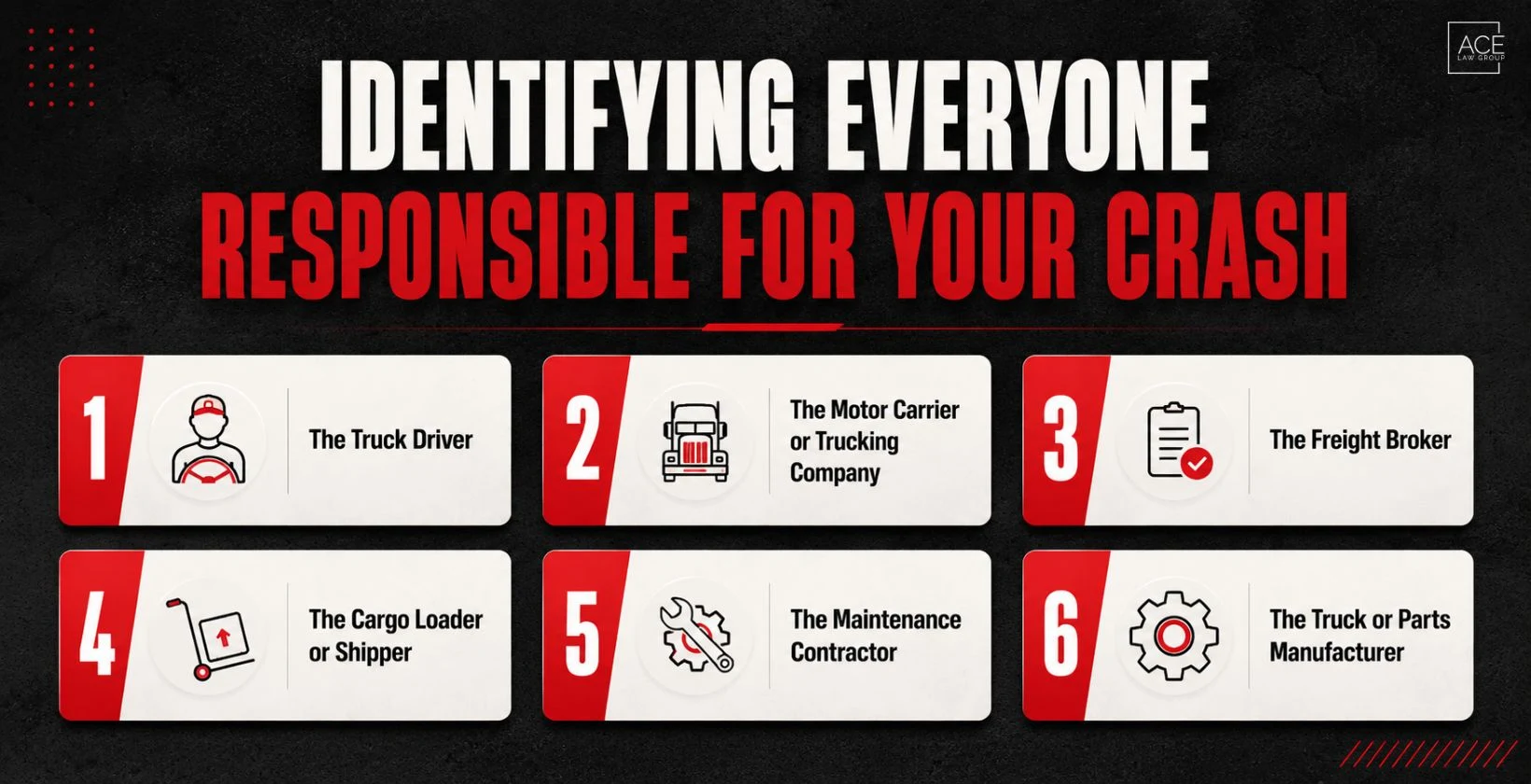
A commercial truck crash rarely has one liable party. Review the dangers commercial trucks pose to understand why these crashes produce multi-party liability. Several entities may carry separate insurance policies, each requiring its own investigation and legal strategy.
- The truck driver may be at fault for fatigue violations, distracted driving, impairment, speeding, or traffic law violations that caused or contributed to the collision.
- The motor carrier or trucking company may be liable for negligent hiring practices, failure to properly train drivers, or imposing delivery schedules that require violating federal Hours of Service rules.
- The freight broker arranged the shipment and may share liability if they selected a carrier with a documented history of safety violations or inadequate insurance coverage.
- The cargo loader or shipper may have improperly secured or overloaded the freight, causing it to shift during transport and destabilize the vehicle.
- The maintenance contractor may have failed to identify or repair brake defects, tire wear, or other mechanical failures during federally required inspections.
- The truck or parts manufacturer may share fault if a defective component contributed to the crash, regardless of how the driver or carrier operated the vehicle.
One additional factor: when a truck driver is classified as an independent contractor rather than a direct employee, the motor carrier may still bear liability. The key legal question is how much operational control the carrier exercised over the driver’s work. Companies that assigned routes, mandated delivery windows, and provided the equipment are frequently found liable regardless of how the employment relationship was labeled.
Different rules apply when a government-owned vehicle, such as a state maintenance truck or municipal utility vehicle, is involved. Nevada law requires a separate claim to be filed with the government entity’s governing body under NRS 41.036. Identifying this situation immediately is critical because the claims process and recovery limits differ from a standard truck accident case.
How FMCSA Violations Establish Negligence
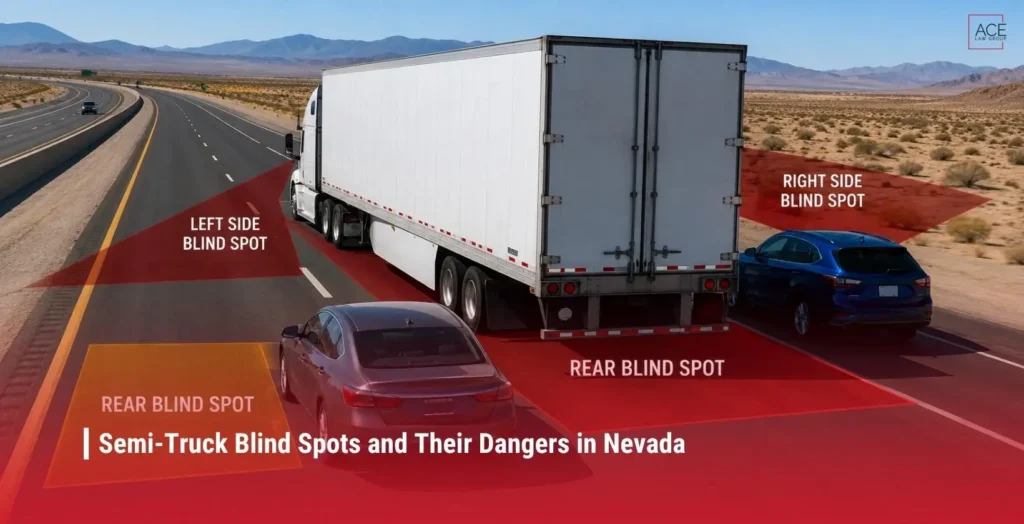
The Federal Motor Carrier Safety Administration sets national minimums for driver hours under 49 CFR Part 395 and vehicle maintenance under 49 CFR Part 396. Understanding how truck and semi-truck blind spots compound FMCSA violations helps clarify why regulatory failures so often contribute to serious crashes. Violations are not technical infractions; they are evidence that a carrier knew the applicable standard and chose not to meet it.
Common violations uncovered during truck accident investigations include falsified driver logbooks, missing commercial driver license verification, overweight cargo loads, and deferred maintenance on brake and steering systems. Each violation strengthens the argument that the carrier’s negligence was systemic rather than incidental.
Managing Insurance Companies and Fighting for a Trial-Ready Outcome
Once liable parties are identified, the most immediate tactical threat is the insurance adjuster. Commercial trucking policies carry minimum required coverage of $750,000 and often reach several million dollars. The carrier’s insurer will assign experienced defense attorneys and claims specialists whose professional role is to minimize what they pay.
We take over all communications with every insurer involved. Phone calls, letters, requests for recorded statements, and requests to sign broad medical authorization forms are routed through our office. A recorded statement made without legal counsel is one of the most common ways injured people damage their own claims. The adjuster’s questions are designed to produce answers that work against you.
Our injury lawyer team includes attorneys who represented Nevada insurance companies before joining the plaintiff side, giving the team direct insight into how carriers evaluate claims and prepare for trial. Insurers calculate settlement value based on how seriously they expect opposing counsel to pursue a courtroom verdict, and that calculation changes when the firm across the table has a record of trying cases.
Trial readiness is not reserved for a small percentage of cases. We prepare every case as if it will be tried. That preparation includes expert witnesses for catastrophic injury claims: a life care planner to calculate future medical costs, a vocational expert to document reduced earning capacity, and a reconstruction specialist when liability is contested. Insurers evaluate risk based on what they believe opposing counsel will actually do in a courtroom. The difference between cases that resolve at full value and cases that settle cheaply often comes down to that single factor.
Ready to find out where your case stands? Call 702-333-4223. The consultation is free, and there is no obligation.
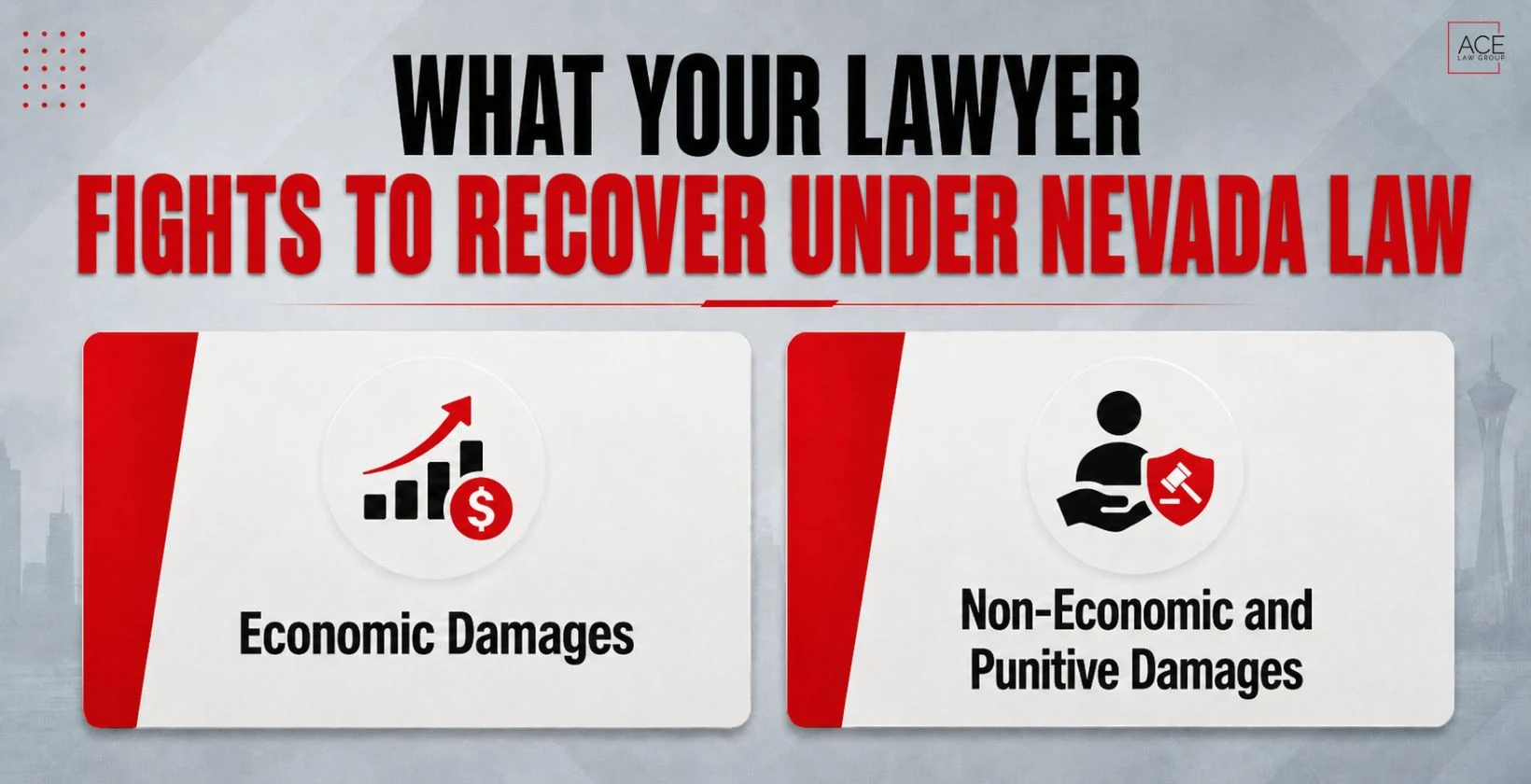
What Your Lawyer Fights to Recover Under Nevada Law
Compensation in a Nevada truck accident case reflects the full scope of your losses, determined by the severity of your injuries, the clarity of fault, and the strength of the case file your attorney assembled.
Economic Damages
Economic damages cover measurable financial losses caused directly by the crash. These include damaged vehicles and other property as well as all past and future medical costs: emergency treatment, surgery, physical therapy, specialist appointments, prescription medications, and medical equipment. They include income lost while you were unable to work, calculated from pay records and employer documentation. Injuries that prevent a return to your previous occupation include the projected difference in earnings over your remaining working life, calculated with the help of a vocational expert.
Non-Economic and Punitive Damages
Non-economic damages compensate for losses without a fixed dollar amount: physical pain, emotional distress, psychological trauma, and the loss of activities and relationships the person valued before the crash. These damages require an attorney’s diligence and arguments and supporting evidence rather than a bill, but they are fully recoverable under Nevada law.
Punitive damages are available when the defendant acted with oppression, fraud, or malice, proven by clear and convincing evidence: a carrier that knowingly retained drivers with suspended licenses, a company that ordered drivers to falsify logbooks, or a fleet that ignored documented brake failures across multiple vehicles. Punitive damages are calculated separately from compensatory damages and require a dedicated argument at trial or in settlement.
Nevada Laws That Directly Affect Your Claim
Nevada’s Modified Comparative Negligence Rule (NRS 41.141)
Nevada follows a modified comparative negligence standard. You can recover various types of compensation as long as your share of fault for the crash is 50% or less. Your recovery is then reduced by your percentage of fault: if a jury finds you 20% responsible in a $400,000 case, you recover $320,000.
Trucking insurers routinely argue that the victim contributed to the crash through tailgating, speeding, or distraction. These arguments serve one purpose: to increase the victim’s assigned fault percentage and reduce the payment obligation. The evidence file your attorney builds, including the traffic camera footage, electronic data, witness accounts, and reconstruction analysis, is what prevents the defense from rewriting the facts of what happened.
The Two-Year Deadline Under NRS 11.190 and Why the Practical Deadline Is Earlier
Nevada law gives personal injury victims two years from the date of the crash to file a civil lawsuit, legally known as the statute of limitations. In practice, the meaningful deadline arrives much sooner.
Electronic logging device data can be overwritten within 30 to 60 days. Physical evidence disappears within days of the crash. Witnesses move, change contact information, or have their memories shaped by early conversations with insurance adjusters. Dispatch communications and maintenance records may be discarded as part of routine business operations unless a legal preservation order is in place.
Every week between the crash and retaining legal counsel is a week the other side works without opposition. Learn what to do immediately after a truck accident in Nevada to protect your right to evidence and compensation from the first day.
How Truck Accident Lawyers in Nevada Are Paid
Ace Law Group handles truck accident cases on a contingency fee basis. There is no upfront cost and no hourly billing at any point in the process.
Our fee is a percentage of the recovery, collected only if the case is won or settled. If there is no recovery, there is no attorney’s fee. We advance all costs of litigation, including expert witness fees, court filing fees, investigator costs, and medical record requests, and recover those costs from the settlement or verdict. The fee percentage and all associated costs are explained in writing before any representation begins.
Frequently Asked Questions
When Is the Right Time to Call a Truck Accident Lawyer?
The right time to call a truck accident lawyer is within hours of the crash. The trucking company’s insurer begins its investigation the same day. A truck accident lawyer sends preservation notices and secures evidence from day one. Waiting weeks reduces the evidence still recoverable and gives the trucking company’s defense uncontested time to build its case before yours exists.
Can I Still Recover Compensation If I Was Partly at Fault?
Yes. Under NRS 41.141, you can recover as long as your percentage of fault does not exceed 50%. Your compensation is reduced by your share of fault. Part of your attorney’s work is presenting the evidence in a way that accurately reflects the truck driver’s and carrier’s conduct, rather than accepting an inflated fault allocation from the defense.
Does It Cost Anything to Hire a Truck Accident Attorney?
No, hiring a truck accident lawyer costs nothing upfront. Attorney fees are collected as a percentage of the settlement or verdict, only if the case recovers compensation. The law firm advances litigation costs, including expert witness fees and court filing fees, and recovers those costs from the final settlement. If there is no recovery, the client owes nothing.
How Long Does a Truck Accident Case in Nevada Take?
Most Nevada truck accident claims resolve in 6 to 18 months. Cases involving catastrophic injuries, multiple defendants, or bad-faith insurer conduct take 2 to 3 years to resolve, though the lawsuit itself must still be filed within Nevada’s two-year deadline. Four factors extend timelines: injury severity relative to maximum medical improvement, number of liable parties, insurer delay tactics, and Eighth Judicial District Court scheduling.
Talk to a Nevada Truck Accident Lawyer Today
Ace Law Group has recovered more than $175 million for injured Nevada clients, including in truck accident cases involving multiple defendants and contested liability. We offer free case consultations, 24-hour availability, and representation in English, Spanish, Korean, and Chinese.
Call us at 702-333-4223 or contact us online. When you call, a member of our legal team reviews the specific facts of your case: what evidence is still recoverable, who may be liable, and what the claim may realistically be worth. There is no obligation.
We handle truck accident cases throughout Las Vegas and across Nevada, including for clients in: Henderson, Boulder City, Reno, Enterprise, North Las Vegas, Spring Valley, Sunrise Manor, Paradise, Whitney, Mesquite, Summerlin.
If your crash happened elsewhere in Nevada, call us, and we will tell you whether we can help.