In Nevada, drivers injured in car accidents are entitled to seek compensation for resulting economic damages. Meaning, tangible and documented financial losses directly tied to the accident. These damages typically include medical expenses, lost wages, and property damage, all of which you must prove through documented receipts, invoices, or official employer records. These differ from non-economic damages, such as mental anguish and pain and suffering, which are subjective and valued differently.
Because economic losses are measurable, they’re often the most straightforward recovery in a car accident claim. This recovery process operates under Nevada’s fault-based insurance system, where the at-fault driver’s insurer is legally responsible for covering the injured party’s financial losses. However, under state-specific car accident liability rules, any tangible damage compensation can be reduced if the injured party shares partial fault for the collision.
So, how does Nevada law define and apply these financial damages in personal injury claims? Let’s break it down.
What Are Economic Damages in a Nevada Car Accident Claim?
Economic damages under Nevada tort law are verifiable financial losses resulting from a motor vehicle accident. These losses result directly from the injury and include substantial and measurable costs. You must support each claim with evidence, such as medical bills, wage statements, repair estimates, or other written proof.
Why Does Nevada Compensate Financial Losses After Car Accidents?
Nevada awards economic damages to injured drivers to help them regain financial stability and restore their quality of life to what it was before the accident. This principle falls under compensatory damages, which aim to reimburse the monetary losses. To recover economic damages, you must show that the loss directly resulted from the accident, was necessary, and has supporting documentation.
For example, if you break a leg in a crash, you can claim emergency treatment costs, follow-up care, and lost wages during recovery. If the injury affects your ability to work long-term, you can pursue damages for future income loss as well.
How Do Courts and Insurers Define “Economic” in Legal Terms?
In legal and insurance terms, “economic” typically refers to objectively verifiable monetary losses and out-of-pocket expenses you can prove with written proof. These losses must result directly from the accident and reflect necessary costs tied to your injury or property damage.
Insurers rely on policies and internal guidelines to verify economic losses. At the same time, courts examine statutory definitions and case law to confirm whether the claimed amount meets the legal standard for compensation.
What Types of Economic Damages Can You Recover After a Las Vegas Car Crash?
Injured drivers can recover all documented financial losses after a traffic crash, both immediate, ongoing, and future. These losses fall into specific categories, depending on how the crash affected your health, income, and property.
If you’re filing an auto injury claim in Las Vegas, the most common types of economic damages include:
Medical Bills and Long-Term Healthcare Costs
Medical expenses are usually the largest portion of economic damages in a car accident claim. You can recover not only the cost of emergency care but also ongoing treatment and projected future medical needs, as long as they directly relate to your injury and are medically necessary.
Compensable medical expenses may include:
- Emergency room and ambulance fees
- Hospitalization and overnight care
- Surgery and follow-up with specialists
- Imaging tests (X-rays, CT scans, MRIs)
- Physical therapy and rehabilitation
- Prescription drugs and pain management
- Future treatment plans based on medical prognosis
Lost Wages, Overtime, and Employer Benefits
Victims can claim lost income as part of their economic damages if crash injuries prevent them from working and earning. The law allows you to recover lost wages you would have earned if the accident hadn’t happened, whether hourly pay, salaried income, or other forms of compensation.
Recoverable wage-related losses include:
- Missed hourly wages or salaried pay
- Overtime you were scheduled to work
- Over time, bonuses or commissions
- Paid time off (PTO), sick leave, or vacation days used
- Employer-paid benefits (e.g., health coverage, retirement contributions)
For example, if you earn $28 per hour but miss 40 hours of work, your compensable lost wage claim equals $1,120.
Future Earnings Loss Due to Disability or Chronic Injury
A car accident can leave you with lasting physical or cognitive limitations, causing you to lose the ability to work at the same level or at all. When this happens, economic damages cover you for the future income losses.
Courts and insurers look at several factors when calculating this loss:
- Your age, occupation, and skill level
- The severity and permanence of the injury
- Pre-injury income and career trajectory
- Medical prognosis and work restrictions
- Expert opinions from vocational specialists or forensic economists
Property Damage and Vehicle Repair or Replacement Costs
If your vehicle or other personal property sustained damage in a crash, you can claim the reasonable cost of repair or replacement as part of your tangible damages. This may include:
- Vehicle repair costs
- Total loss replacement value
- Towing and storage fees
- Rental car expenses during repairs
- Personal belongings inside the vehicle (e.g., phone, electronics, jewelry)
An average repair costs in Las Vegas for moderate collision property damage typically range from $2,500 to $5,000. It strictly depends on the severity of damage and the vehicle’s market value.
Home Care, Medical Devices, and Domestic Assistance
Severe crash injuries often affect your ability to manage daily life without machine support or other human assistance. When that happens, your economic damages may include all support services you’ll need to make your life easier.
- In-home nursing or attendant care
- Mobility aids (wheelchairs, walkers, braces)
- Medical beds or home modifications (e.g., ramps, railings)
- Housekeeping, laundry, meal prep, and childcare assistance
Mental Health Expenses Tied to Physical Injury
It’s normal for victims to face emotional issues and mental conditions, such as PTSD, anxiety, or insomnia, after a traumatic crash event. In such cases, Nevada car accident law allows you to recover the cost of mental health treatment as part of your economic damages, including:
- Psychiatric evaluation fees
- Therapy or counseling sessions
- Trauma-focused treatments (e.g., EMDR for PTSD)
- Prescribed medications for anxiety or depression
Out-of-Pocket Expenses and Transportation Costs
Car accidents frequently lead to smaller, overlooked expenses that add up quickly. These out-of-pocket costs are reimbursable as long as they directly relate to your injury and you can record them with receipts.
- Mileage, gas, or rideshare costs to medical appointments
- Parking fees at hospitals or rehab centers
- Over-the-counter medical supplies (e.g., bandages, braces, ice packs)
- Prescription co-pays
For instance, if you attend physical therapy three times a week for two months, your round-trip fuel and parking expenses could exceed $300 to $400. These are recoverable if you keep itemized receipts and show they relate to treatment for crash-related injuries.

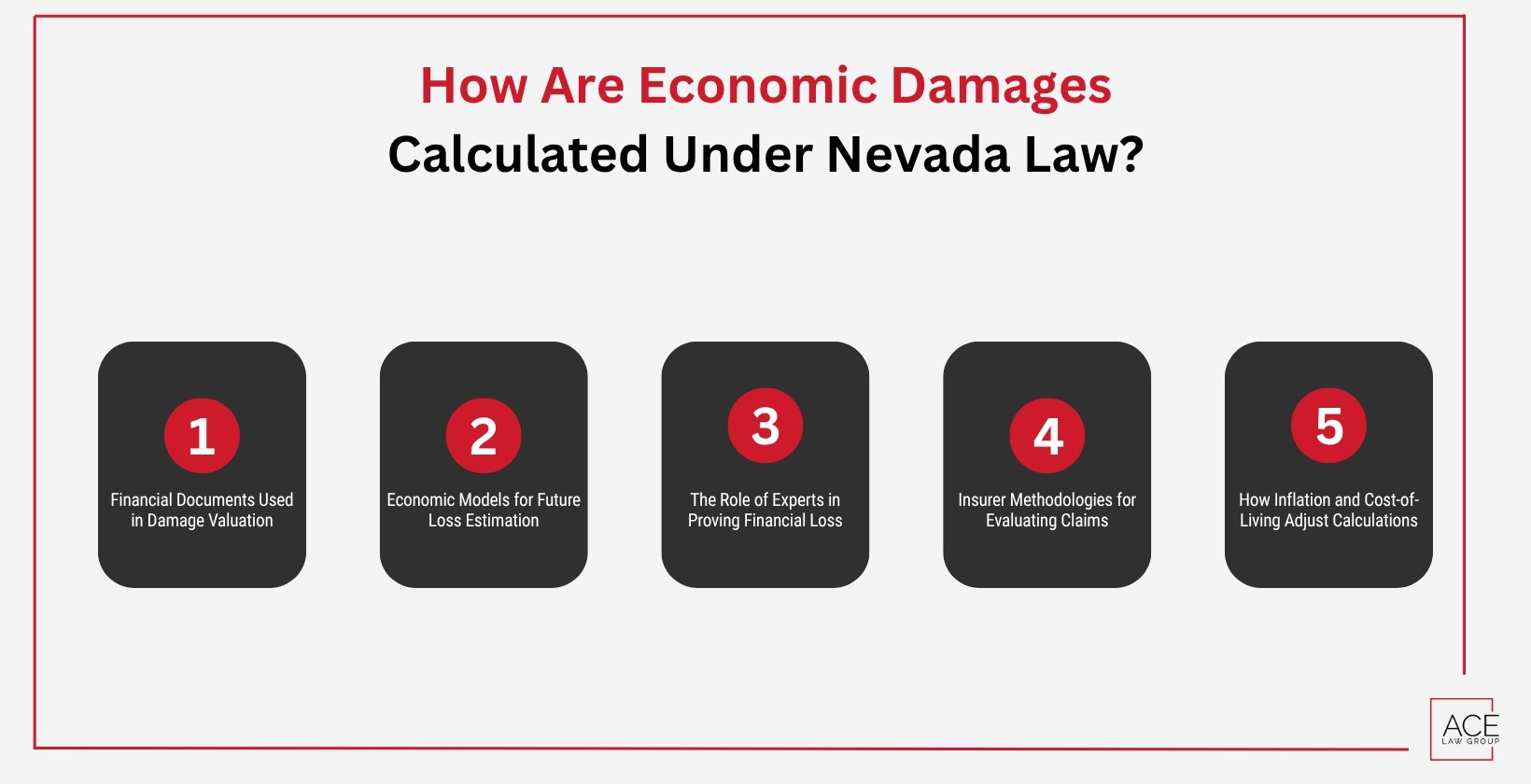
How Are Economic Damages Calculated Under Nevada Law?
Nevada courts, insurers, and Las Vegas car accident attorneys calculate economic damages by totaling all forms of monetary losses tied to the accident. The losses fall into two main categories: past expenses you’ve already incurred and future costs you’re expected to face due to ongoing or permanent injury.
This valuation process typically relies on the following critical determining factors:
Financial Documents Used in Damage Valuation
Insurance companies quantify economic damages based on a review of clear, timestamped, and itemized financial records. Major documentation they demand for damage valuation includes:
- All medical expense bills and treatment-related cost statements
- Employment and wage records that verify income loss
- Property repair estimates and out-of-pocket receipts
Insurers will reject unsupported costs, vague entries, or unrelated charges. Meanwhile, organized and consistent documentation increases both the value and credibility of your claim.
Economic Models for Future Loss Estimation
To calculate projected future losses, insurance adjusters and financial experts use accepted economic models that estimate the prospective expenses in today’s dollars.
Common models used in future loss estimation include:
- Present value calculations, which reduce future losses to their current worth
- Wage growth projections, based on your industry, age, and career path
- Life care plans, which estimate long-term medical and assistance costs
For instance, if a 40-year-old loses the ability to earn $50,000 per year due to a permanent back injury, a forensic economist might project $500,000 to $700,000 in future income loss using work-life expectancy tables and discount rates.
The Role of Experts in Proving Financial Loss
Expert testimonies particularly set a solid foundation for a fair economic damage validation, especially when future losses or complex earnings projections are involved.
Key expert roles include:
- Medical experts, who explain the severity, treatment needs, and long-term impact of your injuries
- Vocational experts, who assess how your injury affects your ability to work or retrain
- Forensic economists, who calculate future wage losses, benefit reductions, and life care costs
Experts help prove not just the amount, but the necessity and cause of each financial loss. Verifiable expert reports often shift how both courts and insurers view your claim.
Insurer Methodologies for Evaluating Claims
Without solely available financial documents, insurers use internal systems and standard formulas to evaluate, adjust, and sometimes reduce your economic damage claim. These methods focus on the type of loss, policy limits, liability findings, and the quality of your documentation.
Here are the most common and accepted evaluation methodologies:
- Medical bill review software to flag duplicate or excessive charges
- Damage severity scoring to estimate fair value ranges
- Internal wage calculators to verify lost income based on occupation
- Comparative fault adjustments based on accident reports and statements
Insurers may also apply reductions based on policy exclusions, coverage limits, or independent medical exam (IME) results.
How Inflation and Cost-of-Living Adjust Calculations
When projecting future economic damages, courts and experts in Nevada account for inflation and regional cost-of-living changes, especially in long-term care, medical treatment, and wage estimates. Without these adjustments, future damages would be undervalued.
Experts commonly use:
- Medical inflation indexes to estimate rising healthcare costs
- Regional cost-of-living data specific to Nevada
- Discount rates to adjust future losses to present value
- Wage trend analysis based on industry growth and labor forecasts
How Do Economic Damages Impact Self-Employed or Gig Workers?
Self-employed and gig workers in Nevada face specific hurdles when claiming economic damages after a car accident. That doesn’t mean non-salaried individuals can’t recover damages, but they need stronger proof and a clear income history.
Proving Variable Income and Missed Contracts
Without a fixed salary or employer documentation, non-salaried victims must present consistent records that show what they typically earned and what work they missed.
This includes tax returns, 1099s, profit-and-loss statements, client invoices, or booking confirmations. Insurers and courts examine this data to assess the scope and credibility of the claimed interruption.
Projecting Business Loss and Client Retention Value
When long-term injuries disrupt operations, claimants may seek compensation for future income loss. This requires documented proof of specific canceled contracts or lost opportunities, supported by historical performance data. Experts can estimate the financial impact using industry benchmarks, client turnover rates, and market forecasts. The objective is to quantify future losses based on measurable business trends, rather than assumptions.
What Are Common Disputes Over Economic Damage Claims?
While the economic losses may appear straightforward on paper, insurance disputes typically arise over the validity, necessity, or long-term certainty of those losses. In Nevada, the most contested economic damage claims involve issues in accurate future expense estimation, inconsistent medical records, and disputes over which treatments qualify for reimbursement.
Challenges in Proving Future Earnings Loss
Speculative Nature of Future Income: Insurers argue that future earnings aren’t guaranteed and rely on projections.
- Inconsistent Work History: Claimants with gaps in employment, freelance jobs, or short-term roles may struggle to establish a reliable earnings baseline.
- Lack of Upward Career Trajectory: Insurers may deny any claim of future economic potential if the claimant fails to show a pattern of income or career growth.
- No Expert Validation: Without expert input, future loss estimates often lack credibility.
- Missing Documentation: Claims without documentation linking the injury to long-term earning impact are usually reduced or rejected.
Gaps in Medical Documentation
When treatment records contain delays, skipped appointments, or inconsistent follow-up, insurers question the severity of the injury or the necessity of care. For example, a claimant who waits weeks to seek treatment or fails to follow medical advice risks losing credibility. Insurers use these gaps to argue that symptoms are unrelated, exaggerated, or resolved earlier than claimed.
Disagreements Over Necessary vs. Optional Treatment
Insurers only cover treatment deemed medically necessary. Alternative therapies, elective procedures, or prolonged care without updated medical justification often trigger disputes. If a treating physician doesn’t clearly recommend or connect the treatment to the accident, insurers may refuse to reimburse those costs.
How Does Long-Term or Partial Disability Affect Compensation?
When a car accident causes lasting physical or cognitive limitations, the value of an economic damages claim increases significantly. Economic damages claimants can recover both diminished earning capacity and the cost of vocational rehabilitation, but require accurate loss estimation and credible documentation.
Estimating Loss of Career Potential
Long-term or partial disability often reduces the injured person’s ability to return to their prior job or continue on their expected career path. To estimate potential career loss, courts and insurers look at:
- Pre-injury occupation, skill level, and salary history
- Age, education, and remaining work-life expectancy
- Industry-specific earning trends and job requirements
- Medical evidence and expert opinions verifying work limitations
Vocational Rehabilitation Costs as Economic Damages
When an injury forces a career change or job retraining, your economic damages can cover vocational rehabilitation costs. These include expenses for services like:
- Job retraining or skill certification programs
- Tuition for career transition education
- Resume support or job placement services
- Assistive technology or adaptive tools required for work
What Legal Rules Govern Economic Damage Recovery in Nevada?
Several legal rules shape how much an injured party can recover in economic damages after a car accident in Nevada. The state’s comparative fault laws, claim filing deadlines, and certain cap rules significantly affect eligibility and payout amounts.
How Comparative Fault Under NRS 41.141 Impacts Compensation
Nevada’s modified comparative negligence rule (or 51% bar rule) under NRS 41.141 determines how much settlement each involved party can claim. This evaluation is based on the percentage of fault each driver shares. Meaning, if you’re found partially at fault, your compensation is reduced by your percentage of fault. However, you lose the right to recover damages entirely if you’re 51% or more at fault.
| Total Damages | Your Fault % | Final Recovery |
|---|---|---|
| $100,000 | 0% | $100,000 |
| $100,000 | 25% | $75,000 |
| $100,000 | 50% | $50,000 |
| $100,000 | 51% or 51%+ | $0 |
What Is the Statute of Limitations for Filing Economic Damage Claims?
Under NRS 11.190, the deadlines for filing economic damage claims are:
| Type of Claim | Filing Deadline |
|---|---|
| Personal injury | 2 years from the date of the accident |
| Property damage | 3 years from the accident date |
Missing any of these car accident statutes of limitations can result in an automatic loss of your right to compensation. Some exceptions apply, such as delayed discovery of the injury, but those are rare and must be proven in court.
Are There Caps on Economic or Other Damages in Nevada?
No, Nevada does not cap economic damages in car accident cases. You can recover the full value of proven losses. However, there are caps on other types of damages, such as non-economic damages in medical malpractice claims and punitive damages.
Follow Special Procedures for Claims Against Nevada Government Entities
If your claim involves a government agency (such as a city department, county agency, or state-run entity), you must follow strict procedural rules under the Nevada Tort Claims Act. You must file a formal notice of claim with the appropriate government office, generally within 2 years of the accident.
Even if the agency is clearly at fault, Nevada law caps your total recovery at $200,000 per claim (NRS 41.035). The law bars punitive damages and does not allow claims to proceed if you miss the deadline or fail to follow proper notice procedures.
How Do You Prove Economic Damages in a Nevada Car Accident Case?
To recover economic damages in Nevada, the primary requirement is to provide admissible car accident evidence that proves your losses are both real and result from the accident.
Below are the common and accepted ways to prove economic damages in Nevada car accident claims.
- Submit medical records, invoices, and receipts as core evidence
- Verify lost wages and benefits through employer documentation
- Use expert reports to validate financial and vocational loss
- Provide tax returns and bank statements for self-employed income
- Include witness statements to support the economic impact
How Do Economic and Non-Economic Damages Differ in Nevada?
Nevada car accident compensation separates personal injury settlements into two categories: economic damages, which reflect direct financial loss, and non-economic damages, which reflect personal, non-financial harm. Each is valued and proven differently, and both may be awarded in the same claim.
Legal Definitions and Key Distinctions
| Type | Definition | Basis of Value |
|---|---|---|
| Economic Damages | Tangible financial losses directly caused by the accident | Calculated using invoices, wage records, tax filings, and itemized expenses that show actual monetary loss |
| Non-Economic Damages | Intangible harm such as pain, emotional suffering, loss of enjoyment, or trauma | Estimated through testimony, medical evaluations, pain journals, and expert psychological opinions |
Quantification Differences in Court and Insurance Claims
| Factor | Economic Damages | Non-Economic Damages |
|---|---|---|
| Insurer Evaluation | Based on documents and itemized totals | Uses formulas or multiplier method |
| Court Calculation | Follows evidence and expert testimony | Determined by jury discretion |
| Typical Dispute Areas | Reasonableness of charges | Severity and credibility of pain |
What Is the Typical Timeline for Economic Damage Resolution?
The time it takes to resolve an economic damage claim depends on several factors: the injury complexity, documentation quality, insurer response time, and whether litigation becomes necessary. While some claims settle in weeks, others may take over a year to resolve fully.
Here is the general timeline and what can affect its speed:
Claim Filing to Payment Duration
| Phase | Typical Duration |
|---|---|
| Initial claim filing | Within 1 – 2 weeks after the accident |
| Insurer review and investigation | 30 – 90 days (or longer, if incomplete) |
| Settlement negotiations | 1 – 6 months, depending on disputes |
| Payment disbursement | 2 – 4 weeks after final agreement |
What Is the Typical Timeline for Economic Damage Resolution?
The time it takes to resolve an economic damage claim depends on several factors: the injury complexity, documentation quality, insurer response time, and whether litigation becomes necessary. While some claims settle in weeks, others may take over a year to resolve fully.
Here is the general timeline and what can affect its speed:
Claim Filing to Payment Duration
Factors That Speed Up or Delay Settlement
| Accelerators | Delay triggers |
|---|---|
|
|
Role of Insurer Review and Independent Medical Exams
Insurers often conduct detailed reviews before offering compensation. In moderate to severe injury cases, they may request an Independent Medical Examination (IME) to verify the diagnosis, treatment plan, and long-term prognosis.
The IME can delay the claim by 2–6 weeks, and insurers often use it to dispute the treating physician’s findings. Legal guidance becomes necessary when an IME conflicts with your current medical evidence, especially when future economic damages are at stake.
Car Accident Resources
How to Get Access to a Car Accident Report in Las Vegas?
Car Accident Determining Fault By Location of Damage
Recovering Lost Wages After a Car Accident in Las Vegas
Are Car Accident Insurance Settlements Taxable?
How to Settle a Car Accident Claim Without a Lawyer?
Causes of Car Accidents in Las Vegas
What Happens If You Total a Leased Car in Nevada?
Frequently Asked Questions About Economic Damages in Nevada Car Accidents
Do Insurers Always Cover 100% of Economic Damages?
No, insurers do not always cover full economic damages and only pay what they deem reasonable, necessary, and properly documented. Disputes often delay the claim process and reduce the final amount.
Can You Claim Economic Loss if the At-Fault Driver Is Uninsured?
Yes, even when the other driver lacks insurance, you can use your own uninsured motorist (UM) coverage to pay for the losses. If you do not carry your UM coverage, recovery depends on the driver’s personal assets.
Are Economic Damages Still Recoverable if the Injured Party Shares Partial Fault?
Yes, under NRS 41.141, the injured party can still recover economic damages even if they are partially at fault. The final recovery decreases by the percentage of fault. The party 51% or more at fault recovers nothing.
Can Economic Damages Include Childcare or Elder Care Costs After an Accident?
Yes, economic damages may include childcare or eldercare costs if the need results from accident-related limitations and the expenses are documented and medically supported.
What Happens If You Underestimate Your Economic Damages During Settlement?
Once you accept an underestimated economic damage settlement, you typically waive the right to claim additional damages, even if future costs arise.
Can You Revise Your Economic Damage Claim After It's Been Submitted?
Yes, before settlement or trial, you can revise your economic damages and update the claim with new documentation, such as updated medical bills or wage losses.
Does Nevada Require Any Specific Documentation for Claiming Economic Losses?
Yes, Nevada law requires specific documentation, such as medical reports, employer records, repair receipts, and other written proof, to support each claimed economic loss.
How Do Courts Verify the Accuracy of Claimed Economic Damages?
Courts rely on financial records, expert testimony, and cross-examination to determine whether the amounts you claim are accurate and justified.
Ensure Accurate Valuation and Legal Compliance in Economic Damage Claims
A fair economic damage value relies on clear documentation, expert support, and compliance with state-specific rules. Underestimating your losses, missing deadlines, or submitting incomplete records may result in far less payout than you’re legally entitled to.
Before negotiating a settlement or going to court, make sure your claim reflects the full scope of your past and projected financial losses. Consult qualified car accident lawyers to understand what you can recover and how. Or call us directly at 702-333-4223