Every year, semi-trucks involved in crashes on Nevada roads produce some of the most catastrophic injuries seen in personal injury law. A single factor drives a large share of those crashes: blind spots.
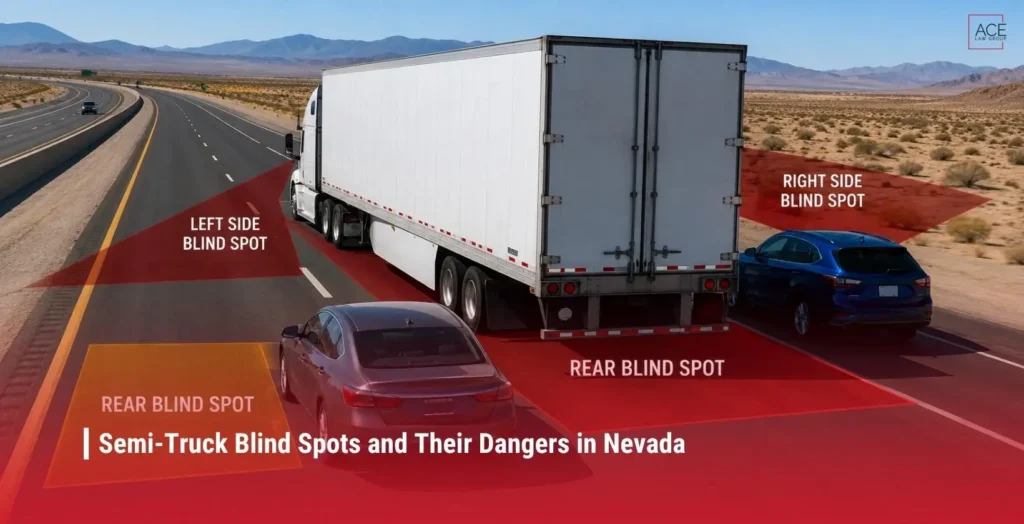
Blind spots on a commercial semi-truck are far larger than most passenger car drivers realize. The Federal Motor Carrier Safety Administration (FMCSA) calls these areas “no-zones” – the four danger zones surrounding a tractor-trailer where the driver’s visibility drops to zero, regardless of how their mirrors are adjusted. On Nevada’s high-speed interstates, those invisible areas become the sites of devastating collisions.
If a semi-truck’s blind spot crash left you or a family member injured in Las Vegas or anywhere in Nevada, you may have the right to hold the truck driver and the trucking company accountable. Attorney Patrick W. Kang and the truck accident attorney team at Ace Law Group have recovered compensation for commercial truck accident victims across Nevada. Call (702) 333-4223 for a free case evaluation, or reach out through our contact form at any time.
Key Takeaways
| Key Fact | Detail |
|---|---|
| What are truck blind spots called? | “No-zones” (FMCSA official term) or “no-go zones” |
| Front no-zone | Up to 20 feet ahead of the cab |
| Right-side no-zone (most dangerous) | 2 or more lanes wide, entire length of trailer |
| Left-side no-zone | Approximately 1 lane wide along the trailer |
| Rear no-zone | Up to 30 feet directly behind the trailer |
| The Mirror Rule | If you cannot see the driver’s face in their side mirrors, they cannot see you. |
| Nevada statute of limitations | 2 years from the accident date (NRS 11.190) |
| Nevada comparative negligence | You can recover if your fault is 50% or less (NRS 41.141) |
What Are Semi-Truck Blind Spots? The No-Zones Defined
Semi-truck blind spots are the zones around a commercial vehicle where the driver cannot see other vehicles through their mirrors from the driver’s seat. These zones are officially called “no-zones” by the FMCSA. According to federal safety research, these blind spots are a leading cause of passenger vehicle collisions with large trucks in the United States.
Unlike passenger cars with relatively small blind areas, an 18-wheeler can weigh up to 80,000 pounds when fully loaded and stretch up to 72 feet in length. That combination of height, weight, and length creates blind zones large enough to swallow an entire passenger car. The trucks have significant blind spots on all four sides simultaneously, which means a driver can be completely unaware of your vehicle even when you are riding directly alongside or behind them.
These blind spots are sometimes referred to as “no-go zones” or simply blind areas around the truck. Whatever name they go by, the danger is the same: truck drivers cannot see you when you ride in these spots, and that invisibility can turn a routine lane change into a fatal crash.
The Four No-Zone Danger Areas on a Semi-Truck
Commercial trucks have significant blind spots at all four points around the vehicle. Understanding where each begins and ends is what keeps Nevada drivers safe when sharing a highway with a big rig.
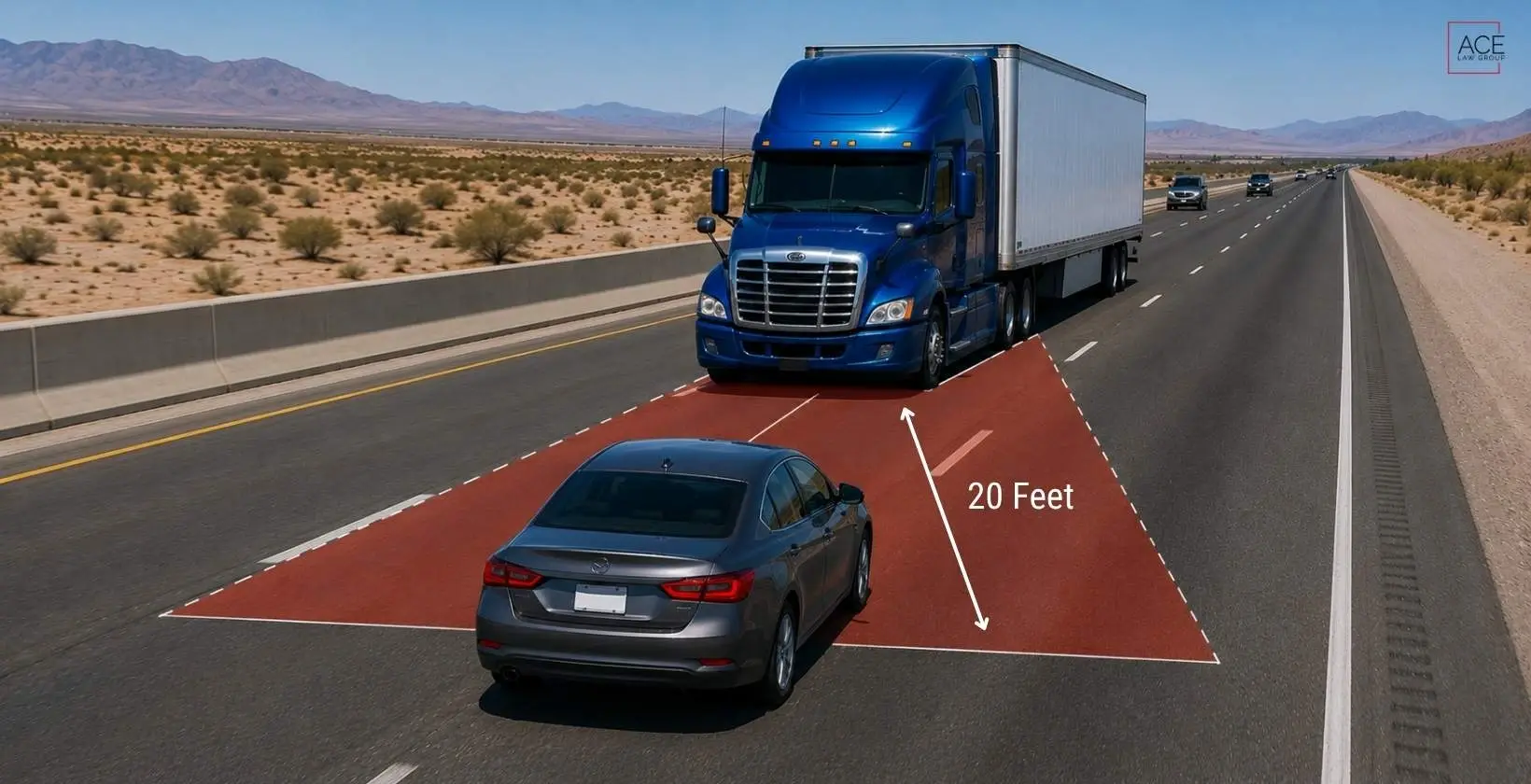
Front Blind Spot: Extends 20 Feet Ahead of the Truck
The front blind spot extends approximately 20 feet directly ahead of the truck’s cab. Because truck drivers sit much higher than passenger car drivers, the height of the cab and hood creates a dead zone directly in front of the vehicle that the driver cannot see at all. If you cut off a semi-truck and merge into the lane ahead of it without leaving at least 20 feet of clearance, your vehicle can disappear from the driver’s view entirely. At highway speed, a trucker with no visual on your car has no opportunity to brake in time.
Right-Side Blind Spot: The Most Dangerous No-Zone
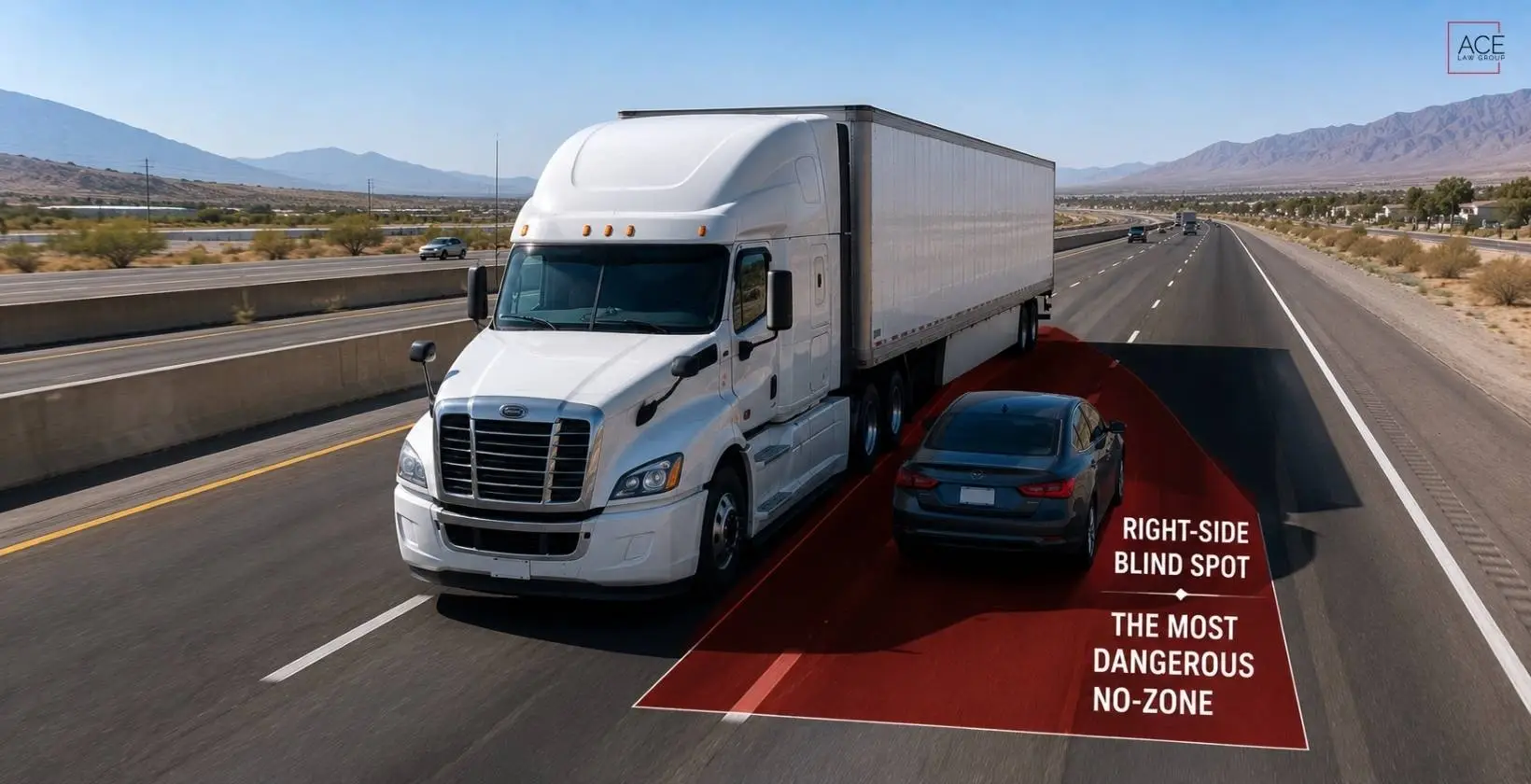
The right-side no-zone is the largest and most dangerous blind area on a semi-truck. It stretches across two or more lanes, running from the cab all the way to the rear of the trailer. Truck drivers cannot see you when you ride in this zone at any position along the passenger side of the vehicle. This is the area where the most dangerous blind spot accidents occur. The rule is absolute: never pass a semi-truck on the right, and never linger beside the right side of the trailer for any length of time.
Left-Side Blind Spot: One Lane Over
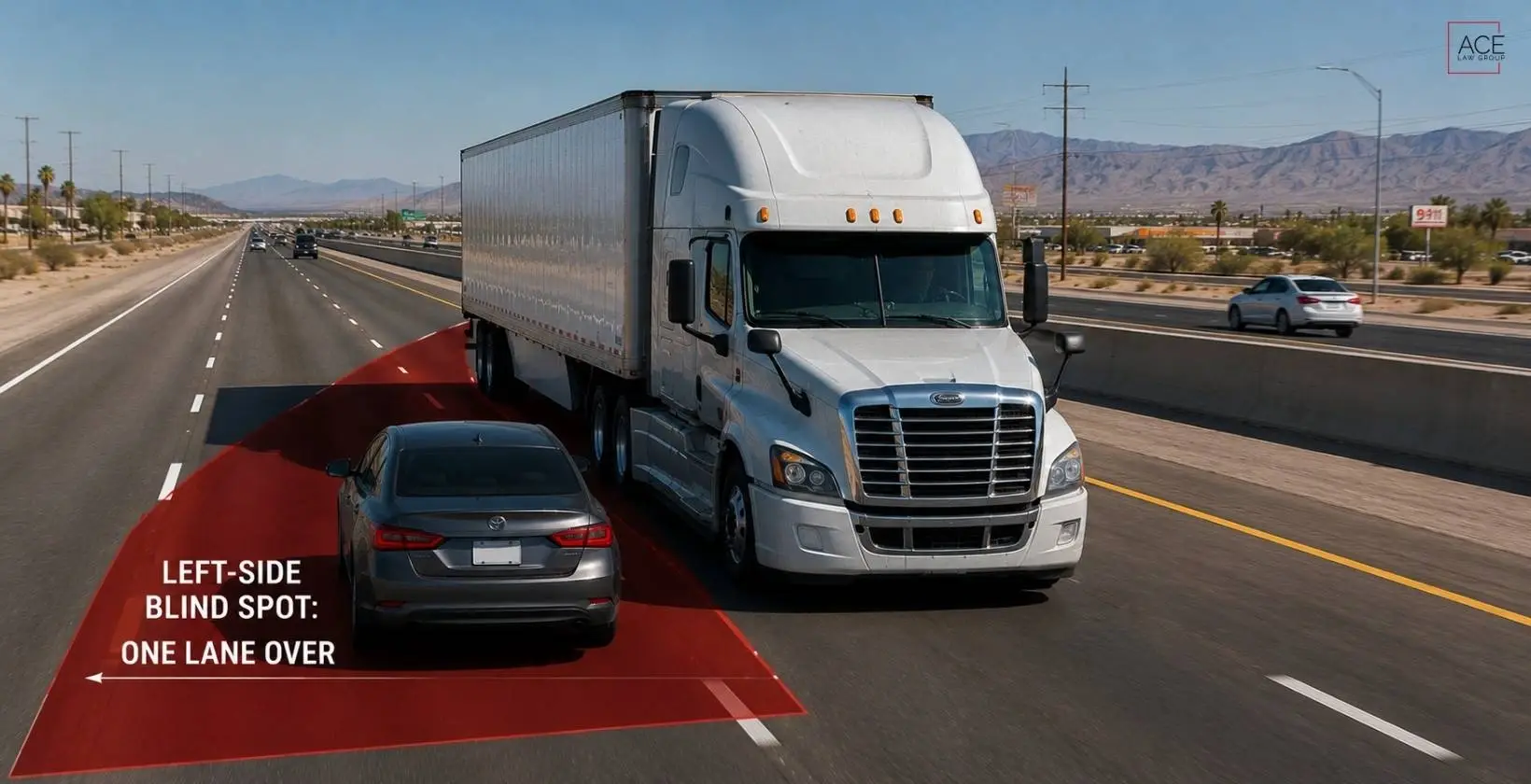
The left-side blind spot runs along the full length of the trailer, extending roughly one lane in width. It is smaller than the right-side zone, but large enough to hide a passenger vehicle entirely. When you pass a truck on the left (which is the correct side to pass), move quickly and do not linger alongside the trailer. The moment you leave the driver’s mirror reflection, you have entered the blind zone.
Rear Blind Spot: Up to 30 Feet Behind the Trailer
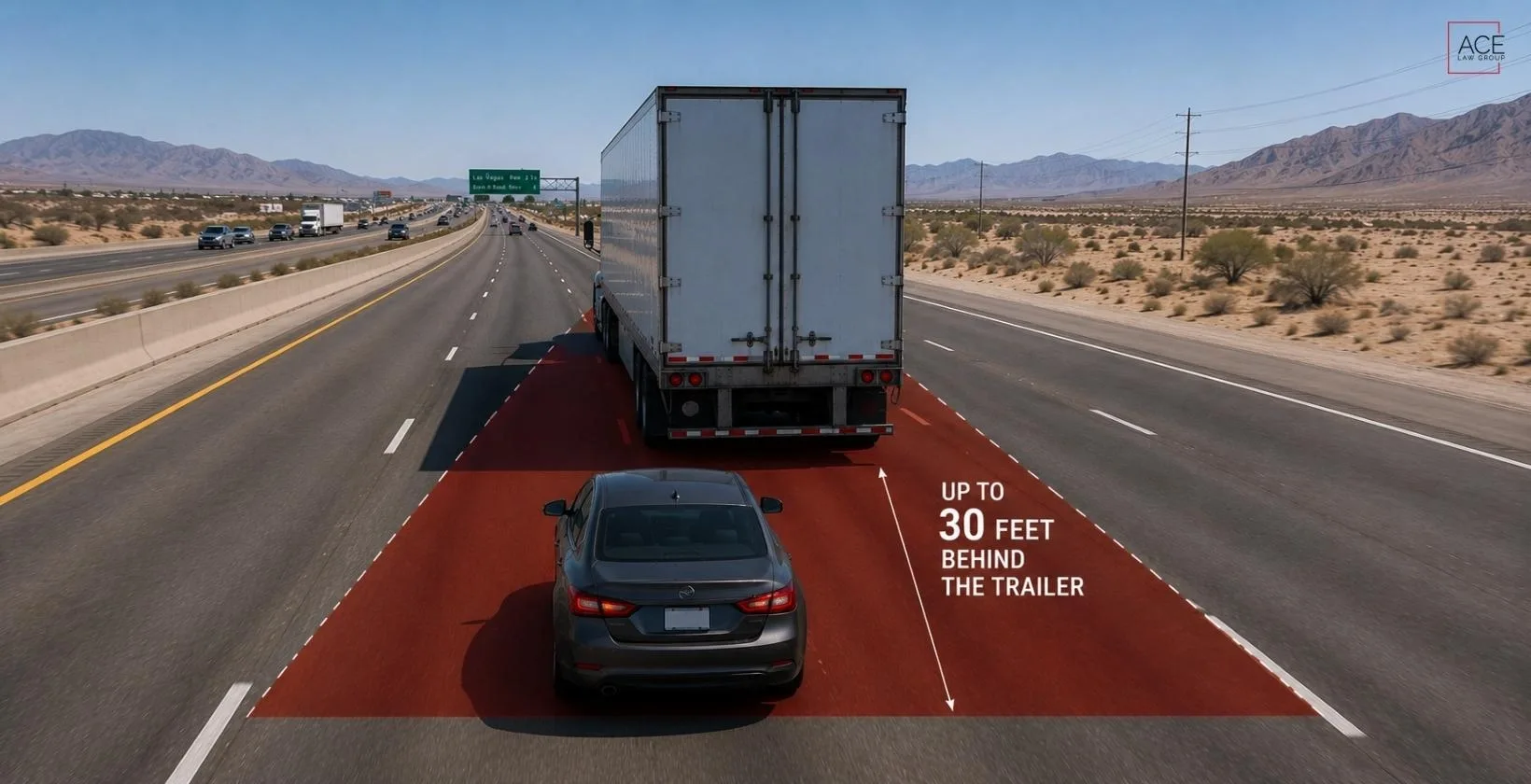
Unlike passenger vehicles, semi-trucks have no rear-view mirror. The rear no-zone extends approximately 30 feet directly behind the trailer, and the driver has absolutely no visibility into that area. Tailgating a semi-truck places you in this zone completely. If the driver brakes suddenly for debris or stopped traffic, you have no warning and no reaction time. The rear blind spot is particularly dangerous on Nevada’s interstates where vehicles follow closely at high speed.
The Mirror Rule: Testing Whether You Are in a Truck’s Blind Spot
Check the truck’s side mirror before you settle into a lane beside it. If you cannot see the driver’s face in that mirror, the driver cannot see you, and you are sitting inside a no-zone right now.
Clearing a side no-zone by moving forward means watching the truck’s mirror, not your own, until the driver’s face shows up in it. If you are passing rather than repositioning, do not stop there. Keep going until the truck’s full cab appears in your own rearview mirror. That is what puts you clear of the front no-zone, too.
Clearing a side no-zone by dropping back instead means treating it the same way you would treat trailing the truck directly: hold at least 30 feet behind the trailer. That is the same distance that keeps you out of the rear no-zone in the first place.
Do not rely on this check in front of or behind the trailer. No mirror reaches the 20 feet ahead of the cab or the 30 feet behind it, so treat those two zones as distance problems. Give yourself the clearance. Do not look for a reflection that will not appear.
Why Nevada’s Roads Make Blind Spot Accidents More Deadly
Nevada’s highway network carries enormous commercial truck traffic, and the state’s road conditions amplify the risks that no-zones already create.
Interstate 15 carries heavy freight traffic through the Las Vegas metro area north toward Utah. Interstate 80 crosses northern Nevada from Reno eastward, linking major distribution hubs across the region. Both corridors operate at posted speeds of up to 80 mph in rural stretches. At those speeds, a passenger vehicle lingering in a truck’s no-zone for even a few seconds faces catastrophic consequences if the truck driver initiates a lane change without visual confirmation.
Las Vegas intersections create a different kind of risk than rural highways. When a semi-truck makes a right turn at a large Las Vegas intersection, the driver must swing wide to the left to create enough room for the trailer to clear the turn. Drivers who attempt to squeeze their vehicle between the truck and the curb on the right side get caught inside the turning radius, which is an area the driver cannot see and cannot abandon once the turn begins. These are the areas that are the most dangerous moments in urban blind spot interactions.
Tourism traffic compounds the problem year-round. Visitors unfamiliar with Nevada’s wide multi-lane interstates and the specific behaviors of long-haul trucking are statistically more likely to drift into no-zones without recognizing the danger. Experienced Nevada drivers learn to give trucks a wide berth. Out-of-state drivers often do not.
One Risk Drivers Overlook: How Semi-Trucks Create Blind Spots for the Vehicles Behind Them
Most coverage of truck blind spots focuses on what the truck driver cannot see. There is a second hazard that receives far less attention: the way a semi-truck eliminates forward visibility for the vehicles traveling directly behind it.
When your vehicle is directly behind a semi-truck on I-15 or I-80, the height and width of the trailer wall block your view of the road ahead almost entirely. If a vehicle ahead of the truck brakes suddenly, or if there is road debris or stopped traffic in the lane, you cannot see it until you move far enough to the side to look around the trailer. By the time you spot the hazard, you may not have enough room to change lanes safely without cutting off the truck or merging into adjacent traffic.
This is why maintaining adequate following distance behind a semi-truck matters beyond just the rear blind spot. You need space not only to stop safely, but to see around the truck before a problem develops. The FMCSA’s commercial vehicle safety guidance specifically addresses this forward-visibility issue and recommends keeping enough distance to have a clear sightline around the vehicle in front.
For a broader look at the dangers that commercial trucks pose to passenger vehicles on Nevada roads, see our post on the dangers of commercial trucks.
A Truck Driver’s Legal Responsibility Under Nevada Law
Your vehicle being inside a truck’s blind spot at the time of impact does not automatically eliminate the truck driver’s legal liability. Under Nevada law and FMCSA federal regulations, commercial truck drivers carry an affirmative duty to operate their vehicles safely, to properly adjust and actively use their mirrors, and to verify their surroundings before changing lanes or turning.
FMCSA regulations under 49 CFR Part 393 require commercial trucks to be equipped with properly positioned mirrors that provide adequate field of view on both sides of the vehicle. Drivers who fail to check those mirrors before a lane change, who have improperly adjusted mirrors, or who violate hours-of-service rules that led to fatigue at the time of the crash, can be found negligent under both federal and Nevada standards.
Liability does not end with the driver. The trucking company can be held accountable under vicarious liability if the driver was operating in the scope of employment at the time of the crash. If the company’s hiring practices, training programs, or dispatch scheduling contributed to the conditions that caused the accident, direct negligence claims against the company can be pursued alongside the claim against the driver.
Nevada follows a modified comparative negligence rule (NRS 41.141). If you were partially responsible for the crash, your recovery is reduced by your share of fault. But as long as your fault is 50% or less, Nevada law still allows you to recover compensation. A thorough investigation frequently uncovers facts that shift fault percentages significantly, including violations of federal trucking regulations that the driver and carrier would prefer to keep quiet.
Nevada’s statute of limitations for personal injury claims is two years from the accident date under NRS 11.190. That deadline applies to blind spot truck accident claims regardless of case strength. Missing it eliminates your right to sue. For legal representation in truck accident claims in Las Vegas and across Nevada, call our office directly at (702) 333-4223.
What to Do After a Blind Spot Truck Accident in Las Vegas
The hours after a semi-truck crash are critical. Evidence that determines fault can be collected, preserved, or permanently lost within days of the accident. These four steps give your case the best foundation.
- Document the scene thoroughly. Photograph both vehicles from multiple angles before they are moved. Capture skid marks, lane positions, traffic signals, and any debris field. Write down the truck driver’s name, commercial driver’s license number, the trucking company name, and the carrier’s Department of Transportation number visible on the truck door.
- Preserve electronic evidence immediately. Commercial trucks carry event data recorders, sometimes called black boxes, that record speed, braking force, and steering inputs in the moments before impact. Understanding what a truck’s black box records is critical: trucking companies are required to preserve that data, but the preservation window is narrow and data can be overwritten during normal operation. A legal hold letter sent by an attorney within hours of retaining a case is often what prevents that data from disappearing.
- Get medical evaluation immediately. Even if you feel uninjured at the scene, adrenaline and shock mask pain. Traumatic injuries from high-speed blind spot crashes often present hours or days later. A documented medical visit establishes a clear timeline connecting your injuries to the crash.
- Contact a truck accident attorney before speaking to the carrier’s insurance company. Trucking companies deploy rapid response teams to accident sites specifically to protect their legal position. Their adjusters are experienced at gathering statements that minimize liability. For a complete breakdown of what evidence matters in these cases, see our guide on truck accident case evidence in Nevada.
FAQs About Semi-Truck Blind Spots
What Are a Truck’s Blind Spots Called?
A truck’s blind spots are officially called “no-zones” by the FMCSA, the federal agency that regulates commercial trucking safety. The existing page for this topic also uses the term “no-go zones,” which some state driver’s manuals and law enforcement use interchangeably. Both terms describe the same four danger areas on all sides of a commercial vehicle.
How Many Blind Spots Does a Semi-Truck Have?
A semi-truck has four primary blind spots: the front no-zone extending up to 20 feet ahead of the cab, the right-side no-zone spanning two or more lanes along the full length of the trailer, the left-side no-zone covering approximately one lane along the trailer, and the rear no-zone extending up to 30 feet directly behind the trailer.
What Are the Two Main Blind Spots Around Commercial Vehicles?
While semi-trucks have four no-zones, the two most commonly cited in driver safety education are the right-side blind spot and the rear blind spot. The right-side no-zone is the largest danger area and covers multiple lanes. The rear no-zone is the most dangerous for following vehicles because there is no rear-view mirror on a commercial truck and no warning before a sudden stop.
Can I Still Recover Compensation If My Car Was in the Truck’s Blind Spot?
Yes, in most cases. Nevada’s modified comparative fault law (NRS 41.141) allows injured drivers to recover damages even if they contributed to the crash, as long as their share of fault is 50% or less. The truck driver’s duty to monitor blind spots and operate safely does not disappear simply because your vehicle was in a no-zone. An investigation often reveals that the driver failed to check mirrors before changing lanes, failed to signal, or was driving in violation of FMCSA hours-of-service regulations that caused fatigue, all of which shift fault substantially toward the driver and carrier.
How Long Do I Have to File a Blind Spot Truck Accident Claim in Nevada?
Nevada imposes a two-year statute of limitations for personal injury claims under NRS 11.190, measured from the date of the accident. This deadline applies to truck accident claims regardless of how serious the injuries are or how clear the liability appears. Missing the filing deadline forfeits your right to pursue any compensation, so contacting an attorney promptly after the crash is essential.
Who Can Be Liable for a Semi-Truck Blind Spot Accident?
Liability can extend to multiple parties: the truck driver for failing to check mirrors and operate safely, the trucking company under vicarious liability and potentially under direct negligence for inadequate driver training or unsafe scheduling, the cargo loader if improper loading affected vehicle stability, and a maintenance contractor if faulty equipment contributed to the crash. A full investigation determines which parties share fault and in what proportion.
Hit in a Las Vegas Blind Spot Truck Crash? Talk to Ace Law Group
Blind spot truck accidents cause some of the worst injuries on Nevada roads, and they are not random. They happen when truck drivers fail to follow federal safety rules, when trucking companies cut corners on training, and when the people responsible for operating 80,000-pound vehicles do not take that responsibility seriously. If a no-zone crash left you injured, you have the right to answers and the right to compensation.
Patrick W. Kang and the personal injury attorneys at Ace Law Group have recovered compensation for truck accident victims throughout Las Vegas, Henderson, and Nevada. We work on a contingency fee basis – you pay nothing unless we win your case. Call (702) 333-4223 for a free, no-obligation consultation, or use our contact form to reach the team at any hour.
Our truck accident attorneys represent injured clients throughout Nevada, including in Las Vegas, Henderson, Boulder City, Reno, Enterprise, North Las Vegas, Spring Valley, Sunrise Manor, Paradise, Whitney, Mesquite, and Summerlin.