
ace law group
Testimonials
The Ace Law Group has helped me and my family through a few difficult challenges. Their level of professionalism is unmatched. Patrick Kang and his team are compassionate, organized and attentive.
Their expertise in handling my accident case provided my family with much needed relief and satisfaction. It’s rare to find the combination of compassion and professionalism that Ace Law Group Possesses.
Ace Law Group was great in helping with an accident. My lawyer Kyle was very knowledgeable and kind to work with as well. Sujin was excellent with all the support.
Boulder City Truck Accident Lawyer
US-93 through Boulder City is one of Nevada’s busiest commercial freight corridors. 18-wheelers run the Las Vegas metro to Kingman, Arizona route around the clock, sharing the road with Hoover Dam construction traffic and tanker loads that cannot legally route through downtown Las Vegas. The preliminary FMCSA data recorded 958 large truck crashes in Nevada in 2025, a 30% increase from 2022. Most victims on this corridor get an adjuster call before they get a diagnosis.
Insurance companies count on victims staying quiet and accepting less. That is exactly why they hate firms like ours. Led by founding attorney Patrick W. Kang, the Ace Law Group team has recovered over $175 million for Nevada injury victims who refused to accept the first offer on the table.
As a Boulder City personal injury lawyer handling truck accidents, car crashes, wrongful death, and catastrophic injury claims across Clark County, Patrick W. Kang and the team take over immediately: preserving black box data, filing claims, negotiating aggressively with insurers, and taking cases to trial when the offer falls short. Clients who retained Ace Law Group recovered far more than the insurance company’s opening offer. Accept nothing less.
- $44M+ recovered in 2025 alone
- $175M+ recovered overall
- 4.7 rating across 400+ verified reviews
- Former judge on our team
- Fluent in English, Spanish, Chinese, and Korean
- Available 24/7
- No recovery, no fee
Call (702) 333-4223 for a free, no-obligation consultation.
The Trucking Company Had Lawyers. We Had Their Driver’s Logs.
A commercial truck hit our client on a Clark County road. Within 48 hours, the trucking company’s adjuster was already on the phone. The offer they made did not reflect what the case was actually worth. It never does. Ace Law Group sent a spoliation letter the day of retention, recovered black box data before it was overwritten, and obtained the driver’s hours-of-service logs from the carrier under a formal preservation demand. The evidence established federal HOS violations.
The carrier settled for $1,000,000.
Prior results do not guarantee a similar outcome. Every case is unique, and the value of any claim depends on its specific facts and circumstances.
Ready to talk about your case? Get a free consultation with our truck accident attorney. No obligation. Available 24/7.
How a Truck Accident Claim Differs From a Car Accident Claim
Three factors separate a commercial truck crash from a standard car accident claim, and each one works against an unrepresented victim from the first day.
The injuries go further. At highway speed, the force of an 80,000-pound semi produces injuries that car crashes rarely cause: traumatic brain injuries (TBI), spinal cord damage resulting in paralysis, internal organ rupture, and crush injuries requiring amputation. These do not resolve in weeks. They reshape earning capacity, independence, and family life for years.
Multiple parties share liability. A car accident typically involves one driver and one insurance policy. A truck accident may involve the driver, the trucking company, the cargo loader who failed to secure freight, the maintenance contractor who ignored brake warnings, and the manufacturer if a defect contributed. Each party carries its own insurer and its own legal team working against you simultaneously.
Federal regulations create a distinct legal framework. Commercial trucks must comply with Federal Motor Carrier Safety Regulations (FMCSR) on top of Nevada law. Violations of hours-of-service limits, ELD requirements, inspection standards, and CDL rules establish negligence in ways that standard traffic law does not. Knowing which regulations apply and how to use them in evidence is what separates a settlement from a full recovery.
Top-notch service from start to finish. Hired this team after a rear-ended accident and the entire process was seamless. Elizabeth, our case manager, was staying on top of my case and kept me informed. Happy with the result and highly recommend for those who is looking for efficent and professional team.
Who Can Be Held Liable for a Truck Crash on US-93
A commercial truck crash on US-93 is not a two-party dispute. It is a claim against an entire operation, and every party in that operation carries its own insurer and its own legal team.
- The truck driver faces liability for HOS violations, speeding to meet delivery deadlines, distracted driving, and impairment. Black box and ELD data establish exactly what the driver was doing before impact.
- The trucking company is liable when it hires unqualified drivers, ignores failed drug tests, enforces schedules that make legal compliance impossible, or keeps trucks with documented maintenance failures on the road. Repeated federal inspection failures create punitive damage exposure.
- Cargo loaders and freight vendors own the crash when an improperly balanced load causes a rollover, or overweight cargo prevents a stop. The driver may be blameless. The freight company is not.
- Maintenance contractors and manufacturers share liability when a missed brake warning or a defective part contributed to the collision. That triggers a product liability claim running alongside the negligence case.
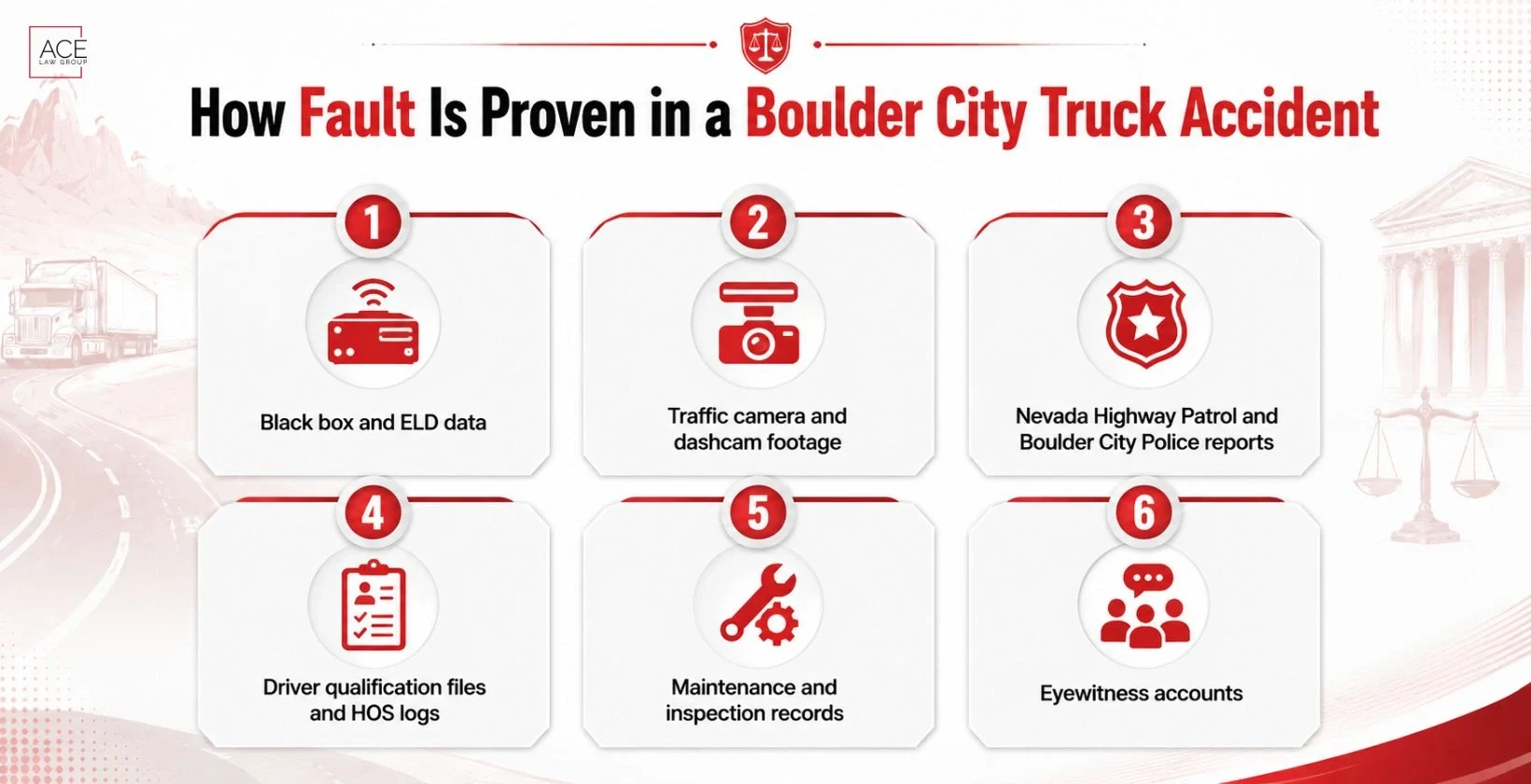
How Fault Is Proven in a Boulder City Truck Accident
On rural corridors like US-93, evidence does not wait. Black box data gets overwritten. Dashcam footage from roadside businesses cycles within days. Witnesses move on. Ace Law Group sends spoliation letters and begins evidence collection promptly, including the following:
- Black box and ELD data are the most valuable evidence in a commercial truck case. FMCSR requires most carriers to use Electronic Logging Devices that record speed, braking force, engine performance, and hours-of-service compliance in the seconds before impact. Trucking companies are not required to preserve it indefinitely. Our spoliation letter goes out within hours of retention.
- Traffic camera and dashcam footage. Nevada DOT cameras cover sections of US-93 approaching Henderson. In-cab dashcam recordings combined with footage from businesses along Boulder Highway frequently resolve disputed liability before litigation begins.
- Nevada Highway Patrol and Boulder City Police reports document skid marks, impact angles, vehicle positions, and initial fault assessments while the physical evidence is still present. Serious crashes on US-93 trigger commercial vehicle inspection protocols that produce their own violation record.
- Driver qualification files and HOS logs must be maintained by every carrier under FMCSA regulations, including CDL records, medical certificates, drug and alcohol testing results, and driving time logs. A violation of 49 CFR Part 395 HOS limits documented in those files is direct evidence of negligence.
- Maintenance and inspection records under 49 CFR Part 396 tell us whether the carrier knew about a brake failure, a tire defect, or a steering problem before putting the truck back on the road. Carriers that destroy these records after receiving a spoliation letter face court sanctions. That destruction becomes evidence of its own.
- Eyewitness accounts from other drivers on US-93 provide independent, third-party confirmation of the crash sequence before recollection fades.
Our attorneys walk through the complete process we use to secure and analyze truck accident case evidence so no carrier violation goes unnoticed.
How Nevada’s Comparative Fault Rule Affects Your Recovery
Nevada’s modified comparative negligence rule under NRS 41.141 allows recovery as long as your share of fault is 50% or less. At 20% fault on a $500,000 claim, you recover $400,000. At 51% or more, you recover nothing.
Nevada is not a no-fault state. Your own insurer does not automatically cover your losses. Trucking company adjusters move fast, ask questions before your attorney has reviewed the evidence, and inflate your fault percentage before you understand what is happening. Do not give any insurer a recorded statement before calling us.
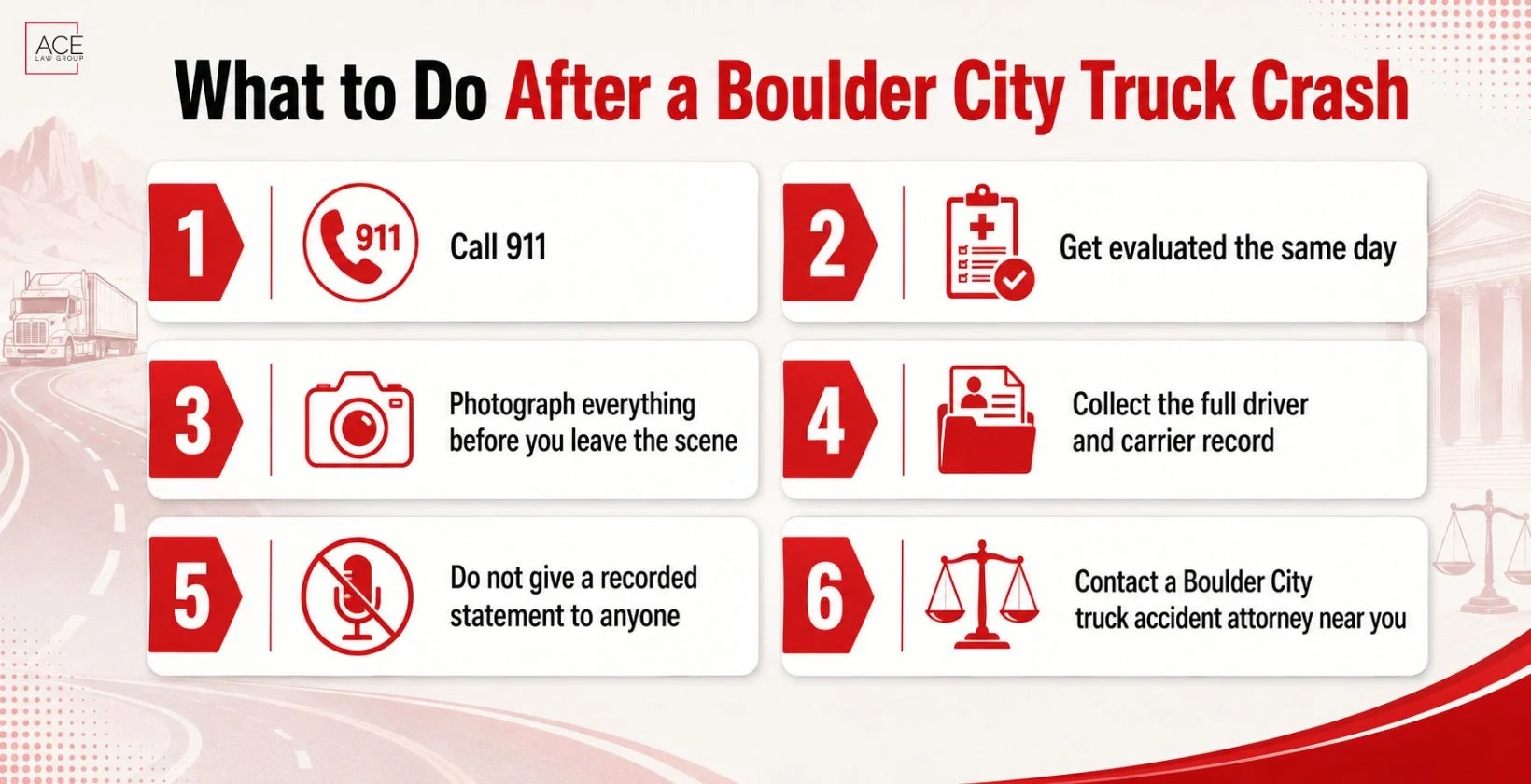
What to Do After a Boulder City Truck Crash
Acting within the first 48 hours preserves evidence, protects the medical record, and avoids the mistakes that trucking company insurers depend on. These 6 actions determine how much your case is worth.
- Call 911. Report the crash to the Boulder City Police Department (900 Arizona Street) or the Nevada Highway Patrol and request medical help. The responding officer’s report documents skid marks, impact angles, and vehicle positions while the physical evidence still exists. That report becomes one of the first documents the carrier’s attorney requests.
- Get evaluated the same day. Boulder City Hospital (901 Adams Blvd) handles initial evaluation. For critical trauma, University Medical Center (800 Rose Street, Las Vegas) is Nevada’s only Level I Trauma Center. Adjusters treat every gap between the crash date and your first medical visit as evidence that your injuries were not serious. Do not give them that gap.
- Photograph everything before you leave the scene. Vehicle damage, skid marks, the truck’s DOT number, license plates, visible cargo, and the carrier name on the truck door. Use your phone’s GPS timestamp. Note road conditions, lighting, and posted speed limits. This takes five minutes, and it matters for years.
- Collect the full driver and carrier record. Driver’s name, CDL license number, employer, plate number, DOT identification number, and VIN. Contact information from every witness. Once people leave the scene, they are gone.
- Do not give a recorded statement to anyone. Trucking company adjusters call unrepresented victims within 24 to 72 hours because those victims accept less. Every word of a recorded statement gets reviewed by the carrier’s legal team before you have reviewed anything. Decline every recorded statement and every settlement offer until you have counsel.
- Contact a Boulder City truck accident attorney near you. The commercial trucking company’s legal team is already working on your case. Level the playing field. Call (702) 333-4223. Free consultation. No obligation. Available 24/7.
Mistakes That Cost Boulder City Truck Accident Victims Money
- Delaying medical care. Adjusters treat every gap between the crash date and your first medical visit as evidence your injuries were not caused by the crash. Get evaluated the same day, even if you feel fine.
- Giving a recorded statement without counsel. A recorded statement is not a conversation. It is a deposition without your attorney present. Every answer gets tested against the physical evidence for inconsistencies, and a single contradictory detail, even an honest one, hands the carrier exactly what it needs to reduce your recovery.
- Posting about the accident on social media. Every photo, caption, and check-in goes directly into the defense attorney’s hands before discovery even begins. Say nothing publicly until your case is resolved.
- Settling before maximum medical improvement (MMI). Closing the case before MMI is reached makes future surgeries, therapy costs, and lost wages your problem permanently. The settlement cannot be reopened.
Types of Truck Accidents on US-93 and Boulder City Roads
US-93 through Boulder City carries interstate freight, Hoover Dam construction traffic, and hazardous cargo loads on two-lane roads without median barriers, at highway speeds, around the clock. Every crash type below is a documented consequence of that combination.
- Rear-End and Blind Spot Crashes: At 65 mph, a loaded semi needs more than 600 feet to stop. Four no-zone areas surround every semi. On US-93’s construction stretches and variable speed zones, the stopping distance and those blind spots combine in ways that passenger drivers do not anticipate.
- Sideswipe and Lane Change Crashes: Wind gusts on the open highway approaching Boulder City push trailers sideways without warning. These crashes are documented on US-93 and along Boulder Highway, where truck blind spots and crosswinds leave smaller vehicles with no room to react.
- Brake Failure on the US-93 Descent: US-93 has significant grade changes approaching Boulder City that put sustained stress on commercial braking systems. When those brakes fail on a descent, the truck does not slow down.
- Jackknife Accidents: Hard braking swings the trailer perpendicular to the cab, turning an 80,000-pound rig into a barrier across both lanes. US-93 has no median barrier on significant stretches outside Boulder City. A jackknife does not stay in one lane.
- Wide Turn Crashes: Before completing a right turn, a tractor-trailer must swing left to accommodate the trailer’s turning radius. Drivers, cyclists, and pedestrians caught in that swing zone on Boulder City’s commercial intersections along Nevada Way and Veterans Memorial Highway have no warning before impact.
- Tanker and Hazmat Crashes: US-93 carries fuel tankers and hazardous cargo loads serving the Hoover Dam corridor year-round. A ruptured tank creates fire, explosion, and chemical exposure risk. Burns, respiratory damage, and contamination require monitoring long after the road reopens.
- Rollover Accidents: The curves approaching Boulder City from Henderson destabilize a trailer fast. On two-lane stretches of US-93 with no barrier, a rollover crosses into oncoming traffic.
- Underride Crashes: A passenger vehicle slides beneath the trailer on impact. Occupants absorb the full force at the roof level. These are among the most fatal crash types on Nevada roads. FMCSA underride guard requirements set minimum standards, but enforcement gaps on older commercial trailers remain a documented problem.
- Lost Load Crashes: Unsecured cargo on US-93 creates secondary crashes as drivers swerve to avoid debris. The cargo loader and the trucking company share liability for every crash that follows. When defective securement equipment contributed, a product liability claim runs alongside the negligence case against the carrier.
Common Causes of Commercial Truck Crashes in Boulder City
US-93’s freight volume, delivery pressure, and two-lane geometry create the exact conditions these causes require.
- Driver Fatigue: A driver past the 11-hour federal limit carries reaction-time impairment equivalent to operating at a 0.08 BAC. Long hours behind the wheel dramatically increase crash risk on corridor runs like US-93, and ELD data tells us exactly how long that driver had been on the road before impact.
- Distracted Driving: The FMCSA prohibits the use of handheld devices by commercial drivers in interstate commerce. On long runs between Las Vegas and Arizona, dispatch communication and GPS reprogramming are the most documented in-cab distractions in commercial vehicle crash investigations. A violation is direct evidence of negligence.
- Speeding: The speed differential between a loaded 18-wheeler and a passenger vehicle on US-93 is not obvious until it is too late. When a carrier’s delivery schedule demands speed the road cannot safely absorb, someone gets hurt.
- Impaired Driving: FMCSA mandates post-crash testing within 2 hours for alcohol and 32 hours for controlled substances after a qualifying crash. A positive result is direct evidence of negligence. Carriers that fail to test face liability that extends beyond the driver.
- Maintenance Failures: Brake system failure is the most documented equipment defect in commercial vehicle roadside inspections. Carriers receive brake warnings and still return trucks to service. That decision, made in a maintenance bay days before the crash, is what eliminated the stopping distance on US-93.
For a full breakdown of commercial vehicle dangers on Nevada roads, see the dangers of commercial trucks.
Injuries Caused by Truck Accidents in Boulder City
An 80,000-pound freight truck hitting a passenger vehicle on US-93 is not a car accident. The force, the weight differential, and the crash dynamics produce a distinct injury profile, one that emergency rooms in Boulder City and Las Vegas see repeatedly on this corridor.
- Traumatic Brain Injuries (TBI): Acceleration-deceleration forces cause the brain to impact the inside of the skull even without direct head contact. TBI affects memory, cognition, emotional regulation, and physical coordination. Severe cases produce permanent disability.
- Spinal Cord Injuries: Spinal fractures and cord damage cause partial or complete paralysis requiring immediate surgical intervention, long-term rehabilitation, and permanent home modification.
- Catastrophic Injuries: Crush injuries, amputations, and multi-system trauma require life-care planners, vocational experts, and long-term damages calculations that standard personal injury claims do not.
- Wrongful Death: Underride crashes, high-speed rollovers, and tanker incidents on US-93 are among the most fatal crash types in Clark County. Surviving family members may pursue wrongful death claims for funeral expenses, loss of companionship, and lost future income.
- Internal Organ Damage: Blunt force trauma ruptures the liver, spleen, kidneys, or bowel. Emergency rooms frequently miss these injuries in initial evaluations. Abdominal pain in the hours after a truck crash requires imaging, not a wait-and-see approach.
- Compound Fractures: High-speed collisions produce compound fractures of the arms, legs, ribs, and pelvis. Pelvic fractures frequently require surgical reconstruction and extended immobilization.
- Severe Burns: Fuel fires, road contact burns, and hazardous cargo exposure require specialized burn center treatment and years of reconstructive care. Burns exceeding 20% of body surface area are classified as critical injuries.
- Psychological Injuries: PTSD, anxiety disorders, and depression are documented outcomes of catastrophic truck crashes. These are compensable non-economic damages under Nevada law and require documentation from a treating mental health professional from the earliest stage of care.
Federal and Nevada Trucking Laws That Apply to Your Claim
The FMCSA administers federal regulations under 49 CFR Parts 300-399 that govern every commercial carrier operating in interstate commerce, including every freight carrier using US-93 through Boulder City.
- Hours-of-Service (HOS) limits. Drivers may not exceed 11 driving hours within a 14-hour on-duty window. A 30-minute break is required after 8 cumulative hours of driving time without an off-duty break. Violations are direct evidence of negligence.
- Electronic Logging Device (ELD) requirements. Most commercial carriers must use ELDs, which record unalterable data (driving time, speed, braking, engine performance) vital for accident claims. While federal regulations require carriers to retain ELD records for six months, a formal preservation demand is needed to enforce that obligation from day one.
- Vehicle inspection and maintenance. Commercial vehicles must be inspected before every trip under 49 CFR Part 396. A truck with a documented brake failure that stayed in service creates direct carrier liability.
- Driver qualifications and CDL standards. Carriers must maintain complete driver qualification files, including CDL records, medical certificates, drug and alcohol testing results, and hours-of-service logs. Hiring unqualified drivers is direct company negligence.
- Post-crash drug and alcohol testing. FMCSA mandates testing within 2 hours for alcohol and 32 hours for controlled substances after a qualifying crash. Failure to test or a positive result is significant evidence.
Nevada-Specific Requirements Beyond Federal Minimums
The Nevada Revised Statutes governing motor vehicles add state-level requirements for every carrier on Nevada roads.
Nevada enforces gross vehicle weight limits on state highways. Overweight trucks damage road surfaces and increase stopping distances beyond safe levels. Carriers hauling hazardous materials through Clark County must follow specific routing, marking, and handling rules, and violations shift significant liability to the carrier.
Nevada also requires commercial carriers to maintain substantially higher liability coverage than personal vehicle drivers. Most commercial trucking policies carry $750,000 to $5M in coverage under 49 CFR 387.9, with $1M minimums for hazardous materials and $5M for bulk hazardous substances. That coverage is what funds a full recovery.
Compensation You Can Recover After a Boulder City Truck Accident
Nevada truck accident victims recover damages across three categories under NRS 42.001.
Economic Damages
Economic damages cover every financial loss with a calculable dollar value: emergency medical care, hospitalization, and surgery; follow-on treatment including physical therapy, occupational therapy, specialist care, and medication; long-term home health care for permanent injuries; lost wages during recovery; reduced future earning capacity for permanent disabilities; and vehicle repair or replacement.
Non-Economic Damages
Non-economic damages compensate for losses that do not appear in a medical bill. Nevada places no cap on non-economic damages in truck accident cases. Compensable categories include pain and suffering, emotional distress, PTSD and anxiety disorders, loss of enjoyment of life, loss of consortium for spouses and family members, permanent disfigurement, and sleep disruption from chronic pain or trauma.
These damages require more than medical records. Treating mental health providers, personal journals, and family testimony build the record. Gaps in that record reduce recovery.
Punitive Damages
Punitive damages apply when a trucking company’s conduct crosses from negligence into deliberate or grossly reckless disregard for public safety. Nevada courts have awarded punitive damages when carriers falsified ELD records, kept drivers with disqualifying violations on the road, or ignored repeated FMCSA inspection failures.
NRS 42.005 caps punitive damages at three times the compensatory award or $300,000, whichever is greater. When carriers falsify records, ignore documented safety failures, or knowingly put unsafe equipment on the road, Nevada courts have the basis to award punitive damages at or near that cap. That exposure, potentially millions in a catastrophic injury case, forces carriers to reconsider every lowball position they take at the table.
I was a client starting in August 2022 and am now finally settled November 2025. The best thing about Ace was their ability and to never give up. Even if I was an ass hat at times Anyone having to seek out a lawyer is going to be going through a great deal of stress and trauma. Ace did an amazing job fighting the good fight and persevering through the ups and downs and providing me with absolutely everything I needed. Every question I had was answered thoroughly so I fully understood what was happening through the whole case. We settled, but we won. I’ve dealt with a good handful of lawyers- most of which are pooh pooh humans. I can genuinely say Paul Wolfram is an attorney who actually cares and will fight for you- like straight out of a movie. Megan Kay the case manager is just another wonderful example of the amount or care you’ll receive. Timely, efficient and always pleasant. So yeah- if your reading this review looking for a law firm to fight your case and not treat you like just a number go with these guys.
Why Boulder City Truck Accident Victims Choose Ace Law Group
Patrick Kang built this firm after watching his own family struggle without adequate legal support following a serious injury. He knows what it feels like when the system leaves an injured person without answers while the other side has every resource. That experience is in every case this firm takes.
Truck accident cases require a specific skillset: federal trucking regulations, multi-defendant liability strategy, corporate discovery, and the counter-tactics that commercial carriers deploy against unrepresented victims from the moment a crash is reported. Every client at Ace Law Group is treated as a person dealing with a real crisis.
- Evidence secured before it disappears. Spoliation letters go out and evidence collection begins the same day you retain us. Black box data recovered within 48 hours has directly established HOS violations and changed liability outcomes in active cases.
- Every liable party identified and pursued. Limiting the claim to the driver’s policy leaves money on the table. We investigate employment classification, the carrier’s FMCSA safety record, the cargo loader’s compliance history, and the maintenance contractor’s inspection records. Every party with liability exposure gets a demand.
- Insurance companies meet a prepared opponent. Within 72 hours of a crash, the carrier’s insurer is building a defense. We communicate directly with all insurers, block recorded statements, and build the case file that produces numbers insurers cannot easily refuse. When insurers stall, we know exactly what to do.
- Bad faith claims pursued when warranted. Nevada recognizes an independent cause of action for insurance bad faith under NRS 686A.310. A carrier that refuses to pay a legitimate claim, delays without cause, or misrepresents policy coverage faces liability beyond the underlying claim value. That exposure changes the calculus at every negotiation.
- Trial-ready from day one. Ace Law Group has taken cases to verdict in the Eighth Judicial District Court of Clark County. When insurers know they face counsel who will actually try the case in front of a Las Vegas jury, settlement negotiations change fundamentally.
- $44M+ recovered in 2025. $175M+ overall. Every figure in our Verdicts and Settlements record represents a real client who trusted us with a real crisis. The firm holds recognition from Newsweek as a Top Injury Law Firm, the National Trial Lawyers Top 40 Under 40, and the Multi-Million Dollar Advocates Forum, which fewer than 1% of U.S. attorneys qualify to join.
See why clients choose Ace Law Group when the stakes are this high. Meet our attorneys.
Prior results do not guarantee a similar outcome. Every case is unique, and the value of any claim depends on its specific facts and circumstances.
Ace Law Group
Patrick Kang, Paul Wolfram
Megan Kay, Thomas Davis
August 28, 2025I am pleased to express our sincere appreciation to Ace Law Group for their exceptional handling of our case. What initially appeared to be a very complicated matter was managed with the utmost professionalism and expertise. Their diligent efforts and strategic approach led to a successful and favorable settlement, exceeding our expectations. We are truly grateful for their support and highly recommend their services to anyone seeking skilled legal representation.
Sincerely,
Ralph & Susan Alvarez
Frequently Asked Questions: Boulder City Truck Accident Claims
Do I Need a Truck Accident Lawyer, or Can I Handle This Claim Myself?
Yes, you need a lawyer. Represented truck accident victims recover substantially more than unrepresented ones. Trucking company insurers assign experienced adjusters to unrepresented claimants within 24 to 72 hours because those victims accept lower settlements. Commercial truck cases involve federal FMCSR regulations, multiple liable defendants, and corporate discovery that requires specialized legal experience. Meet our attorneys to see who handles your case.
How Much Is a Boulder City Truck Accident Settlement Worth?
Nevada truck accident settlements range from $50,000 for soft tissue cases to $5M+ for catastrophic injury and wrongful death claims. Six factors determine settlement value: injury severity and permanence, medical documentation quality, comparative fault percentage under NRS 41.141, available insurance coverage, evidence of corporate misconduct, and quality of legal representation. Review our Verdicts and Settlements record.
What Is the Deadline to File a Truck Accident Claim in Nevada?
Nevada gives truck accident victims two years to file under NRS 11.190. Missing this deadline permanently eliminates the right to recover. Three exceptions affect the timeline: minor victims have the clock tolled until age 18 under NRS 11.250; delayed discovery applies when TBI or spinal injuries are not immediately apparent; and government vehicle involvement triggers a separate notice of claim requirement (often as short as 180 days) that must be filed before any lawsuit can proceed.
How Long Does a Boulder City Truck Accident Case Take?
Most Nevada truck accident claims resolve in 6 to 18 months. Cases involving catastrophic injuries, multiple defendants, or bad-faith insurer conduct take two to three years. Four factors extend timelines: injury severity relative to maximum medical improvement (MMI), number of liable parties, insurance company delay tactics, and Eighth Judicial District Court scheduling. A claim cannot be fully valued before MMI is reached.
What if I Was Partly at Fault for the Crash?
Nevada’s modified comparative negligence rule under NRS 41.141 allows recovery as long as your fault is 50% or less. Recovery is reduced by your fault percentage. At 25% fault on a $400,000 claim, you recover $300,000. At 51% or more fault, you recover nothing. Insurance adjusters inflate fault attributions before counsel has reviewed the full evidence. Ace Law Group challenges every fault allocation with evidence.
What if the Truck Driver Was Classified as an Independent Contractor?
The independent contractor label does not automatically protect the trucking company. Courts examine actual control: how the company dispatched the driver, whether it set routes and schedules, and whether it supplied the truck. Trucking companies misclassify drivers to limit insurance exposure. Ace Law Group investigates employment classification in every Nevada truck accident case because the classification determines which insurance policy is reachable.
Call a Boulder City Truck Accident Attorney Today
Patrick Kang built Ace Law Group for people in exactly this situation. You didn’t cause this crash. You shouldn’t have to fight this fight alone.
Nevada’s two-year statute of limitations is real. The evidence that wins these cases disappears fast: ELD data, dashcam footage, post-crash drug test results, maintenance records. Every day that passes without legal representation is a day the trucking company’s team spends building their case against yours.
Ace Law Group. We fight until the number is right.
Call (702) 333-4223 or schedule your free case review. No pressure, no obligation, and no fee unless we win. Available 24/7.
Se habla español. Chinese and Korean-speaking attorneys and staff are available.
We serve truck accident victims throughout Clark County, including Las Vegas, Henderson, North Las Vegas, Summerlin, Spring Valley, Paradise, Enterprise, Whitney, Sunrise Manor, Mesquite, and surrounding Nevada communities.
Why Ace Law Group Is Your #1 Choice?
The National Trial Lawyers: Top 40 Under 40
Avvo’s Clients’ Choice Award Rated 10.0 Superb By Avvo
We Offer FREE Case Evaluations
We Are Fluent In Spanish, Chinese & Korean
Our Team Is Dedicated To Winning
Superior Legal Representation At An Excellent Rate
Arrange A Free Consultation Today
When you retain our services, we will work at your side to identify the most effective strategy according to your unique circumstances. Guided by Patrick W. Kang, our founding attorney, we have compiled a record of success negotiating and litigating a range of personal injury disputes.
Contact Us
Arrange Your Free Personal Injury Consultation With Ace Law Group By
Calling us at
or completing our online intake form