Nevada’s premises liability laws determine whether you have a case, how much you can recover, and what defenses the property owner can use against you. Understanding these laws is not optional. It is the difference between getting compensated and getting nothing.
Las Vegas welcomes over 40 million visitors every year. Those visitors walk through casinos, hotels, restaurants, shopping centers, and entertainment venues that are open around the clock. When a property owner fails to maintain safe conditions and someone gets hurt, Nevada law holds them accountable. But that accountability has rules, deadlines, and categories you need to understand before filing a claim.
Here is what every slip and fall victim in Las Vegas needs to know.
Key Takeaways
- Nevada property owners are legally required to maintain safe conditions under NRS 41.130. A breach of that duty that causes injury creates liability for damages.
- Casino and hotel guests are invitees under Nevada law, which means property owners must actively inspect for hazards, not just respond to ones they notice.
- Partial fault does not bar recovery. Under NRS 41.141, your damages are reduced by your fault percentage as long as it stays below 51 percent.
- You have two years from the date of injury to file under NRS 11.190(4)(e). Falls on government property require a Notice of Claim within 180 days.
- The “open and obvious” defense does not automatically protect property owners in Nevada. Casino lighting, noise, and alcohol service are factors courts consider.
- Constructive notice is proven through surveillance footage, inspection logs, and maintenance records showing how long a hazard existed before the fall.
What Is Premises Liability?
Premises liability is the legal principle that property owners must maintain reasonably safe conditions for the people who enter their property. If a dangerous condition exists, and the owner knows about it or should have known about it, and someone is injured as a result, the owner is legally responsible.
In Nevada, premises liability applies to casinos, hotels, restaurants, shopping centers, apartment complexes, government buildings, and private homes. It covers wet floors, broken handrails, uneven sidewalks, poor lighting, loose carpet, unmarked construction zones, and every other hazard a property owner can and should fix.The concept is straightforward. You own the property. You control the property. You are responsible for making it safe. When you fail, and someone gets hurt, you pay. If you were injured in a slip and fall on someone else’s property, a Las Vegas slip and fall lawyer can evaluate your claim.
NRS 41.130: The Foundation of Every Slip and Fall Claim
NRS 41.130 establishes general negligence liability in Nevada. Property owners have a legal duty to maintain safe conditions on their premises. When they breach that duty, and the breach causes injury, they are liable for the resulting damages. This is the statute behind every slip and fall claim filed in the state.
To win a premises liability claim under this statute, we must prove four elements: the property owner owed you a duty of care, they breached that duty, the breach caused your fall, and the fall caused your injuries. Each element has to be established. Skip one, and the case falls apart.
The Three Visitor Categories and What They Mean for Your Case
Not every visitor gets the same level of protection. Nevada law divides visitors into three categories, and the category you fall into determines the duty of care the property owner owes you.
| Visitor Status | Definition | Duty of Care | Common Examples |
|---|---|---|---|
| Invitee | On the property for the owner’s commercial benefit | Highest: Must reasonably inspect for hazards and fix them or warn about them | Casino guests, hotel guests, shoppers, restaurant diners |
| Licensee | On the property with permission, but not for the owner’s commercial benefit | Moderate: Must warn of known hidden dangers | Social guests, visiting friends or neighbors |
| Trespasser | On the property without permission | Minimal: Cannot intentionally injure the person or set traps; Nevada law limits duties to trespassers under NRS 41.515 | Unauthorized entrants |
Why this distinction matters:
If you fell at a casino, hotel, restaurant, or retail store in Las Vegas, you are almost certainly an invitee. That means the property owner owed you the highest level of protection under the law. They had an obligation to actively inspect for hazards, not just respond to hazards they happened to notice. If you were injured as a guest at a casino on the Strip, a casino injury lawyer can help you hold the property owner to that standard. The Nevada Supreme Court confirmed this standard in Foster v. Costco Wholesale Corp., holding that a business owner’s duty to invitees includes reasonable inspection and cannot be dismissed simply because a hazard may have been visible.
NRS 41.141: Modified Comparative Negligence
Here is where it gets personal. NRS 41.141 establishes Nevada’s modified comparative negligence rule. You can recover compensation even if you were partially at fault for your fall, as long as your fault does not reach 51 percent or more. Your compensation is reduced by your percentage of fault.
The math is simple. If your claim is worth $200,000 and a jury finds you were 20 percent at fault, you recover $160,000. If your fault hits 51 percent, you recover nothing.
Property owners and their insurance companies weaponize this rule. They will argue you were looking at your phone when you fell. They will claim your shoes were inappropriate for the surface. If the fall happened in a casino or bar, they will argue you were intoxicated. Every percentage point they shift onto you is money out of your pocket. That is why having an experienced slip and fall accident attorney on your side matters. We fight those arguments with evidence, not guesswork.
NRS 11.190(4)(e): The Two-Year Deadline You Cannot Miss
Under NRS 11.190(4)(e), you have exactly two years from the date of your slip and fall to file a lawsuit. This is an absolute deadline. Miss it by one day, and your case is dismissed permanently. No exceptions. No extensions. No second chances.
Two years sounds like a long time. It is not. Evidence disappears. Surveillance footage gets overwritten. Witnesses forget details. Medical records need to be gathered. Expert opinions need to be secured. The stronger your case is at the start, the better your outcome. We cover the statute of limitations deadline in detail in our dedicated guide, including the government claim notice rules and exceptions that may apply to your situation.
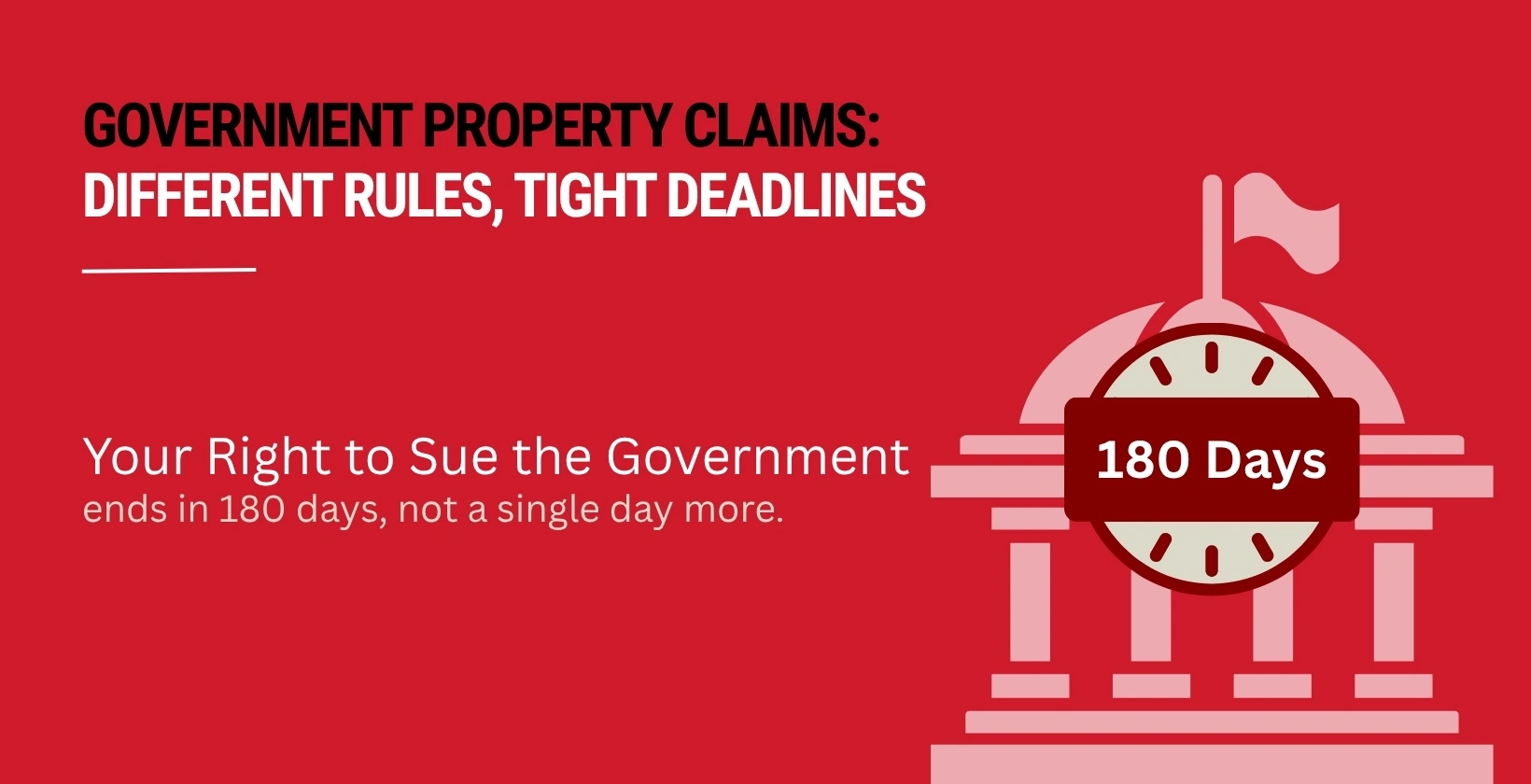
Government property claims are even more urgent. If you fell on government property, a public sidewalk, a government building, or a city park, you must file a Notice of Claim within 180 days. That is roughly six months. Fail to file that notice, and your right to sue is gone before the two-year statute even becomes relevant.
NRS 651.015: Special Rules for Hotels and Casinos
NRS 651.015 establishes specific liability standards for owners and operators of hotels, inns, motels, and similar lodging establishments in Nevada. Under this statute, hotel and casino operators must exercise due care for the safety of patrons on their premises. When they fail to take reasonable precautions, and a foreseeable incident causes injury, they are civilly liable.
This statute is critical for injuries on the Las Vegas Strip. Casinos and hotels operate 24 hours a day. Alcohol flows freely. Floors are polished to a shine. Lighting is deliberately dim. Millions of people walk through these properties every year, and every one of them is owed a duty of care. If you were injured at a Strip property, our hotel accident attorneys understand these heightened obligations and how to enforce them.
Constructive Notice vs. Actual Notice
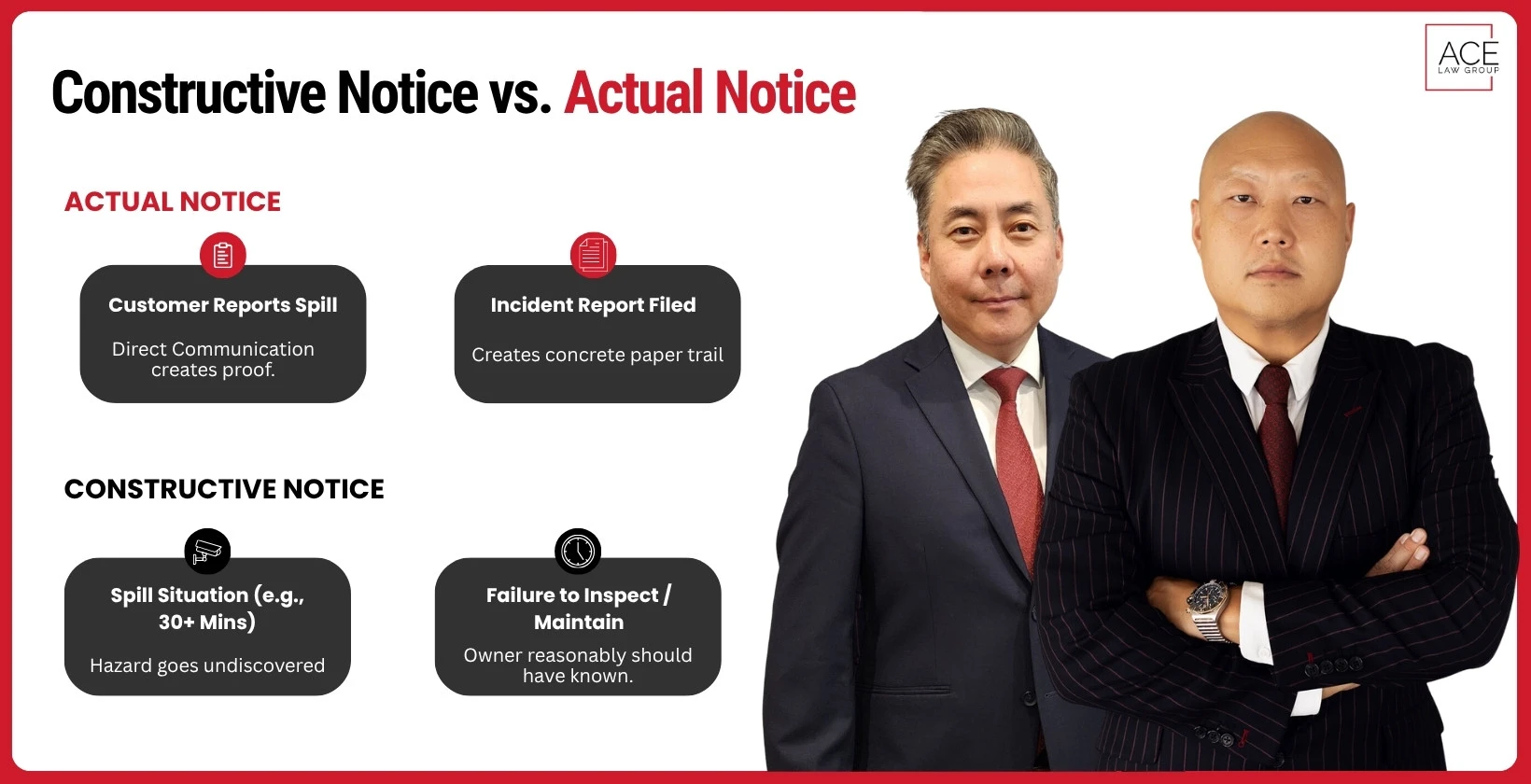
Proving a property owner knew about a hazard is often the most contested part of a slip and fall case. Nevada recognizes two types of knowledge: actual notice and constructive notice.
Actual notice means the owner or an employee directly knew about the dangerous condition. A customer reported a spill. A maintenance worker saw a broken tile. An incident report was filed. The property owner had actual, documented knowledge that the hazard existed and did not fix it.
Constructive notice means the hazard existed long enough that a reasonable property owner, exercising ordinary care, should have discovered it. A spill on a casino floor that sits for 30 minutes with no employee inspection is constructive notice. A cracked stair that has been deteriorating for weeks is constructive notice. The property owner did not technically know, but they should have known, and that is enough.
In Las Vegas, we use evidence such as surveillance footage, maintenance logs, and inspection records to show the property owner had constructive notice of the hazard. Casinos have cameras everywhere. If those cameras show a spill going unaddressed for any significant period, the property owner has a serious problem.
The “Open and Obvious” Defense
This is one of the most common defenses property owners use. They argue the hazard was so visible that you should have seen it and avoided it. If the danger was “open and obvious,” they claim, they had no duty to warn you or fix it.
Nevada law rejects that argument as an automatic defense. In Foster v. Costco Wholesale Corp., the Nevada Supreme Court held that the open and obvious nature of a hazard does not automatically relieve a property owner of liability. Instead, it is one factor in assessing whether the owner exercised reasonable care. The court recognized that surrounding circumstances, such as distracting displays and environmental conditions, affect whether a visitor would reasonably notice a hazard.
This matters enormously in Las Vegas. Casino environments are deliberately designed to capture your attention. Dim lighting, flashing slot machines, loud music, free drinks. A clear puddle on a dark, polished floor is not “obvious” when everything around you is engineered to distract. We make that argument, and Nevada courts recognize it.
Government Property Claims: Different Rules, Tight Deadlines
Falls on government property, such as public sidewalks, city buildings, parks, and government offices, follow different rules. The State of Nevada and its political subdivisions have sovereign immunity protections that limit when and how you can sue.
The most critical difference is the 180-day Notice of Claim requirement. Before you can file a lawsuit against a government entity, you must submit a formal notice of your claim within 180 days of the injury. This is not optional. If you miss this window, your claim is barred regardless of how strong your case is.
Government claims are still viable. But they require fast action and precise compliance with procedural requirements. If you fell on public property anywhere in the Las Vegas valley, contact a lawyer immediately.
Why These Laws Hit Different in Las Vegas
Las Vegas is not a typical city. Over 40 million people visit every year. The Strip operates 24 hours a day, 365 days a year. Alcohol is served around the clock, often for free on the casino floor. Properties are massive, with polished stone floors, elaborate water features, constantly changing lighting, and design elements built to overwhelm your senses.
That environment creates enormous liability exposure for property owners. When a casino serves alcohol to guests walking on marble floors in an environment designed to distract them, the duty of care is not theoretical. It is constant and high. We explain how casinos contribute to slip and fall injuries in a separate post. The combination of Nevada’s leisure and hospitality industry, which reports injury rates of 3.7 per 100 workers compared to the national average of 2.3, and the sheer volume of foot traffic makes slip and fall incidents inevitable.
Property owners on the Strip know this. They have legal teams, risk management departments, and surveillance systems specifically designed to defend against liability claims. You need representation that matches their resources. We provide that. If you were recently hurt, start by reading our guide on what to do in the first 24 hours to protect your rights while the evidence is still fresh.
The Law Is on Your Side. But Only If You Act.
Nevada’s premises liability laws protect you. The statutes, the duty of care categories, the notice requirements all of it exists to hold negligent property owners accountable. But none of it matters if you do not take action within the legal deadlines.
We have recovered $44 million for our clients in 2025 alone. We speak English, Spanish, Chinese and Korean. Consultations are free. You pay nothing unless we win.
Call 702-333-4223.