At Ace Law Group, we represent tenants who have suffered serious health problems caused by mold exposure in their rental units.
These cases are complex, time-consuming, and expensive. Before our Las Vegas toxic mold injury lawyers can file a lawsuit, there are specific steps you must take to preserve your rights and build evidence for potential court proceedings.
1. You Must Have a Professional Mold Test
To prove mold exposure you need a professional air-quality test performed by a licensed environmentalist or industrial hygienist.
A proper test includes:
- A control sample taken outdoors, and
- One or more indoor air samples from affected rooms inside your residence.
Mold is everywhere, in order to prove that mold is elevated in a property, the indoor air must have spore counts higher than the outdoor control sample. This is key evidence in establishing an unsafe environment linking adverse health symptoms to contamination in the property.
Air testing is non-destructive, so you do not typically need permission from a landlord or property manager to obtain this testing. You can request this testing from a landlord or property management company, but typically this request denied. Likewise, in many instances, if a landlord or property manager pays for testing, it is not uncommon for them to refuse to provide test results to the tenants. If you want to pursue a legal case, obtaining your own mold test is absolutely necessary.
While at-home mold test kits can be purchased at most hardware stores or online, these tests do not measure air quality, are inconsistent in their accuracy, and do not meet the requisite threshold to be admitted in court.
2. You Must Notify the Landlord or Property Manager
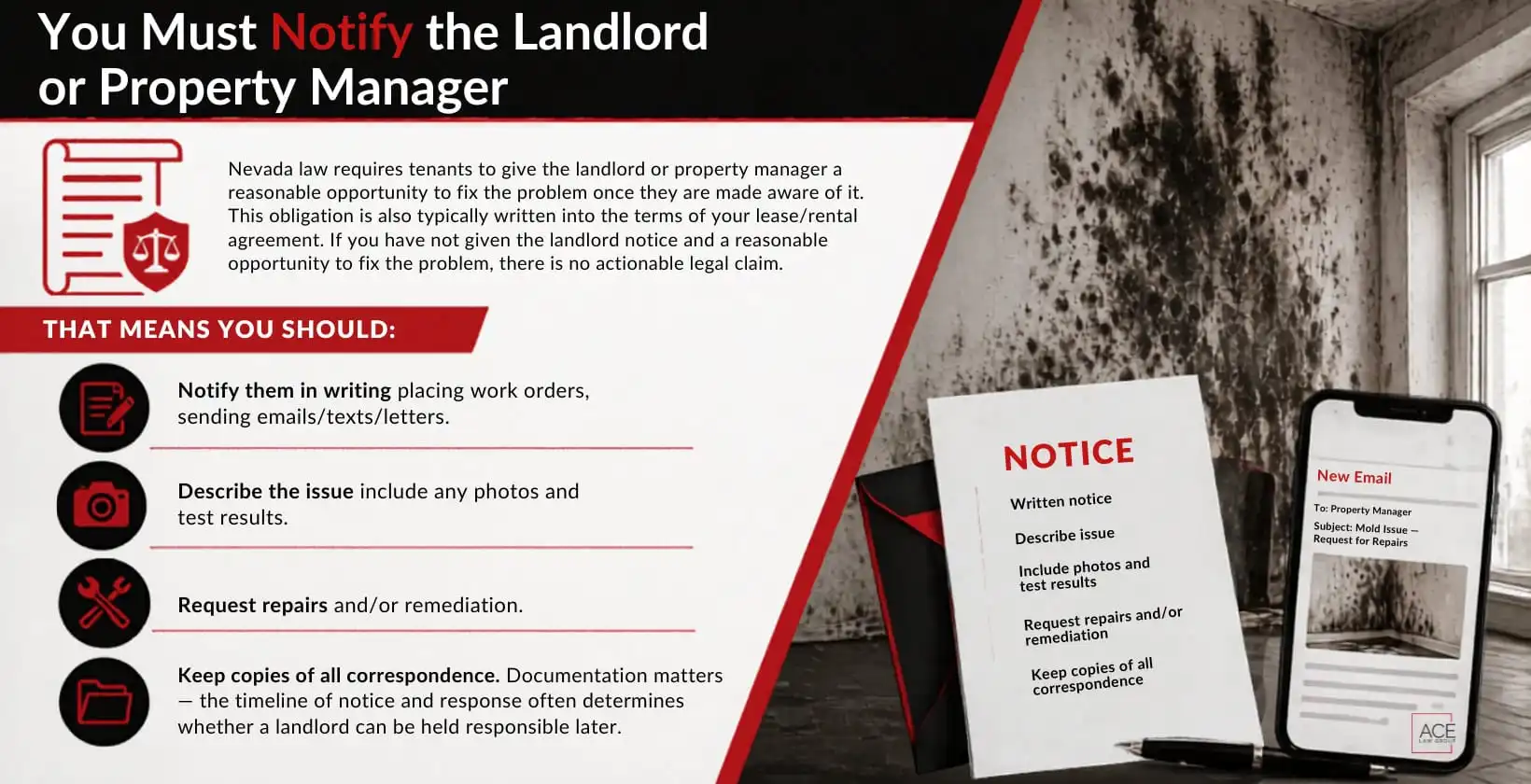
Nevada law requires tenants to give the landlord or property manager a reasonable opportunity to fix the problem once they are made aware of it. This obligation is also typically written into the terms of your lease/rental agreement. If you have not given the landlord notice and a reasonable opportunity to fix the problem, there is no actionable legal claim.
That means you should:
- Notify them in writing placing work orders, sending emails/texts/letters,
- Describe the issue include any photos and test results, and
- Request repairs and/or remediation.
Keep copies of all correspondence. Documentation matters — the timeline of notice and response often determines whether a landlord can be held responsible later.
3. Give a Reasonable Opportunity to Correct the Issue
Not every mold issue turns into a lawsuit. Responsible landlords and property managers take mold concerns seriously.
The landlord or property manager should:
- Take prompt, appropriate steps to professionally remediate and
- Hire a qualified contractor who follows proper safety and containment procedures.
In those cases, there may be no basis for a legal claim — and that’s not necessarily a bad thing. If the landlord makes the residence safe again, you get to avoid years of litigation.
However, in some situations, landlords or managers:
- Hire unqualified contractors,
- Perform improper “demo and cover” jobs, or
- Ignore the problem entirely.
When that happens — and your health continues to suffer — legal action may be necessary.
When you are initially working with the landlord/property manager, it is not the time to nitpick, refuse access, or focus on the 24 hour “notice to enter” requirement. If you interfere with a landlord/property manager’s efforts to complete repairs it will negatively affect your legal case. Likewise, it can take time to get inspectors and contractors out to the property to perform an estimate and begin work. Delays may be justified if the landlord is actively trying to rectify the problem, the court wants to see that the parties are being reasonable. Cooperate, be patient, be professional. It is only when the landlord acts unreasonably that a legal claim might exist.
If it is evident that the mold was not properly removed/remediated, you can get a professional air quality test at that time. Mold will still be present if the problem was not properly addressed.
4. Document Everything
Throughout the process, make sure to:
- Save copies of all letters, emails, and text messages with the landlord or property management company,
- Take photos and videos of visible mold or water damage,
- Keep copies of mold testing reports,
- Maintain medical records documenting your symptoms and treatment, and
- Allow reasonable access for inspections or repairs (unless they are unsafe).
This documentation will be critical to proving your case later.
5. Injuries
While mold conditions should always be timely addressed by a landlord/property manager, not every mold case results in injuries. At Ace Law Group, our focus is handling injuries arising from mold exposure, not property damage or habitability disputes. Everyone responds to mold exposure differently. Almost everyone experiences allergy related symptoms when they are in a mold contaminated environment. Some individuals have symptoms clear up within a few days, or weeks when the mold is removed. However, some individuals suffer chronic and severe adverse health effects from mold exposure. Make sure to monitor symptoms and seek medical treatment. Since litigation is inconvenient, carries risk, and is a significant investment in time and costs, it is typically only worth going to court if injuries are chronic.
While we would love to help everyone with mold problems in their rental units, unfortunately, given the complexities of these cases we are not able to consult and move forward with every potential client that contacts our office. If you’ve followed the steps here, we will be in a much better position to provide assistance.
6. When to Call Ace Law Group
If you’ve:
- Obtained a professional mold air quality test showing elevated indoor spore counts,
- Notified your landlord or property manager, and
- Given them a fair chance to fix the problem, but the issue still isn’t resolved
- Experienced deterioration in your health that has required professional medical treatment
Our team at Ace Law Group has experience holding landlords, property managers, and contractors accountable for failing to maintain their properties free of mold, resulting in injuries.