One second, you are walking. Next, your feet are gone, and the ground rushes up to meet you. Your hip hits first. Then your elbow. Then your skull. The world goes sideways. Sounds blur together. Someone above you is asking if you are okay, but you cannot answer because you are still trying to figure out what just happened.
That moment of shock passes. The pain does not. And what you do in the next 24 hours will determine whether you have a viable legal case or an uphill battle with no evidence.
Property owners start protecting themselves immediately after a fall on their premises. Their risk management teams activate within minutes. Incident reports get shaped. Surveillance footage queues up for review, and not to help you. They are building a defense before you have even stood up.
You need to do the same. Here is exactly how.
Key Takeaways
- Report the fall to the property manager or hotel front desk before you leave the scene. Get a written incident report.
- Get medical care the same day, even if you feel fine. Adrenaline masks pain, and delayed treatment is the insurer’s first argument against your claim.
- Photograph the exact hazard, your injuries, your clothing, and your shoes before anything gets cleaned up or repaired.
- Collect witness names, phone numbers, and emails on the spot. Las Vegas tourists fly home within days and cannot be tracked down later.
- Preserve your clothing and shoes in separate bags, unwashed. They are physical evidence.
- Do not give recorded statements to the insurance company. Let your attorney handle all communication.
- Request surveillance footage preservation in writing the same day. Most systems overwrite within 24 to 72 hours.
- Nevada gives you two years to file a lawsuit under NRS 11.190(4)(e), but the evidence window closes within hours.
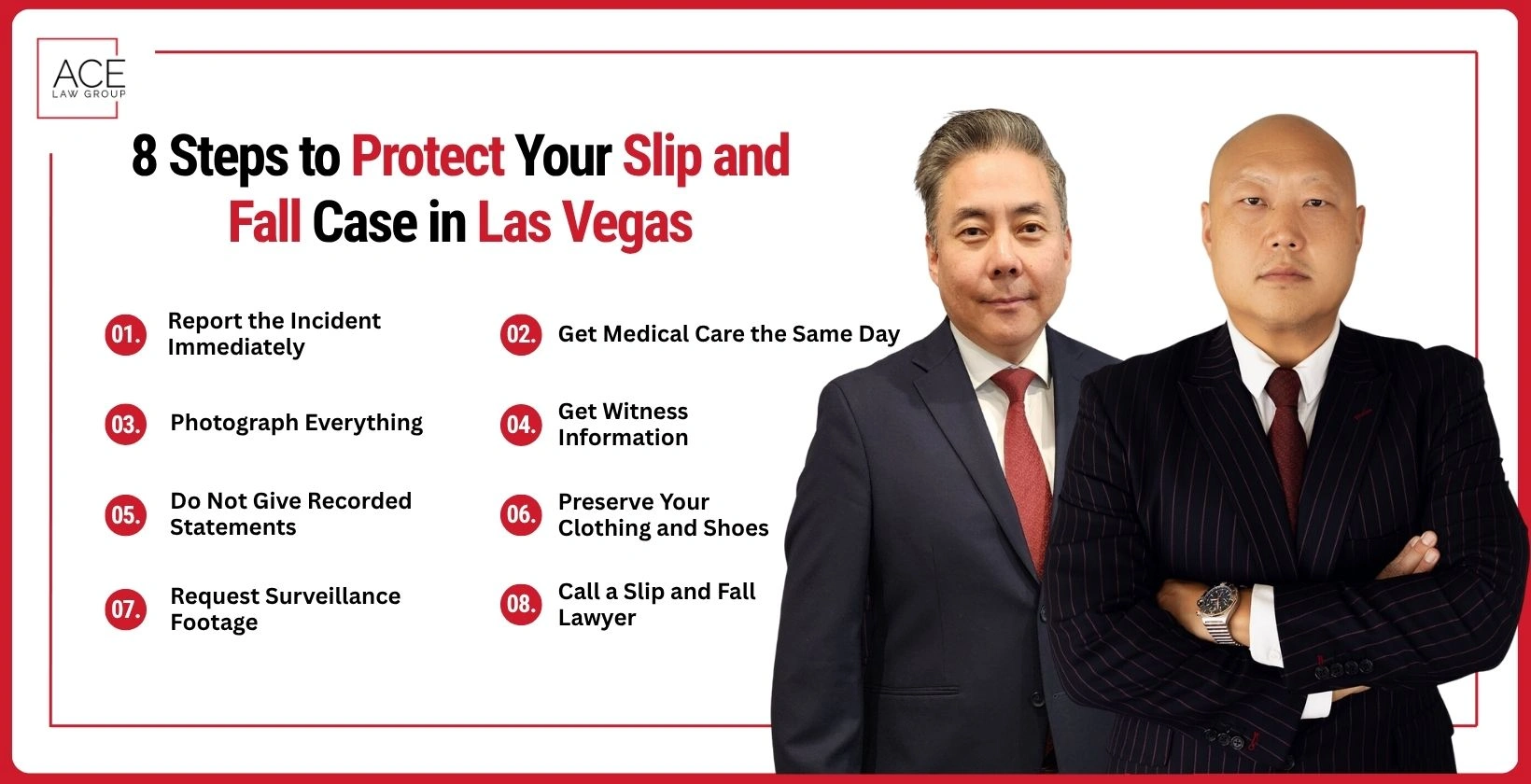
8 Steps to Protect Your Slip and Fall Case in Las Vegas
The actions you take in the first 24 hours after a fall carry more weight than anything that happens later. Property owners move fast. Here is what you need to do faster.
Step 1: Report the Incident Immediately
Tell the property manager, casino floor supervisor, or hotel front desk what happened. Do it before you leave the scene. Request a written incident report and get the name and direct contact information of the person who takes it. If they refuse to create a report, document their refusal with your phone. Record the date, time, and the name of the person who said no. That refusal becomes evidence of its own.
Step 2: Get Medical Care the Same Day
Go to the emergency room or an urgent care clinic, even if you feel fine. Especially if you feel fine. Adrenaline masks pain. Symptoms from concussions, internal bleeding, and hairline fractures take hours or days to surface. A delayed medical visit is an insurance adjuster’s favorite argument: “If you were really hurt, why did you wait three days to see a doctor?” Do not hand them that weapon.
Step 3: Photograph Everything
Pull out your phone and photograph the exact spot where you fell. Capture the hazard: the wet floor, the torn carpet, the uneven surface, the missing handrail. Take wide shots of the surrounding area and close-ups of the specific condition. Photograph your injuries, your clothing, and your shoes. The stronger your evidence is, the harder it is for the property owner to rewrite what happened.
Step 4: Get Witness Information
Names. Phone numbers. Emails if possible. Las Vegas welcomes over 40 million visitors per year. The witness who watched you fall on a wet casino floor may be on a flight home within 48 hours. Casino floors, hotel lobbies, restaurants, and retail centers are full of tourists who leave within days and cannot be tracked down later. If someone saw you fall, or saw the hazard that caused it, get their contact details on the spot before they walk out the door.
Step 5: Do Not Give Recorded Statements
The property owner’s insurance company will call fast. Adjusters work to minimize claim payouts, and a recorded statement gives them grounds to dispute your injuries or your account of what happened. “Were you looking at your phone?” “Had you been drinking?” “Did you see any signs?” Decline the call. Let your attorney handle all communication with the insurer.
Step 6: Preserve Your Clothing and Shoes
Do not wash or discard what you were wearing when you fell. Place each item in a separate bag and store them untouched. Your shoes show whether the surface was unreasonably slick or give the defense grounds to argue inadequate footwear. Your clothing carries residue from the hazardous substance. These items are physical evidence.
Step 7: Request Surveillance Footage
Casinos and hotels are covered in cameras. That footage can prove exactly what happened. Most surveillance systems overwrite on a loop, sometimes within 24 to 72 hours. If you do not request preservation immediately, the footage is gone permanently. You or your attorney needs to send a written preservation demand the same day. Time is critical.
Step 8: Call a Slip and Fall Lawyer
Contact our Las Vegas slip and fall attorneys as soon as possible. We send preservation letters to the property owner the same day you call, demanding they retain surveillance footage, incident reports, and maintenance logs. We handle the insurance company so you do not have to. Be aware of the deadline that applies to your claim, because Nevada’s two-year statute of limitations is strict and begins the day you fall.
There is no fee unless we win.
Mistakes That May Destroy Your Slip and Fall Case
These mistakes are more damaging in Las Vegas than in most cities because the environment creates compounding risks that insurance companies exploit. Each one gives the property owner’s insurance company ammunition to deny or devalue your claim.
Apologizing or saying “I’m fine” at the scene: It is a reflex. But those words get written into the incident report verbatim, and the insurer will use them to argue you were not injured.
Not reporting the fall because it seems minor: What feels like a bruise today can be a herniated disc next week. No report means no official record that the incident ever happened.
Posting about the incident on social media: Your social media posts are monitored by the insurance company after you file a claim. A photo of you smiling at dinner the night after your fall becomes Exhibit A in their argument that you are not hurt.
Waiting days to see a doctor: Every day you wait is a day the defense uses against you. The gap between the fall and your first medical visit is the weakness the defense exploits most..Accepting the property owner’s first offer to “take care of it”: That offer comes with strings. Sometimes it is a few hundred dollars and a release form that waives all future claims. Once you sign, your case is over, even if you discover a serious injury months later.
Do You Have a Valid Slip and Fall Claim in Nevada?
To win a slip and fall claim in Nevada, you must prove three things: the property owner owed you a duty of care, they breached that duty by allowing a hazardous condition to exist, and that breach directly caused your injuries.
Premises liability is the area of law that holds property owners responsible for injuries caused by unsafe conditions on their property. A property owner’s duty of care requires them to maintain reasonably safe conditions for anyone lawfully on the premises. A wet floor with no warning sign, a torn carpet left unrepaired, a broken handrail, and an uneven walkway are breaches of that duty.
What Types of Hazards Cause Slip and Falls in Las Vegas?
Las Vegas is not a typical city when it comes to premises liability. The concentration of casinos, hotels, retail centers, entertainment venues, and construction zones creates hazards that most cities never deal with at this scale. Understanding the most common causes of slip and fall accidents helps identify whether a property owner failed their duty of care.
Casino Floors
Dim lighting is designed to keep you gambling. Free drinks impair balance and judgment. Polished stone and tile surfaces that become dangerously slick when wet. Casino injury claims are among the most complex premises liability cases because casinos have large legal teams and sophisticated surveillance systems that they can deploy both for and against you.
Hotels, Lobbies, and Pool Areas
Freshly mopped lobbies without warning signs. Pool decks with inadequate drainage. Bathroom floors with no slip-resistant coating. Stairwells with worn treads and missing handrails. Hotel accident claims require fast action because hotels cycle through thousands of guests weekly, and the conditions that caused your fall can be “fixed” before anyone documents them.
Retail Stores and Shopping Centers
Wet entrances after rain with no floor mats or warning signs. Freshly waxed floors in grocery aisles. Merchandise left in walkways. Broken or uneven flooring near store entrances. Retail property owners have the same duty of care as hotels and casinos, and the same obligation to address known hazards before someone gets hurt.
Restaurants and Bars
Spilled drinks and food on the dining room floor. Wet kitchen runoff that reaches public areas. Poorly lit stairways between floor levels. Outdoor patios with uneven pavers or broken decking. In a city built around nightlife, these conditions are common and frequently go unaddressed during peak hours.
The Strip and Surrounding Areas
Construction zones along Las Vegas Boulevard have uneven temporary walkways. Crowded sidewalks where debris, spilled drinks, and broken pavement go unaddressed for days. The sheer volume of foot traffic creates hazards that property owners should anticipate but often ignore.

How Serious Are Slip and Fall Injuries?
Falls are the leading cause of injury death for adults 65 and older in the United States, according to the CDC. The CDC also reports about 1 million fall-related hospitalizations among older adults each year. In Nevada, state data estimates that roughly 111,690 older adults experience a fall each year.
A slip and fall is not an embarrassing moment; you walk off. Depending on how you land, it can mean soft tissue injuries and sprains, broken wrists or arms from bracing the fall, fractured hips, herniated discs, torn knee ligaments, or traumatic brain injuries from striking the ground or a hard surface. Some heal in weeks. Others require surgery and change the trajectory of your life permanently.
Nevada Laws That Affect Your Slip and Fall Case
Nevada law sets two rules that directly determine whether you can file a claim and how much you can recover. The first sets your deadline. The second governs how fault is divided between you and the property owner.
You have two years from the date of your fall to file a lawsuit in Nevada under NRS 11.190(4)(e). Miss that deadline and you lose the right to pursue compensation permanently. Two years sounds like a long time. Building a strong case takes months of investigation, medical documentation, and negotiation. Start the clock from the day it happens.Nevada’s modified comparative negligence rule (NRS 41.141) means the property owner’s insurance company will try to shift blame onto you. Were you wearing appropriate shoes? Were you distracted by your phone? Were you in an area you should not have been? Your compensation drops by your percentage of fault. At 51% or higher, you recover nothing. Every photo, every witness, every medical record fights back against that argument.
What Compensation Can You Recover After a Slip and Fall?
A successful slip and fall claim in Nevada covers two categories of damages. Economic damages include medical bills, lost wages, future medical costs, and out-of-pocket expenses with a dollar figure attached. Non-economic damages cover pain and suffering, emotional distress, loss of enjoyment of life, and reduced quality of life. Nevada imposes no cap on either category for personal injury cases.
Medical costs for serious fall injuries accumulate fast. Hip fracture treatment averages $30,000 to $40,000 before rehabilitation. Traumatic brain injuries and spinal injuries routinely exceed six figures. Lost wages compound on top of medical expenses when recovery takes weeks or months. What you recover depends largely on how early you get a slip and fall lawyer involved.

Ready to Talk? Here Is How Ace Law Group Helps
Surveillance footage gets overwritten. Witnesses fly home. Evidence disappears. The property owner’s legal team is already working. You need someone working for you.
At Ace Law Group, our Las Vegas slip and fall attorneys send preservation letters immediately. We deal with the insurance company. You pay $0 upfront. Call 702 333 4223 for a free case review, 24/7.
No fee unless we win your case.