Slip and fall cases are won or lost on evidence. That is not a cliché. It is the reality we see every week in Las Vegas courtrooms.
The casino or property owner is not sitting idle after you fall. Their surveillance teams are reviewing footage. Their legal departments are drafting internal memos. Their insurance companies are building a defense before you even leave the emergency room. Every hour that passes tips the scale in their favor.
We have recovered millions for slip and fall victims across the Las Vegas Strip and throughout Clark County. The cases we win have one thing in common: strong evidence, gathered fast. The cases that fall apart almost always trace back to evidence that disappeared before anyone preserved it. Working with slip and fall lawyers in Las Vegas who move quickly is the difference between a strong case and a lost one.
Here is exactly what it takes to build a case that forces insurers to pay.
Key Takeaways
- To win a slip and fall case, you need evidence that the property owner knew or should have known about the hazard.
- The most important evidence usually includes surveillance footage, incident reports, maintenance logs, photos, witness statements, and medical records.
- Evidence can disappear fast in Las Vegas, especially surveillance footage and tourist witness contact information.
- A preservation letter can help prevent the property from deleting footage or losing key records after the fall.
- Nevada comparative negligence rules can reduce or bar compensation if you are found mostly at fault.
- Strong evidence does not just prove fault. It also helps show how serious your injuries are and how much your claim may be worth.
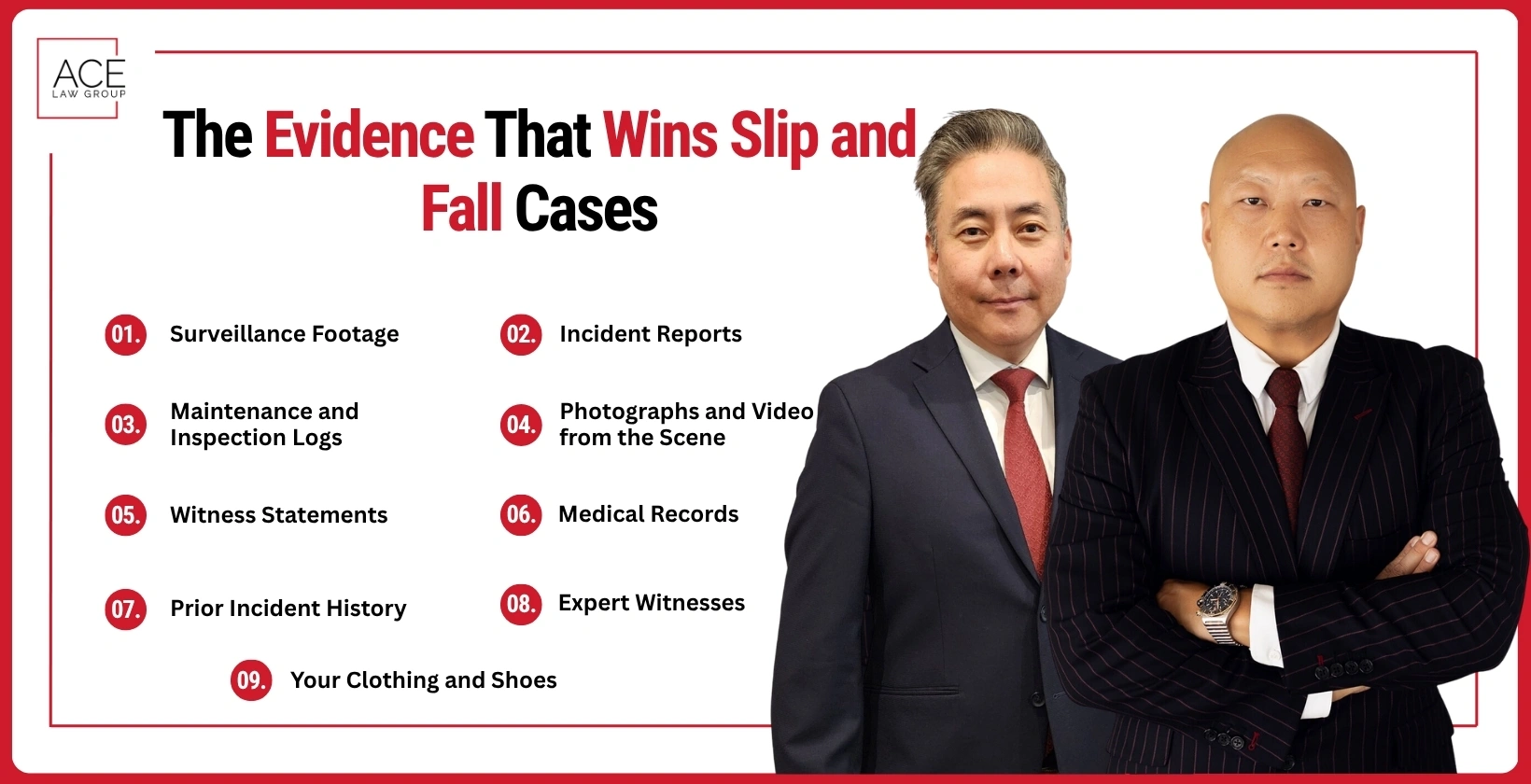
The Evidence That Wins Slip and Fall Cases
Every piece of evidence below targets a specific argument the defense will make. The stronger your evidence file, the harder it is for an insurer to deny or lowball your claim.
1. Surveillance Footage
Las Vegas is one of the most camera-dense cities on earth. Casinos like the Bellagio resort, Aria, and Planet Hollywood operate thousands of cameras covering gaming floors, lobbies, restaurants, parking garages, and walkways. This footage often captures the critical details: the puddle sitting untouched for 45 minutes, the broken tile no employee flagged, and the absence of any warning sign near the hazard.
But there is a problem. Most properties overwrite surveillance footage on 24 to 72-hour loops. Once that window closes, the footage is gone permanently. We send preservation letters within hours, putting the property on legal notice to retain all relevant recordings. If the property claims the footage was “lost” or overwritten, that itself becomes powerful evidence. Courts recognize spoliation, and judges can instruct juries to assume the destroyed footage would have helped your case.
2. Incident Reports
Every casino, hotel, and major commercial property in Las Vegas documents on-premises injuries with internal incident reports. These reports capture what happened, when it happened, which employees responded, and often contain admissions you would never hear in a deposition. An employee writing “the spill was reported 20 minutes before the guest fell” is devastating to the defense. If the property fails to produce the report during discovery, that failure is itself evidence of negligence. At Ace Law Group, our premises liability attorneys understand the legal responsibilities of casino owners and hold them accountable.
3. Maintenance and Inspection Logs
We subpoena cleaning schedules, inspection records, and maintenance logs from every property we pursue a claim against. These documents tell the real story. A wet floor that sat for 30 minutes without a warning sign proves negligence. If the last inspection was four hours before your fall, that gap proves the owner was not meeting its duty to inspect.
4. Photographs and Video from the Scene
Your phone is your best tool in the minutes after a fall. Photograph the exact spot where you fell. The hazard itself – whether it is a puddle, a broken tile, a loose mat, or an uneven surface. The lighting conditions. Your injuries. Your clothing and shoes. Warning signs nearby, or the absence of them. Take wide shots showing the full area and close-ups capturing specific details. Do not rely on the property to document the scene. They will document it in a way that protects them, not you.
5. Witness Statements
Other guests, employees, and bystanders can provide testimony that corroborates your account. In Las Vegas, this presents a unique challenge. The city welcomes over 40 million visitors per year. Many witnesses are tourists who leave town within days. If you do not get their names and phone numbers at the scene, they may be impossible to locate later. Employees are equally critical, but properties routinely reassign or coach staff after incidents. We move quickly to identify and interview witnesses before the property can control the narrative.
6. Medical Records
Immediate medical treatment creates a direct, documented link between your fall and your injuries. Gaps in treatment give insurance companies ammunition. If you wait two weeks to see a doctor, the insurer will argue your injuries were caused by something else, or that they are not as serious as you claim. Every visit, every diagnosis, every prescription, every imaging scan must be documented. We work with our clients to build a complete medical record that connects the fall to every injury. Falls are the leading cause of injury-related death for adults 65 and older nationally, and Nevada recorded 18,870 traumas across 54 facilities in 2024 alone. These injuries are serious. Your medical records must reflect that.
7. Prior Incident History
If other people have fallen in the same spot, slipped on the same surface, or tripped over the same hazard, it proves the property owner was on notice that a dangerous condition existed. We research prior claims, complaints, OSHA reports, and health department records to establish patterns of negligence. A casino that has received three complaints about a slippery lobby floor and has done nothing about it has no defense when a fourth person falls. Prior incident history transforms a “he said, she said” case into a pattern of corporate indifference.
8. Expert Witnesses
Safety engineers, biomechanical experts, and building code specialists provide technical testimony that forces insurers to take claims seriously. They measure the coefficient of friction on flooring surfaces, identify building code and ADA violations, analyze how the fall occurred, and testify about what a reasonable property owner should have done. When an expert tells a jury the flooring failed basic slip-resistance standards, insurance companies start writing larger settlement checks.
9. Your Clothing and Shoes
Physical evidence matters. The defense will argue that you wore inappropriate footwear, that your shoes were worn out, or that your sandals had no traction. Preserving the shoes you wore at the time of the fall eliminates this argument. Bag them. Store the clothing you wore that day. Do not wash them. Do not wear them again. They are evidence now.Each piece of evidence listed above directly affects how the value of your claim is calculated. The stronger your evidence file, the higher the settlement or verdict.
How Do Property Owners Destroy Evidence After a Fall?
Property owners in Las Vegas use several methods to weaken fall claims. After handling hundreds of premises liability cases in Las Vegas, we have seen every tactic. Overwriting surveillance footage on 24 to 72-hour loops, altering or withholding incident reports, cleaning the hazard before anyone photographs it, and coaching or reassigning employee witnesses.
- Surveillance footage gets overwritten on loops. Most systems cycle every 24 to 72 hours. Unless a preservation letter goes out immediately, the footage disappears. This is the single most common way critical evidence is lost.
- Incident reports vanish or get altered. Properties claim reports were never created, or they produce versions that omit key details. We have seen reports where employee statements were redacted or rewritten after legal counsel got involved.
- Hazards get cleaned up before documentation. A puddle gets mopped. A broken tile gets replaced. A torn carpet gets patched. All before anyone photographs the condition. By the time your attorney requests an inspection, the scene has been sanitized.
- Employee witnesses get reassigned or coached. The security guard who saw the spill an hour before your fall suddenly transfers to a different shift. The housekeeper who failed to place a wet floor sign receives “additional training” and a script from the legal department.
This is why preservation letters from attorneys are not optional. They are critical. The moment we take your case, we put the property on formal legal notice that all evidence, including surveillance footage, incident reports, maintenance logs, and employee records, must be preserved. Destruction of evidence after receiving a preservation letter exposes the property to sanctions and adverse inference instructions from the court. We know how to protect your case from day one. What you do in the first 24 hours after a fall determines whether that evidence survives or disappears forever.

The Burden of Proof: What You Must Show
In Nevada, you do not need to prove the property owner intentionally caused your fall. You need to prove one of two things: the owner knew about the hazardous condition and failed to fix it, or the owner should have known about it through reasonable inspection. The second concept is constructive notice, meaning the hazard existed long enough that a property conducting proper inspections would have discovered and corrected it.
Under NRS 41.130, property owners owe a duty of care to people lawfully on their premises, a legal obligation requiring them to inspect for hazards, warn visitors of known dangers, and correct unsafe conditions within a reasonable time. Nevada premises liability law sets the standard that the property must meet.
Here is what constructive notice looks like in practice. A grocery store mops its floors every morning. At 2:00 PM, a customer spills a drink in Aisle 7. No employee inspects for the next 90 minutes. At 3:30 PM, you slip and break your wrist. The store may not have known about the specific spill, but 90 minutes without an inspection means they should have known. That gap is the heart of most slip and fall cases.
Be aware: the defense will attack your evidence too. Under NRS 41.141, Nevada follows a modified comparative negligence standard. If a jury decides you were partially at fault, your compensation is reduced by your percentage of fault. If you are 51% or more at fault, you recover nothing. The defense will argue you were distracted, looking at your phone, wearing inappropriate shoes, or ignoring posted warnings. Strong evidence neutralizes these arguments before they gain traction.For falls in casinos and hotels, NRS 651.015 imposes specific duties on innkeepers to maintain safe premises for guests. Las Vegas casinos are held to a high standard precisely because they invite millions of visitors onto their properties each year. A casino slip and fall injury claim backed by surveillance footage, maintenance logs, and expert testimony is a case insurers cannot easily dismiss.
How Long Do You Have to Preserve Evidence After a Fall in Las Vegas?
You have 24 to 72 hours before surveillance footage is gone. Witnesses leave Las Vegas within days. Employees change shifts and forget details. Without early medical documentation, the defense will argue you were never seriously hurt.
Strong cases collapse when clients wait two weeks to call an attorney. By then, the footage is overwritten. The incident report has been revised. The witnesses have flown home. Every day without a preservation letter is a day the property’s defense gets stronger, and yours gets weaker.
At Ace Law Group, we move within hours of your first call. We send preservation letters immediately. We dispatch investigators to document the scene. We identify and contact witnesses before the property can intervene.
Our lead attorney, Patrick Kang, founded this firm after watching his own family navigate the aftermath of a serious injury. We are available 24/7 because the evidence window does not wait for business hours.
Call us now at 702-333-4223 for a free, confidential consultation. You pay nothing unless we win your case. We are available 24/7 and serve clients in English, Spanish, Chinese and Korean.